


Listen to the article
Higher Education Organizations Launch Webinar Series on Academic Freedom and Palestine Advocacy
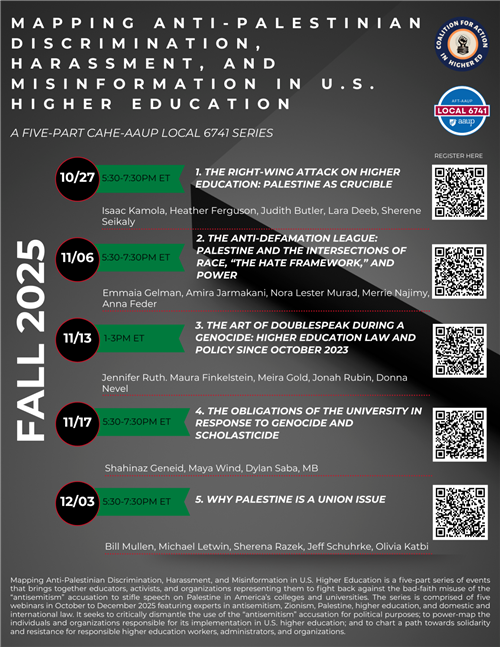
Two academic groups have announced a joint webinar series examining what they describe as increasing restrictions on Palestine-related discourse in U.S. higher education. The Coalition for Action in Higher Education and AAUP Local 6741 will host “Mapping Anti-Palestinian Discrimination, Harassment, and Misinformation in U.S. Higher Education” between October and December 2025.
The five-part series aims to bring together educators, activists, and organizations to address what organizers characterize as the “bad-faith misuse” of antisemitism accusations to restrict speech on Palestine on college campuses. Scheduled speakers include representatives from various organizations including Jewish Voice for Peace, Palestine Legal, and the Middle East Studies Association.
According to the announcement, the series has four key objectives: providing political education on groups behind campus speech restrictions, building activist community networks, strengthening advocacy within the American Association of University Professors (AAUP), and developing support for the Boycott, Divestment, and Sanctions (BDS) movement against Israel.
The first webinar, “The Right-Wing Attack on Higher Education: Palestine as Crucible,” scheduled for October 27, will feature speakers including Judith Butler from Jewish Voice for Peace. Panelists will discuss what they describe as unprecedented measures taken by U.S. colleges and universities to suppress academic freedom related to Palestine education and advocacy.
Subsequent sessions will focus on specific organizations and issues. The November 6 webinar examines the Anti-Defamation League’s role in what organizers describe as efforts to “excise the history and colonial/capitalist contexts of colonization in Palestine from education.” Later events will address legal and policy developments affecting campus speech, university obligations during conflicts, and labor union perspectives on Palestine solidarity.
The series announcement situates current campus tensions within a broader historical context of pressure on academic institutions regarding Israel-Palestine discussions. Organizers reference the 2007 book “The Israel Lobby and U.S. Foreign Policy” by John Mearsheimer and Stephen Walt, arguing that what began as an “orchestrated pressure campaign” now has “the full backing of the federal government.”
Central to the series is criticism of the International Holocaust Remembrance Alliance (IHRA) definition of antisemitism, which organizers claim has been weaponized to suppress legitimate criticism of Israeli policies. The announcement states that implementation of this definition “abolishes free speech and academic freedom when it comes to Palestine in teaching, research, and advocacy.”
The series comes amid heightened tensions on campuses nationwide following the October 7, 2023 Hamas attack on Israel and subsequent Israeli military operations in Gaza. Universities have struggled to balance concerns about antisemitism with protecting academic freedom and free expression.
Critics of such academic events argue they often present one-sided views of complex geopolitical issues, while supporters maintain that open discussion of Palestinian rights is increasingly restricted on American campuses. The webinar series explicitly challenges what it describes as efforts to “dismantle Palestine solidarity on campuses” through various governmental and institutional pressures.
Registration for the webinars is open to the public, with the organizers encouraging participation from academic workers, administrators, and organizations concerned with academic freedom and free speech in higher education.
Fact Checker
Verify the accuracy of this article using The Disinformation Commission analysis and real-time sources.

5 Comments
Maintaining academic freedom and open discourse is essential, even on contentious issues like the Israeli-Palestinian conflict. I’m interested to learn more about the specific tactics and organizations that have been restricting speech on Palestine at American universities.
This is an important issue that deserves close attention. Ensuring academic freedom and open discourse on contentious political topics is crucial for universities. I’m interested to learn more about the specific restrictions and tactics being used to limit discussion of Palestine on campuses.
The silencing of pro-Palestinian voices on college campuses is a concerning trend. Academic institutions should encourage the free exchange of ideas, even on sensitive geopolitical issues. I’m glad to see efforts to push back against the ‘bad-faith misuse’ of antisemitism claims in this context.
While the topic of Israel/Palestine is highly polarized, universities should strive to be forums for fact-based, nuanced debate rather than sites of censorship or political intimidation. This webinar series sounds like a constructive step towards understanding and addressing troubling trends.
Accusations of antisemitism are sometimes wielded to shut down legitimate criticism of Israeli government policies. It’s critical that we can distinguish between anti-Jewish bigotry and legitimate political disagreements. This webinar series could help shed light on that important distinction.