


Listen to the article
Somalia’s first direct local elections in nearly 60 years concluded peacefully in Mogadishu, though a surge in misinformation threatened to undermine the historic democratic milestone, according to a comprehensive report released Wednesday by the National Union of Somali Journalists (NUSOJ).
The December 25 Banadir local council elections represented the capital’s first direct vote since 1969, with 1,604 candidates vying for 390 seats across the city’s 16 districts. The NUSOJ assessment, based on structured monitoring conducted between November and December 2025, highlighted both achievements and challenges in Somalia’s democratic transition.
“Somalia’s democratic transition will depend not only on peaceful voting but also on the integrity of the information citizens rely on to make their choices,” said NUSOJ Secretary General Omar Faruk Osman. “Professional journalism can strengthen elections, but disinformation is becoming a direct threat to democratic trust.”
Authorities implemented extensive security protocols, deploying approximately 10,000 troops and imposing a citywide lockdown on election day. Despite these restrictions, observers documented no incidents of election-related violence—a remarkable achievement in a country with a history of political instability.
The media landscape during the election period revealed significant disparities in coverage quality. Radio emerged as the dominant medium, reaching 58% of the electorate, with television and online media capturing 29% and 13% of audience share respectively. Print media played a negligible role, with only one independent newspaper still in circulation.
Private media outlets generally provided the most balanced coverage, adhering to a code of conduct established in partnership with the National Independent Electoral and Boundaries Commission (NIEBC) and the Ministry of Information. Several private organizations demonstrated professional responsibility by promptly correcting errors that could have inflamed political or clan tensions.
In contrast, state media faced criticism for exhibiting clear bias toward the ruling Justice and Solidarity Party while failing to provide equitable access to opposition candidates. The report also noted concerning instances where ownership interests compromised editorial independence at certain private outlets.
Disinformation emerged as one of the election’s most significant challenges. False narratives circulated at moderate to high levels before voting, briefly subsided on election day, then surged dramatically in the aftermath. The report identified multiple sources of misinformation, including government-aligned communicators, opposition politicians, and ordinary citizens, with social media algorithms and foreign-operated accounts amplifying divisive content.
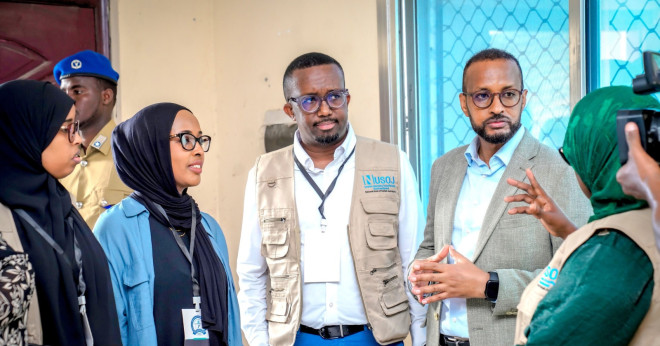
The NUSOJ accredited 40 media organizations, comprising 28 local and 12 international outlets, with 94 journalists receiving credentials. While accreditation generally facilitated comprehensive coverage, inconsistent enforcement of access protocols and the inclusion of social media influencers alongside traditional journalists created confusion at some polling stations.
On-the-ground observation revealed that 70-75% of polling stations opened punctually, with voters typically completing the process in four to six minutes. Initial police restrictions on movement between 5 a.m. and 10:30 a.m. temporarily hampered journalists’ access until NUSOJ successfully intervened with authorities.
The organization had prepared for the electoral milestone by training 102 journalists in partnership with the NIEBC, focusing on electoral procedures, ethics, and professional standards—efforts that contributed to improved coverage and public understanding.
While concluding that the Banadir elections were “peaceful, orderly and encouragingly successful,” NUSOJ emphasized that future elections will require stronger protections for media freedom, more equitable access for all political actors, enhanced transparency in official communications, and robust mechanisms to counter disinformation.
“The lesson is clear,” Osman stated. “Media freedom is not optional. It is a benchmark for credible elections.”
The successful completion of these local elections establishes a foundation for Somalia’s continued democratic development as the nation prepares for eventual direct national elections, offering hope for sustainable political stability in a region long plagued by conflict and instability.
Fact Checker
Verify the accuracy of this article using The Disinformation Commission analysis and real-time sources.

20 Comments
The peaceful local elections in Mogadishu represent an important milestone, but Somalia must continue to address disinformation risks to protect the integrity of its democratic transition. Strengthening professional journalism and fact-checking will be key priorities.
Absolutely. Maintaining public trust in the electoral process will be essential as Somalia works to further consolidate its democratic institutions and deliver tangible benefits to citizens.
It’s encouraging to see Somalia making strides towards more inclusive local governance, but the country will need to remain vigilant against disinformation campaigns that could undermine the democratic process.
Agreed. Robust security measures and effective election monitoring were crucial to the peaceful vote, but ongoing efforts to strengthen media integrity and counter misinformation will be critical.
The peaceful local elections in Mogadishu are a positive sign, but addressing disinformation risks will be crucial to sustaining democratic progress in Somalia. Strengthening election monitoring and media integrity will be key priorities.
Absolutely. Maintaining security and public confidence in the electoral process will be essential as Somalia continues its democratic transition.
Peaceful elections in Mogadishu after decades of turmoil is an impressive feat. Strengthening democratic institutions and combating disinformation will be key to Somalia’s continued progress.
Absolutely. Maintaining security and integrity of the electoral process is crucial, especially in a challenging environment like Somalia.
The successful local elections in Mogadishu are a positive step, but the country must remain vigilant against disinformation threats that could undermine public confidence in the democratic process. Strengthening media integrity and fact-checking capabilities will be crucial.
Agreed. Robust security measures and effective election monitoring were key to ensuring a peaceful vote, but continued efforts to address misinformation risks will be essential for Somalia’s democratic progress.
This is an important step for Somalia’s democratic transition, but the country will need to remain vigilant against disinformation campaigns that could undermine public trust in the electoral process.
Agreed. Professional journalism and effective fact-checking will be critical to countering the spread of misleading information and protecting the integrity of elections.
It’s encouraging to see Somalia taking steps towards more inclusive and transparent local governance. Addressing disinformation risks will be critical to sustaining public trust in the democratic process.
Agreed. Professional journalism has an important role to play in safeguarding the integrity of elections and countering the spread of misinformation.
Holding peaceful local elections in Mogadishu is an important milestone, but the country must remain vigilant against disinformation threats that could undermine public trust in the democratic process.
Agreed. Robust security measures and effective election monitoring were crucial to ensuring a smooth vote, but ongoing efforts to strengthen democratic institutions and media integrity will be critical.
The successful local elections in Mogadishu are a significant milestone after decades of instability. However, continued vigilance against disinformation threats will be essential going forward.
Robust security measures and strong election monitoring were key to ensuring a peaceful vote. Somalia must build on this progress to further strengthen its democratic institutions.
The successful local elections in Mogadishu represent progress, but Somalia must continue to address disinformation risks to protect the integrity of its democratic transition. Strengthening professional journalism and fact-checking will be key priorities.
Absolutely. Maintaining public confidence in the electoral process will be essential as Somalia works to further consolidate its democratic institutions.