


Listen to the article
Bangladesh to Hold Landmark Constitutional Referendum Alongside February Elections
Bangladesh is preparing for a crucial political moment as over 127 million voters head to the polls on February 12 to elect 300 members of parliament from nearly 2,000 candidates. The general election will be accompanied by a significant constitutional referendum on the July National Charter (JC), marking a potential turning point for the country’s democratic institutions.
The referendum, only the second in Bangladesh’s history, follows the political upheaval of July-August 2024 that led to the collapse of Sheikh Hasina’s government and the installation of an interim administration led by Professor Muhammad Yunus.
“Bangladesh is a multi-ethnic, multi-religious, multi-lingual and multi-cultural country where the coexistence and due dignity of all communities shall be ensured,” states a key provision in the July National Charter Implementation Order. This declaration represents a meaningful shift in how the nation defines itself constitutionally.
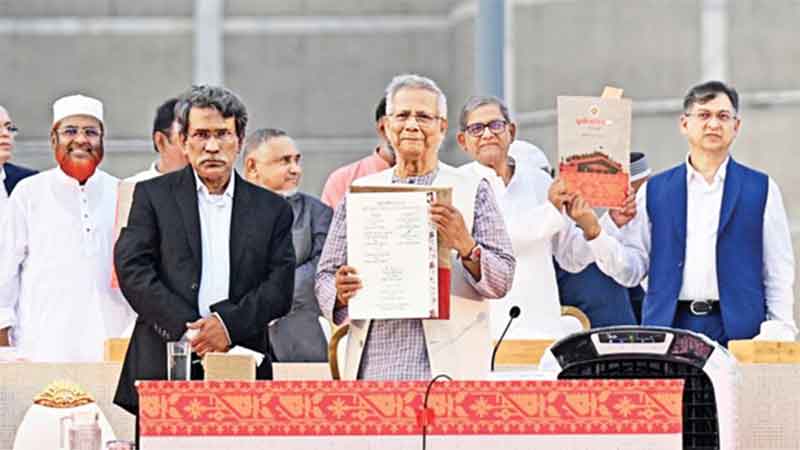
The Charter, signed in October 2025 by the National Consensus Commission and 25 political parties, contains over 80 proposals for reform. The referendum asks voters to approve several fundamental changes to Bangladesh’s governance system, including the restoration of caretaker governments to conduct polls, the creation of a bicameral parliament with an upper house elected by proportional representation, increased representation for women, and the election of parliamentary committee chairs from opposition parties.
Constitutional experts Muhammad Ekramul Haque and Sumit Bisarya note that the charter represents “only one step in a long journey,” but could significantly strengthen democratic institutions if implemented.
The referendum also addresses citizenship definitions, proposing to replace the ethnically-focused term “Bangalees” with the more civic identity of “Bangladeshi.” Other reforms include expanded language rights and stronger protections for the judiciary.
Bangladesh’s literacy rate of approximately 80 percent—higher than several Indian states—positions the country reasonably well for such a democratic exercise, though challenges remain in ensuring widespread understanding of the complex reforms.
In the electoral landscape, the Bangladesh Nationalist Party (BNP), led by Tarique Rehman following the recent death of his mother Begum Khaleda Zia, is contesting all 300 seats and is considered a frontrunner. The Democratic United Front of Left parties is contesting 149 seats, while Jamaat-e-Islami leads a 12-party alliance contesting 298 seats.
The Jamaat-e-Islami has undergone significant transformation in recent years, moderating some positions and making notable overtures to minority communities. Party leader Dr. Shafiqur Rahman recently appealed directly to Hindu voters, declaring: “We have become the chowkidaar of their respect and wealth of their lives. No one will be able to look at them with an evil gaze.”
The party has also modernized its approach to women’s participation, with its women’s wing now boasting over 500,000 active members. While not fielding female candidates under its own symbol, it has pledged to include women in cabinet positions if voted into power and supports women candidates from allied parties.
Bangladesh’s election comes amid complex regional dynamics, with India’s approach to the post-Hasina government drawing criticism for alleged misinformation campaigns. Some analysts note the contrast between India’s concerns about Islamic influence in Bangladesh while simultaneously developing diplomatic relations with Afghanistan’s Taliban government.
As Bangladesh navigates this critical democratic exercise, the outcome will significantly shape the country’s constitutional future and its approach to religious pluralism, women’s rights, and democratic institutions.
Fact Checker
Verify the accuracy of this article using The Disinformation Commission analysis and real-time sources.

13 Comments
The proposed constitutional changes seem quite substantial. I’m curious to learn more about the specific reforms being considered and how they aim to address the democratic deficits highlighted in the article.
Holding a referendum alongside general elections is an ambitious move. I hope the process is transparent and that voters have the information they need to make informed decisions about the future of Bangladesh’s constitution.
Agreed. Ensuring a free and fair electoral process will be critical, especially given the potential for misinformation and polarization around such a consequential issue.
The proposed constitutional changes seem to be a significant shift in how Bangladesh defines its national identity. It will be important to monitor how this impacts minority communities and the overall balance of power in the country.
Agreed. The implications of these reforms could be far-reaching, both positively and negatively. Careful implementation and ongoing dialogue with all stakeholders will be crucial.
This is a pivotal moment for Bangladesh’s democracy. I hope the referendum leads to a constitution that better reflects the country’s diversity and safeguards the rights of all citizens, regardless of their background.
This is a critical moment for Bangladesh’s democracy. I hope the referendum leads to meaningful and inclusive reforms that strengthen democratic norms and protect the rights of all citizens.
Me too. Consolidating democratic gains after a period of political upheaval will be challenging, but an updated constitution could help set Bangladesh on a more stable path forward.
Interesting to see Bangladesh holding a constitutional referendum alongside their elections. It will be important to monitor how the proposed reforms impact the country’s democratic institutions and safeguards for minority groups.
Agreed. The changes to the definition of Bangladesh’s national identity could have significant implications, both positive and negative, that will be worth watching closely.
It’s good to see Bangladesh attempting to strengthen its democratic institutions through constitutional reform. Navigating this process amid ongoing political challenges will require careful management and broad stakeholder engagement.
Absolutely. The success of these reforms will depend heavily on how inclusive and transparent the process is, as well as the government’s commitment to upholding the new provisions.
Bangladesh’s transition to a more inclusive and pluralistic national identity, as described in the article, could be a positive step. However, the details will be important in determining the real-world impact of such reforms.