


Listen to the article
Fake Images and Disinformation Spread After Cartel Leader’s Death in Mexico
In the chaotic aftermath of Mexican military forces killing Jalisco New Generation Cartel (CJNG) leader Nemesio “El Mencho” Oseguera Cervantes, a wave of disinformation swept across social media, amplifying public fear and painting a more catastrophic picture than reality.
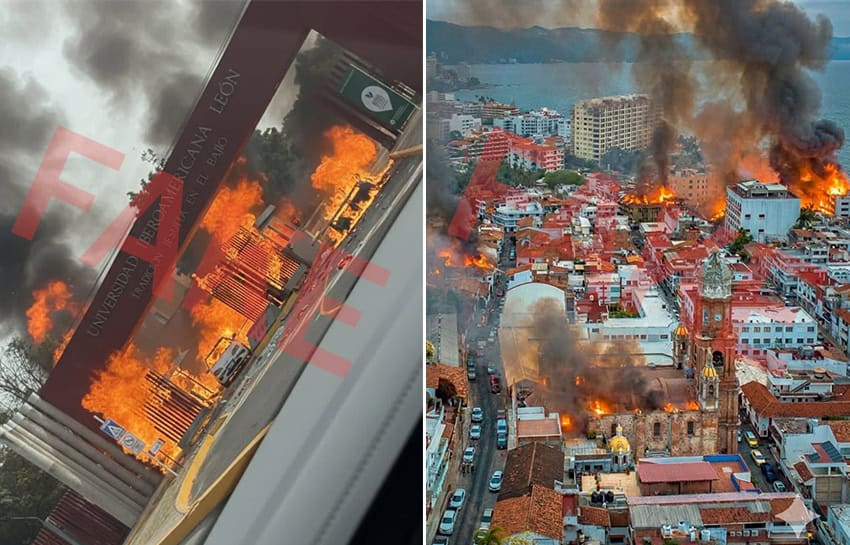
Dramatic images circulated showing a plane engulfed in flames on the tarmac at Guadalajara Airport and a burning church in Puerto Vallarta. These visually striking scenes, apparently created using artificial intelligence, contributed to widespread panic as real-world violence erupted across Mexico, with cartel members establishing fiery roadblocks, setting fire to banks and OXXO convenience stores, and engaging in deadly shootouts with National Guard officers.
The fake images were just the beginning. False reports claiming gunmen had taken over Guadalajara Airport spread rapidly, seemingly supported by footage of panicking passengers. Other fabricated stories alleged that President Claudia Sheinbaum had been evacuated to a naval vessel off Sonora’s coast and that Puerto Vallarta’s Costco had burned to the ground.
“Between 200 and 500 posts containing false information related to the operation against El Mencho appeared on social media,” according to a government video citing research from Tec. de Monterrey university. “Between 20 and 30 of those posts were viewed more than 100,000 times.”
The Mexican government has moved aggressively to combat this disinformation campaign. On Wednesday, officials presented a five-minute video during Sheinbaum’s morning press conference, systematically debunking numerous false claims, including assertions that U.S. tourists had been taken hostage and that a U.S. agent had strangled El Mencho.
Security experts believe the CJNG itself was partially behind the disinformation blitz. “They are trying to show that the Mexican government doesn’t have control over the country,” said Jane Esberg, an assistant professor of political science at the University of Pennsylvania who studies Mexican criminal groups’ social media tactics.
Federal Security Minister Omar García Harfuch announced that authorities had identified social media accounts spreading fake news and would investigate which ones had “direct relationships with an organized crime group.”
The emergence of artificial intelligence has dramatically changed how cartels can manipulate public perception. While criminal organizations have long used social media for propaganda, AI now allows them to create convincing fake content with minimal resources.
“Sunday was a good day for Mexican security forces,” noted Pablo Calderón, an associate professor at Northeastern University in London, referring to the successful operation against El Mencho. “But organized crime has been successful in shifting the narrative, away from the military operation to chaos.”
Vanda Felbab-Brown, an organized crime expert at the Brookings Institution, called the “level of misinformation” circulating after El Mencho’s death “impressive,” adding that AI-generated images depicting violence “certainly added to the aura of chaos and meltdown in Mexico.”
For ordinary Mexicans caught in the midst of genuine violence and a storm of misinformation, distinguishing truth from fiction proved nearly impossible. “We didn’t know what was true and what was false,” said Victoria Elizabeth Peceril, a 31-year-old mother in Guadalajara. “We were really scared.”
The CJNG’s history of spectacular violence—including downing a military helicopter in 2015 and orchestrating a brazen attack on García Harfuch in 2020 when he was Mexico City’s police chief—made even outlandish scenarios seem plausible.
Nicolás Martín, who was in Puerto Vallarta when the violence erupted, told the Associated Press he was surprised by the sophisticated quality of fake images. “At first, we believed everything we saw on social media.”
The disinformation campaign also affected perceptions abroad. Foreign relatives of Mexican residents reported believing false claims that the cartel was specifically targeting Americans due to alleged U.S. involvement in El Mencho’s capture.
Despite the fear it generated, some found a silver lining in the fake news deluge. Sarai Olguín, a 22-year-old university student in Guadalajara, suggested that widespread fear—even if based on false information—kept people safely indoors during the actual violence. “In a way it’s good, because all of this false news helped take care of people even though they sowed immense fear.”
Fact Checker
Verify the accuracy of this article using The Disinformation Commission analysis and real-time sources.

12 Comments
The use of fake images and disinformation to sow panic in the aftermath of this event is deeply troubling. It’s a reminder of the importance of critical thinking and fact-checking, especially when it comes to sensitive issues like cartel violence.
Absolutely. Responsible journalism and digital literacy initiatives will be crucial in empowering the public to navigate this complex information landscape and separate fact from fiction.
This underscores the need for reliable, up-to-date information from trusted sources during times of crisis. Relying on unverified claims, no matter how visually compelling, can have serious consequences. Responsible reporting and digital literacy must be prioritized.
Agreed. The proliferation of AI-generated misinformation is a concerning development that requires a multifaceted response from media, tech companies, and the public. Staying vigilant and fact-checking are essential.
This highlights the ongoing challenge of combating the proliferation of misinformation, particularly in regions with high levels of criminal activity. Responsible journalism and digital literacy initiatives will be key to stemming the tide of false narratives.
Well said. Fact-checking and source verification need to be a priority, both for media outlets and individual consumers of information. Spreading unverified claims, even inadvertently, can have serious consequences.
It’s disheartening to see how quickly misinformation can spread and cause panic, especially in the aftermath of violent events. Strengthening media literacy and fact-checking efforts will be crucial to combat this trend and maintain public trust.
You make a good point. Equipping people with the skills to critically evaluate information, particularly in high-stakes situations, is an important step in curbing the spread of harmful falsehoods.
Tragic to see how disinformation can spread so quickly, especially around sensitive events like cartel violence. It’s important to verify information from credible sources before sharing. I hope the authorities can provide clarity and keep the public safe during this turbulent time.
Agreed. Fake images and stories only serve to amplify fear and panic, which can be just as dangerous as the real violence. Careful vetting of information is crucial.
The use of AI-generated fake imagery to further inflame an already volatile situation is quite disturbing. We need to be vigilant about the potential for such technologies to be abused and work on developing more robust detection methods.
Absolutely. The malicious manipulation of visual content is a growing concern that requires urgent attention from tech companies, policymakers, and the public. Proactive measures are needed to stay ahead of these emerging threats.