


Listen to the article
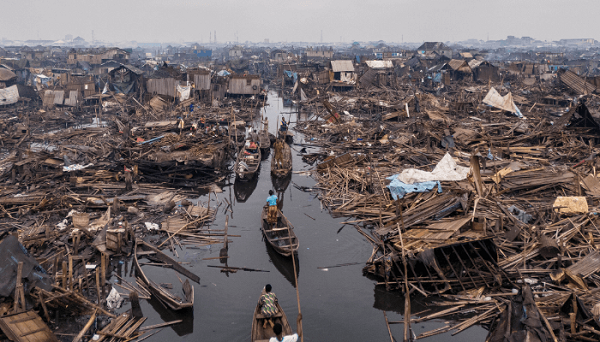
In a renewed spotlight on urban development challenges, the Makoko community in Lagos has become the epicenter of a heated debate, with competing narratives pitting government intentions against community preservation. The controversy centers on potential relocation efforts in this densely populated, low-income waterfront settlement.
Public discourse around Makoko has intensified following a recent national television appearance featuring a septuagenarian resident accompanied by NGO representatives. This emotional portrayal has contributed to narratives casting the Lagos State Government’s urban renewal initiatives as self-serving rather than public-oriented.
Critics have accused authorities of harboring hidden land acquisition agendas, a framing that has gained significant traction across media channels. However, this perspective risks oversimplifying the complex urban challenges facing one of Africa’s fastest-growing metropolitan areas.
Makoko, which began as a modest fishing settlement, has evolved organically over decades outside formal urban planning frameworks. While celebrated for its distinctive stilt houses and resilient community, the area faces serious infrastructure deficiencies. Overcrowding, poor sanitation, environmental degradation, and heightened vulnerability to disasters like fires and flooding create immediate risks for residents.
“Urban renewal is not about aesthetics or elite preference; it is about safety, functionality, and the long-term viability of the city,” explains urban planning experts familiar with the situation. Settlements constructed without consideration for structural integrity, environmental impact, or access to essential services present significant challenges for sustainable urban management.
The Lagos State Government’s proposed relocation of residents to areas like Agbowa has met resistance, particularly from fishing communities concerned about maintaining proximity to water for their livelihoods. While this concern is legitimate, urban planners argue it’s not insurmountable, as Agbowa exists within a broader coastal ecosystem that could potentially support fishing with proper infrastructure development.
Lagos has precedent for managing such transitions. The relocation of sawmill operators from Oko Baba, though initially met with resistance, ultimately provided structured workspaces and improved living conditions for affected individuals. Similar redevelopment efforts in Agboyi-Ketu have transformed previously disorganized settlements into more regulated and habitable environments.
Urban development specialists emphasize that these examples demonstrate a consistent policy direction aimed at replacing hazardous, unplanned communities with safer, more sustainable alternatives. They argue that preserving Makoko in its current form without addressing fundamental safety and infrastructure concerns romanticizes conditions that pose significant risks to residents.
The controversy has also highlighted the complex role of activism in shaping public perception. While civil society engagement remains vital for protecting vulnerable communities, some observers suggest that certain advocacy efforts may be oversimplifying the issues, potentially complicating efforts at constructive engagement.
“Trust is not demanded; it is built through consistent and demonstrable action,” notes one community development expert. “Government engagement with affected communities must be genuine, and relocation plans must include clear guarantees regarding housing, livelihoods, and social services.”
The Makoko situation reflects the growing pains of a rapidly developing megacity attempting to balance compassion with pragmatism. Urban policy experts suggest that meaningful progress requires moving beyond simplified narratives toward inclusive dialogue based on transparent information and shared commitment to sustainable solutions.
As Lagos continues its ambitious transformation into a 21st-century megacity capable of supporting its expanding population, the resolution of the Makoko situation will likely serve as a significant indicator of the city’s ability to implement development policies that genuinely serve all residents, present and future.
Fact Checker
Verify the accuracy of this article using The Disinformation Commission analysis and real-time sources.

10 Comments
This debate highlights the complex challenges facing rapidly growing cities like Lagos. While Makoko’s heritage is valuable, the area also faces serious infrastructure deficiencies that need to be addressed. I hope all sides can find a middle ground.
Makoko’s situation highlights the difficult balance between urban renewal and preserving historical communities. While the government’s intentions may be complex, it’s important to hear all perspectives and find solutions that work for the residents.
It’s good to see the Makoko issue gaining national attention, but the coverage needs to avoid simplistic narratives. Sustainable solutions will require nuanced understanding of the challenges and open dialogue between all stakeholders.
This is a challenging issue with valid concerns on both sides. I hope the authorities and community can come together to find a balanced approach that addresses infrastructure needs while respecting Makoko’s unique heritage.
Agreed, open and transparent dialogue will be key to finding a constructive path forward.
It’s good to see the media spotlight shining on Makoko, but the coverage needs to avoid oversimplifying a nuanced situation. All stakeholders should approach this with empathy and a focus on sustainable solutions.
Urban renewal is always tricky, balancing progress with preserving community identity. I hope the authorities can work closely with Makoko residents to address infrastructure needs while respecting the area’s unique culture and history.
Absolutely, a collaborative approach is crucial here. Careful planning and open communication will be vital.
Makoko’s story is a reminder that urban development is rarely straightforward. I’m curious to see if the authorities can find a way to improve living conditions while preserving the community’s unique character and history.
This is a complex situation with valid concerns on both sides. I hope the authorities and Makoko residents can work together constructively to find a balanced approach that addresses infrastructure needs while respecting the community’s heritage.