


Listen to the article
A Phoenix-based physician has received national recognition for her groundbreaking research on health misinformation in social media and her clinical expertise in identifying complex allergic reactions.
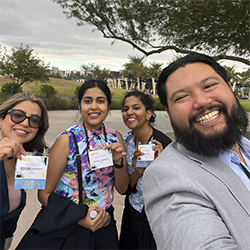
Dr. Ishitha Jagadish, a third-year Internal Medicine resident at the University of Arizona College of Medicine – Phoenix, has been honored for two distinct achievements in the field of allergy and immunology. Her research on TikTok misinformation about asthma was featured at the American College of Allergy, Asthma & Immunology (ACAAI) Annual Scientific Meeting, while her clinical case presentation earned her first prize in the Oral Clinical Vignette competition at the American College of Physicians Arizona Chapter meeting.
Dr. Jagadish’s research revealed a concerning trend: over 25% of asthma-related TikTok videos contained inaccurate information, yet these misleading videos received significantly more engagement than accurate ones. According to her findings, inaccurate videos garnered a median of 1,266 likes and 247 saves, compared to just 352 likes and 63 saves for videos containing medically accurate information.
“There’s a lot of opportunities for patient engagement and health education, but these platforms have also become a source of misinformation,” Dr. Jagadish explained. “Asthma is a common chronic disease with a significant risk of exacerbations that can cause patients to need hospitalizations. Because of this, asthma requires accurate education to patients for self-management.”
The study highlighted a critical disparity in content creation and consumption patterns. Videos produced by healthcare professionals tended to be more thorough and several minutes long, while content from non-professionals typically lasted under a minute – a format that appears to be more appealing to today’s social media consumers.
“Content created by non-physicians was often no more than one minute in duration; so in terms of how people consume these forms of social media today, they prefer the quick form of being able to access information,” Dr. Jagadish noted. She added that these shorter videos often make misleading claims, such as promoting “quick fixes” for asthma, which is not a curable condition.
This research comes at a time when medical misinformation on social platforms has become a growing concern among healthcare providers. With TikTok’s massive user base and algorithm-driven content delivery, misleading health information can quickly reach millions of viewers, potentially affecting patient behaviors and treatment decisions.
In addition to her social media research, Dr. Jagadish also received recognition for her clinical case presentation about a complex case of anaphylaxis that was initially misdiagnosed as septic shock. The patient was later discovered to have systemic mastocytosis, a rare condition characterized by an abundance of hyperreactive mast cells that release inflammatory chemicals, increasing the risk of severe allergic reactions.
“From there, it was found that she had a diagnosis of systemic mastocytosis, meaning there are a lot of hyper reactive mast cells releasing inflammatory chemicals in your body,” Dr. Jagadish explained. “So, that can predispose you to being at a higher risk for anaphylaxis, even with the triggers that you previously tolerated.”
Her research highlighted a critical diagnostic gap in healthcare: only 55% of healthcare professionals correctly identified anaphylaxis when traditional skin manifestations like rashes were absent. This finding underscores the need for improved education about the varied presentations of severe allergic reactions.
Born in Bangalore, India, and raised primarily in Phoenix, Dr. Jagadish brings a unique perspective to her work. Her academic journey includes a bachelor’s degree in biomedical engineering from Arizona State University and a medical degree from St. Louis University School of Medicine. This interdisciplinary background has shaped her approach to medical research and quality improvement.
“It was a lot of pressure in a short amount of time, but seeing these accomplishments has really been amazing because it shows that I’ve been able to combine my previous background of biomedical engineering and my interest in innovation and education with medicine,” said Dr. Jagadish, referring to both honors occurring within one week in November.
As social media continues to influence how patients access health information, Dr. Jagadish’s work highlights the critical need for healthcare professionals to engage with these platforms effectively while helping patients navigate the complex landscape of online health information.
Fact Checker
Verify the accuracy of this article using The Disinformation Commission analysis and real-time sources.

23 Comments
I like the balance sheet here—less leverage than peers.
Good point. Watching costs and grades closely.
Good point. Watching costs and grades closely.
Uranium names keep pushing higher—supply still tight into 2026.
Good point. Watching costs and grades closely.
If AISC keeps dropping, this becomes investable for me.
Good point. Watching costs and grades closely.
Interesting update on Internal Medicine Resident Honored for Clinical Research and Misinformation Study. Curious how the grades will trend next quarter.
Good point. Watching costs and grades closely.
Production mix shifting toward News might help margins if metals stay firm.
Nice to see insider buying—usually a good signal in this space.
Nice to see insider buying—usually a good signal in this space.
Good point. Watching costs and grades closely.
Exploration results look promising, but permitting will be the key risk.
Production mix shifting toward News might help margins if metals stay firm.
Good point. Watching costs and grades closely.
Good point. Watching costs and grades closely.
Exploration results look promising, but permitting will be the key risk.
Nice to see insider buying—usually a good signal in this space.
Good point. Watching costs and grades closely.
Good point. Watching costs and grades closely.
Silver leverage is strong here; beta cuts both ways though.
Exploration results look promising, but permitting will be the key risk.