


Listen to the article
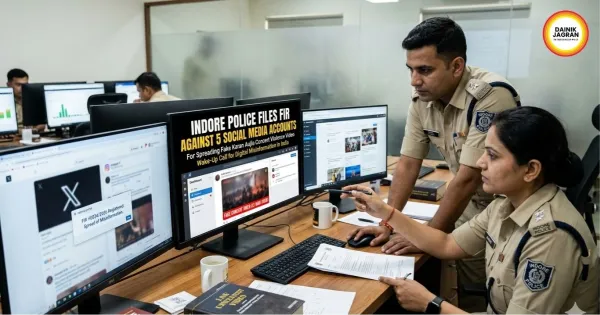
In a significant move against digital misinformation, Indore police have filed FIRs against five social media accounts for circulating a fabricated video that falsely portrayed violence at a Karan Aujla concert in the city.
The Khajrana Police in Indore, Madhya Pradesh, registered cases under the Bharatiya Nyaya Sanhita against accounts named Metro City, O Ban News, Indore Express, Indore Viral Official, and Rooh-E-Indore after an investigation determined they had deliberately shared misleading content.
The incident began on March 21, 2026, when footage claiming to show a violent brawl during the popular Punjabi singer’s performance in Indore spread rapidly across social platforms. The video, accompanied by alarming captions, triggered immediate concern among local residents and families of concert attendees.
Authorities moved quickly to investigate. The police’s dedicated social media monitoring team discovered that the footage originated from an entirely different event held in Mumbai and was unrelated to Aujla’s Indore concert in both location and timing.
“This was a clear case of recycling old content with fabricated context to generate panic and engagement,” said an official from the Khajrana Police Station who requested anonymity as the investigation remains active. “Such irresponsible actions have real consequences for public safety and perception.”
The five accounts targeted by the FIRs represent a growing category of hyperlocal digital news and entertainment pages that have established significant followings in India’s tier-2 and tier-3 cities. These pages often operate without editorial oversight or verification processes, relying instead on engagement metrics to drive revenue through advertisements and sponsored content.
Media analyst Priya Sharma, who studies digital misinformation trends across India, told reporters: “The business model for many of these local pages creates perverse incentives. A sensational video with a local angle generates far more engagement than accurate reporting, regardless of its authenticity.”
This case holds particular significance for Indore, a city that has experienced communal tensions in the past. False information about public violence can potentially inflame existing societal divisions and undermine public trust.
The legal action invokes India’s newly enacted Bharatiya Nyaya Sanhita, which replaced the Indian Penal Code in 2024 and includes provisions specifically addressing the deliberate spread of false information designed to cause public fear or disorder. These provisions complement existing digital regulations under the Information Technology Act.
The case emerges at a critical moment in India’s evolving digital regulatory landscape. The IT Amendment Rules of 2026, which took effect in February, now require platforms to remove unlawful content within three hours and mandate clear labeling of AI-generated material.
Digital rights advocate Rahul Mehta notes that while the swift action by Indore police is commendable, enforcement remains inconsistent nationwide. “Hundreds of similar fabricated videos circulate across India daily, attributed to wrong locations or communities. This Indore case should become the standard template for enforcement, not an exception.”
The incident also highlights ongoing challenges with platform accountability. Despite new regulations placing greater responsibility on social media companies, their response to regional misinformation in local languages remains inadequate.
“Large platforms need to invest significantly more in regional language moderation and proactive detection systems for hyperlocal content,” said tech policy researcher Anjali Desai. “This fake video spread for days before police intervention. Platform-level mechanisms should have flagged and removed it within hours.”
While modest in scale, the Indore case signals that India’s law enforcement is developing more sophisticated approaches to combating digital misinformation. It demonstrates that police, when equipped with dedicated monitoring resources, can respond effectively to viral falsehoods.
For India’s sprawling ecosystem of hyperlocal digital accounts, the message is clear: recycling old footage with false local captions is not merely questionable content strategy—it constitutes a criminal offense with real legal consequences.
As digital literacy continues to evolve across India’s smaller cities, cases like this underscore the critical importance of verification and responsible information sharing in maintaining public trust and safety in an increasingly complex information landscape.
Fact Checker
Verify the accuracy of this article using The Disinformation Commission analysis and real-time sources.

8 Comments
This is an important case that highlights the real-world consequences of digital misinformation. Appreciate the police taking decisive steps to identify the source and bring charges against the offending social media accounts.
This highlights the need for social media platforms to improve content moderation and enforcement against coordinated disinformation campaigns. Curious to know if the charged accounts will face meaningful penalties.
Good point. Robust rules and enforcement are essential to deter such malicious behavior on social media. Hoping this case sets an example and deters future attempts at spreading misinformation.
Worrying to see social media accounts spreading false information like this. Fact-checking and accountability are crucial to combat misinformation, especially around sensitive events. Glad the police took swift action to identify the source and set the record straight.
Agreed, misinformation can have serious real-world consequences. Kudos to the authorities for investigating thoroughly and bringing charges against the offending accounts.
Disturbing that someone would go to such lengths to fabricate a video and context around a concert event. Appreciate the police’s efforts to swiftly identify the source and take legal action.
It’s concerning to see false content like this being spread, especially around a public event. Glad the authorities were able to trace the source and hold the responsible parties accountable. Hopefully this serves as a deterrent.
Agreed, misinformation can have real impacts on people’s lives. Kudos to the police for the thorough investigation and swift action to address this issue.