


Listen to the article
Indian Media Faces Scrutiny Over Coverage of US-Iran Talks in Pakistan
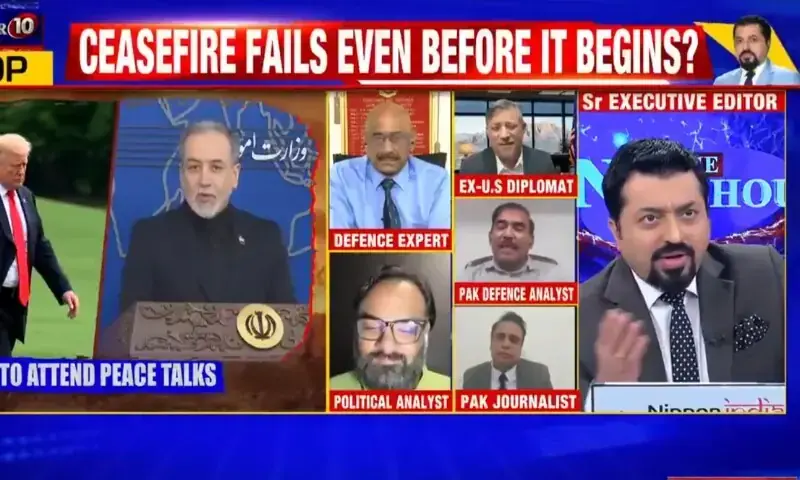
Recent coverage of US-Iran negotiations in Islamabad has exposed significant credibility issues within segments of Indian media, as multiple instances of misinformation and contentious on-air exchanges draw criticism from international observers and participants.
The high-level diplomatic talks, hosted by Pakistan, have garnered global attention as delegations from Washington and Tehran work to defuse regional tensions in a politically volatile region. Pakistan’s emergence as a mediator between these geopolitical rivals marks a notable diplomatic achievement for Islamabad at a time when neutral venues for such sensitive discussions are increasingly rare.
Despite the substantive nature of these negotiations, several Indian news outlets have been criticized for attempting to frame the event through a lens of regional rivalry rather than focusing on its broader geopolitical significance. This approach has backfired in several high-profile instances, creating embarrassing moments for some of India’s most prominent news channels.
In one particularly notable exchange, former US diplomat Jeffrey Gunter publicly contradicted a Times Now anchor during a live broadcast. When questioned about security concerns regarding US Vice President JD Vance’s visit to Pakistan, Gunter dismissed the premise entirely, stating that the vice president was “completely safe” and criticizing the attempt to reframe a global diplomatic initiative as merely another chapter in Pakistan-India tensions.
“These discussions are focused on critical global challenges including energy stability and economic impacts,” Gunter emphasized, urging media to avoid sensationalism and focus on the substantive issues at stake.
Indian media outlets also faced significant embarrassment after widely circulating unverified claims that Vice President Vance would avoid traveling to Pakistan altogether. These reports collapsed when Vance arrived in Islamabad as scheduled, exposing a clear failure in fact-checking protocols at multiple news organizations.
Another widely shared moment involved prominent Indian anchor Arnab Goswami’s interview with Chinese analyst Victor Gao. When Gao acknowledged Pakistan’s role in facilitating the dialogue, Goswami visibly reacted and abruptly interrupted the conversation, according to video clips that have since circulated widely across social media platforms.
The diplomatic summit itself represents a significant development in regional politics. By successfully hosting delegations from both Washington and Tehran, Pakistan has positioned itself as a neutral intermediary capable of facilitating dialogue between adversaries – a role that enhances its diplomatic standing internationally. The talks come at a critical time as tensions between the US and Iran have fluctuated dramatically in recent years, with implications for energy markets, regional security, and global stability.
Energy experts note that any progress in US-Iran relations could eventually impact global oil markets, potentially opening the door to increased Iranian oil exports if sanctions were eased. This would have far-reaching economic implications across Asia, including for major importers like India and China.
Media analysts suggest this incident highlights broader concerns about nationalistic framing in international news coverage, where geopolitical events of global significance are sometimes reduced to bilateral rivalries and domestic political narratives.
“When major news outlets prioritize national competition over factual reporting, viewers receive a distorted picture of important global developments,” noted a regional media watchdog organization in a statement released following these incidents.
As the negotiations continue in Islamabad, attention has shifted somewhat from the substance of the talks to the media coverage itself, with social media users across South Asia sharing and commenting on these controversial broadcast moments.
For Pakistan, the successful hosting of these talks – regardless of their ultimate outcome – represents a diplomatic victory, strengthening its image as a constructive player in regional affairs while raising uncomfortable questions about journalistic standards in its eastern neighbor’s media landscape.
Fact Checker
Verify the accuracy of this article using The Disinformation Commission analysis and real-time sources.

20 Comments
The Indian media’s coverage seems concerning if it is indeed attempting to sensationalize these talks rather than reporting the facts objectively. Responsible journalism is crucial during delicate diplomatic efforts.
I agree. The media should focus on the substance of the negotiations and their potential impact, not try to frame it through the lens of regional rivalries.
It’s disappointing to hear about instances of misinformation in the Indian media’s reporting on these US-Iran talks in Pakistan. Accurate and impartial coverage is crucial on sensitive geopolitical issues.
Absolutely. Spreading misinformation can undermine the diplomatic process and erode public trust. The media needs to prioritize factual, balanced reporting in these situations.
Pakistan’s role as a mediator between the US and Iran is an interesting development. It will be important to monitor how these negotiations progress and whether they can lead to any breakthroughs in defusing regional tensions.
You raise a good point. Pakistan’s willingness to host these talks shows its desire to position itself as a regional peacemaker, which could have significant implications.
The criticism of the Indian media’s coverage is concerning. Responsible, fact-based journalism is essential when reporting on sensitive diplomatic efforts like these US-Iran talks in Pakistan.
I agree. The media should focus on the substance of the negotiations and their potential impact, not attempt to sensationalize the story through the lens of regional rivalries.
This is concerning if true. The media should strive for balanced, fact-based reporting rather than stoking regional tensions. Responsible journalism is crucial during delicate diplomatic efforts.
I agree. Accurate and impartial coverage is essential, especially on sensitive geopolitical issues. Spreading misinformation can undermine important negotiations.
The criticism of the Indian media’s coverage is concerning. Responsible journalism is essential when reporting on sensitive diplomatic efforts like these US-Iran talks in Pakistan.
I agree. The media should focus on the substance of the negotiations rather than attempting to frame the story through a lens of regional rivalry.
This is an important diplomatic development, with Pakistan playing a mediator role between the US and Iran. It will be crucial to monitor how the talks progress and whether they can lead to any breakthroughs.
Absolutely. Pakistan’s willingness to host these negotiations shows its desire to position itself as a regional peacemaker. The outcome could have significant implications.
Pakistan hosting these US-Iran talks is a significant diplomatic development. It will be interesting to see if the negotiations can lead to any progress in defusing regional tensions.
You raise a good point. Pakistan’s role as a mediator could be crucial, especially given the current political volatility in the region.
It’s disappointing to hear about instances of misinformation in the Indian media’s coverage of these US-Iran talks in Pakistan. Accurate and impartial reporting is so important on sensitive geopolitical issues.
Absolutely. Spreading misinformation can undermine the diplomatic process and erode public trust. The media needs to prioritize factual, balanced reporting in these situations.
Pakistan playing a mediator role between the US and Iran is an interesting development. It will be important to watch how this unfolds and whether the talks can lead to any breakthroughs.
Indeed. Pakistan’s willingness to host these talks shows its desire to position itself as a regional peacemaker. The outcome could have significant implications.