


Listen to the article
Knowledge Crisis Threatens Democracy, Says Canadian Public Health Scholar
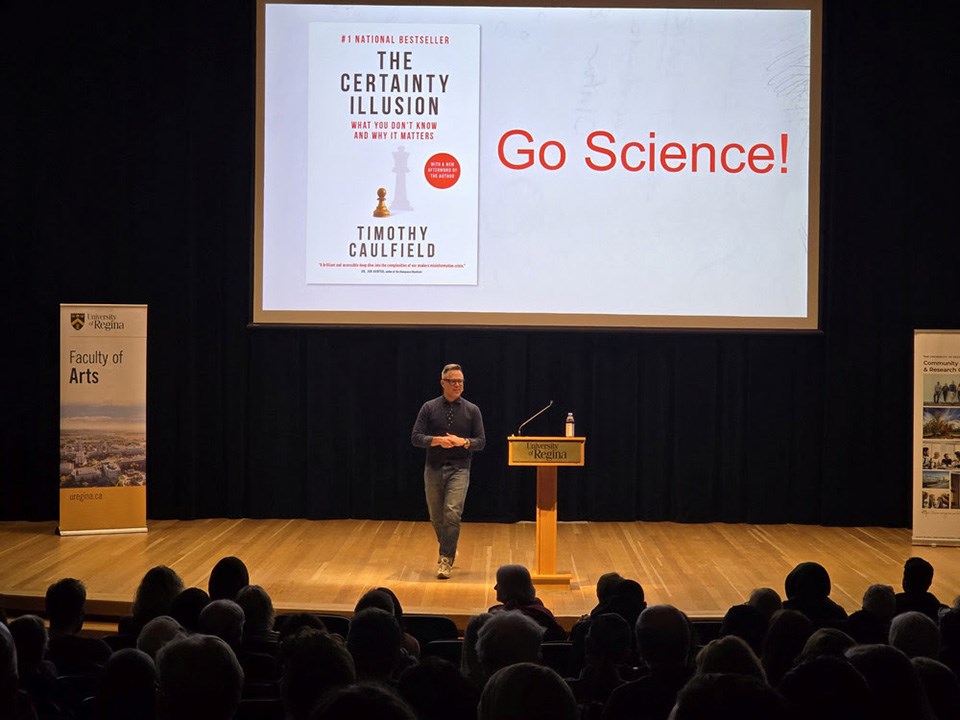
The seats filled rapidly at the University of Regina’s Education Auditorium for the 2026 Woodrow Lloyd Lecture. Faculty, students, healthcare professionals, and community members gathered in what was the largest crowd the series had seen since before the COVID pandemic, underscoring the urgency of the topic at hand.
Timothy Caulfield, a professor in the Faculty of Law and the School of Public Health at the University of Alberta and a member of the Order of Canada, delivered a stark warning: we are facing a knowledge crisis that threatens the very foundation of our democratic society.
“The first thing we need to do is teach critical thinking skills,” Caulfield emphasized during his presentation. “We should start teaching critical thinking skills in kindergarten and continue teaching them throughout grade school, high school, and university. It should be fundamental. This is a generational problem.”
The annual lecture, funded by the Woodrow Lloyd Trust and presented by the Faculty of Arts, honors Saskatchewan’s eighth premier. Lloyd is remembered not only for implementing Medicare following the contentious doctors’ strike of 1962 but also for his significant contributions to education in the province, including laying the cornerstone for what would eventually become the University of Regina.
Tom McIntosh, Associate Dean of Arts for Research and Graduate Studies, introduced Caulfield as a scholar who has been “tireless in his mission to combat public health illiteracy and to expose the hucksters, fraudsters, and conspiracy theorists that have wreaked havoc on public health systems across the globe.”
In his presentation, Caulfield traced the evolution of health misinformation from its roots in the alternative wellness movements of the 1960s counterculture through the commercialization of fitness and the rise of celebrity influencers like Dr. Oz and Gwyneth Paltrow. He noted that today, misinformation has become deeply intertwined with political identity.
While the audience laughed at examples of pseudoscientific wellness products and improbable celebrity-endorsed treatments, Caulfield emphasized the serious consequences. “Misinformation is killing people,” he stated plainly, pointing to falling vaccination rates in developed nations as a direct result of widespread falsehoods.
Social media platforms have exacerbated the problem. Caulfield cited a recent analysis of Meta platforms showing that 75 percent of content is shared without users ever clicking through to read it. This has created an information environment driven by algorithms that reward extreme, outrage-inducing content rather than critical thinking.
The rapid integration of artificial intelligence poses an additional challenge. “AI is the next battleground,” Caulfield warned, noting that algorithms are evolving so quickly that research becomes outdated almost immediately after publication.
Despite this grim assessment, Caulfield offered a hopeful framework for addressing the crisis. He advocated for a multi-faceted approach including prebunking (providing accurate information before exposure to misinformation), debunking, nudging (encouraging small behavioral changes), and regulatory measures. Simple daily practices, such as verifying scientific consensus before sharing emotional posts, can help, as can systemic changes like enforcing truth-in-advertising laws.
Caulfield stressed the importance of compassion in combating misinformation. “We should never blame the individuals who are looking for answers,” he said. “We have an information environment largely shaped by emotional responses, not by critical thinking. We need to be compassionate.”
During the question-and-answer session, a Grade 11 student from Campbell Collegiate asked for “pillars of truth” to help young people discern misinformation. Caulfield provided practical advice: look for red flags, compare claims against established consensus, and practice lateral reading (checking multiple sources).
For the University of Regina, an institution founded on Woodrow Lloyd’s vision of accessible, public-minded education, the response to the knowledge crisis begins with creating spaces for critical discourse. The substantial turnout demonstrated the community’s appetite for public intellectualism and opportunities to engage with challenging subjects.
As McIntosh noted in his closing remarks, addressing the knowledge crisis requires precisely what the University of Regina aims to provide: spaces to gather, ask difficult questions, and generate opportunities for listening, learning, and critical inquiry.
Fact Checker
Verify the accuracy of this article using The Disinformation Commission analysis and real-time sources.

8 Comments
Promoting digital literacy and fact-checking should be a priority in schools. The knowledge crisis poses real risks if left unchecked.
Absolutely, a generational approach to teaching critical thinking is a wise strategy to build resilience against misinformation.
This is a timely warning about the dangers of unchecked medical misinformation. Strengthening critical thinking skills is a sensible approach.
The influence of celebrities and algorithms on medical misinformation is a complex challenge. Addressing it will require multifaceted solutions.
Agreed, a combination of digital literacy education, platform accountability, and fact-checking initiatives will be key.
This is a concerning issue that deserves more attention. Tackling medical misinformation spread through celebrity influence and algorithms is crucial for public health and democracy.
I agree, critical thinking skills are key to navigating the digital landscape and identifying reliable information sources.
Worrying to hear about the threat to democracy from the spread of misinformation. Glad to see experts like Caulfield highlighting this important issue.