


Listen to the article
U.S. measles outbreak grows as Gov. Green criticizes federal response, citing “public health malpractice”
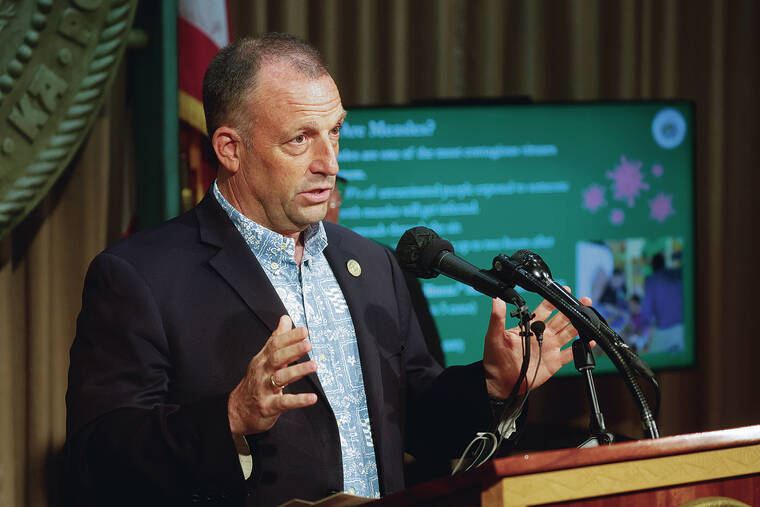
Hawaii Governor Josh Green delivered a scathing rebuke of the current measles crisis sweeping across the United States, calling it “absolutely public health malpractice” and “completely preventable.”
Speaking at a news conference Tuesday hosted by the Washington, D.C.-based nonprofit Protect Our Care, Green specifically criticized U.S. Health Secretary Robert F. Kennedy Jr. for spreading misinformation about vaccines that prevent diseases such as measles.
“In this first year of the president’s second term, they’ve kind of taken the gloves off and allowed Secretary Kennedy to just run roughshod over policy,” Green said. He added that the Trump administration has created a foundation of distrust, leading to “terrible outcomes” in public health.
The governor’s comments come amid a rapidly expanding measles outbreak in South Carolina, where confirmed cases have surpassed 640 since October, affecting numerous schools. The Centers for Disease Control and Prevention (CDC) has reported new measles cases in at least nine states this year.
The United States has now experienced 12 consecutive months of measles transmission, putting the nation at risk of losing its measles elimination status, a designation achieved in 2000 after decades of vaccination efforts.
Green was joined at the news conference by Dr. Demetre Daskalakis, an infectious disease physician and former director of CDC’s National Center for Immunization and Respiratory Diseases, and Dr. Annie Andrews, a pediatrician from South Carolina. All three blamed Kennedy’s anti-vaccine messaging for the current crisis.
“If we lose measles elimination status, it will be a clear indicator that our public health infrastructure needs urgent revitalization,” Daskalakis said, “and that we must commit to science-driven policies rather than the ideological policies that we have seen in the last year.”
U.S. Health and Human Services press secretary Emily Hilliard defended the administration in a statement, calling the claims baseless. “Under Secretary Kennedy, CDC surged resources, and multiple states declared measles outbreaks over in 2025,” Hilliard said. She noted that all vaccines on the CDC schedule, including MMR, remain covered by insurance.
Hilliard argued that declines in vaccination rates began before the current administration took office, stating, “Public confidence in health institutions was significantly undermined during the COVID era, particularly in states that imposed prolonged mandates and delivered inconsistent messaging.”
Green, who led a medical mission to Samoa during a deadly 2019 measles outbreak that killed 83 people, emphasized the serious nature of the disease. “It can cause pneumonia, it can cause encephalitis or brain inflammation, and it can cause permanent disability and death,” he said, adding that “two shots of the measles vaccine, MMR, are 97% effective.”
Dr. Andrews described how many parents mistakenly believe measles is merely a cold-like illness. While the disease often causes mild symptoms like fever, rash, and cough, it can lead to severe complications including respiratory failure, permanent neurological damage, or death when it causes pneumonia or encephalitis.
Andrews also expressed concern about increasing vaccine hesitancy among parents. “So many parents are hesitant to vaccinate their children. So many parents have delayed vaccines. So every encounter I have with a patient in the hospital now involves a conversation about where they are on their vaccine journey.”
Hawaii reported only two travel-related measles cases in 2023, but the state has detected the virus in wastewater samples multiple times since then. The state is also experiencing declining childhood vaccination rates, with MMR vaccination coverage among kindergartners at 89.9% for the 2023-24 school year, below the national average of 92.5% and well short of the 95% threshold needed for herd immunity against measles.
Meanwhile, Hawaii faces growing opposition to mandatory vaccinations. A grassroots campaign called “Keep Vaccinations Optional” recently held events across the islands opposing required immunizations for school attendance. The group is particularly concerned about a legislative bill that would eliminate religious exemptions for school vaccinations.
According to CDC data, over 2,200 confirmed measles cases were reported across 45 U.S. states in 2022, resulting in three deaths. So far in 2023, 171 cases have been reported, predominantly affecting unvaccinated children or those with unknown vaccination status.
Health officials continue to emphasize that vaccination remains the best prevention strategy against measles. The Hawaii Department of Health recommends all children receive two doses of the MMR vaccine, with the first at 12-15 months and the second at 4-6 years of age. Adults born during or after 1957 should have documentation of at least one MMR vaccination unless they can demonstrate immunity through blood testing or prior infection.
Fact Checker
Verify the accuracy of this article using The Disinformation Commission analysis and real-time sources.

8 Comments
The rising measles cases in the U.S. are troubling, and the governor’s comments highlight the need for a more proactive federal approach. Allowing misinformation to spread is unacceptable and can have severe public health consequences. Vaccination programs must be reinforced to prevent further outbreaks.
The measles outbreak is a serious public health concern, and the governor’s criticism of the federal response is justified. Misinformation about vaccines is dangerous and must be countered with factual, science-based information. Strengthening vaccination efforts should be a top priority to protect communities.
Concerning to hear about the growing measles outbreak in the U.S. The governor’s criticism of the federal response and misinformation spreading is warranted. Vaccination is crucial for public health, and we need a coordinated effort to address this issue effectively.
The measles outbreak is indeed worrying. I agree with the governor’s assessment that the federal response has been lacking and that misinformation is fueling this public health crisis. Addressing vaccine hesitancy and strengthening vaccination programs should be a top priority.
Absolutely. Misinformation about vaccines is dangerous and can have devastating consequences. The government needs to take a stronger stance in countering these false narratives and promoting the importance of vaccination.
The governor’s comments highlight the need for a more proactive and coordinated federal response to the measles outbreak. Allowing misinformation to spread is unacceptable and can have dire public health consequences. Vaccination programs must be reinforced to prevent further outbreaks.
It’s alarming to see the measles cases rising in the U.S. The governor’s criticism of the federal response and the spread of misinformation is valid. Protecting public health should be a top priority, and vaccination efforts need to be strengthened nationwide.
The growing measles cases in the U.S. are deeply concerning. The governor’s criticism of the federal response and the spread of misinformation about vaccines is understandable. Vaccination is a critical tool for public health, and the government needs to take stronger action to address this issue.