


Listen to the article
Governor Green Condemns Measles Resurgence, Blames Vaccine Misinformation
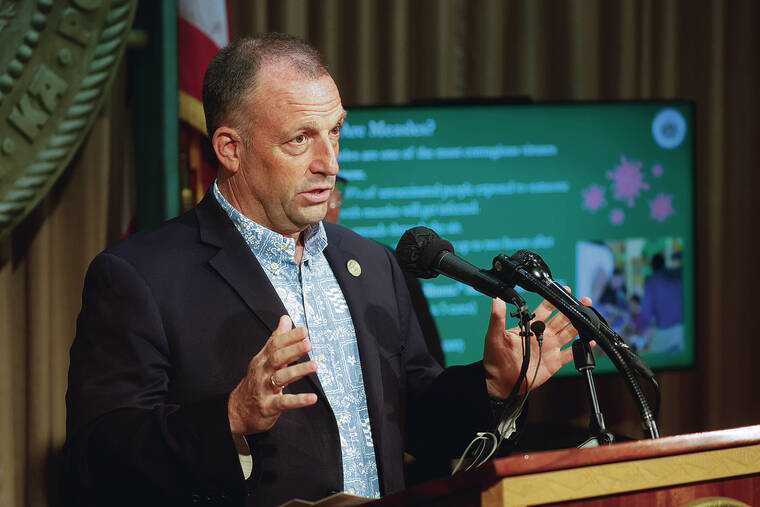
Governor Josh Green of Hawaii delivered a scathing critique of the current measles crisis sweeping across the United States, calling it “absolutely public health malpractice” and “completely preventable.” His comments came during a Tuesday news conference organized by Protect Our Care, a Washington, D.C.-based nonprofit.
Green specifically criticized U.S. Health Secretary Robert F. Kennedy Jr. for spreading misinformation about vaccines, stating that the Trump administration has “taken the gloves off and allowed Secretary Kennedy to just run roughshod over policy,” creating a foundation of distrust with “terrible outcomes.”
The governor’s remarks come as South Carolina battles a massive measles outbreak that has grown to over 640 confirmed cases since October, affecting numerous schools. The Centers for Disease Control and Prevention (CDC) reports new measles cases in at least nine states this year. The U.S. has now experienced 12 consecutive months of measles transmission, putting the nation at risk of losing its measles elimination status.
Green, a physician himself, spoke from personal experience about the disease’s severity. In 2019, as Hawaii’s Lieutenant Governor, he led a critical medical mission to Samoa during a devastating measles outbreak that resulted in 83 deaths.
“Hospitals were overflowing, with hallways full of children in respiratory distress,” Green recounted. “It’s absolutely deadly serious, and it’s completely preventable because two shots of the measles vaccine, MMR, are 97% effective.”
Dr. Demetre Daskalakis, an infectious disease physician and former director for CDC’s National Center for Immunization and Respiratory Diseases, echoed Green’s concerns. He emphasized that the current situation represents the largest measles outbreak since 1991, attributing it directly to Kennedy’s questioning of vaccine safety and efficacy.
“If we lose measles elimination status, it will be a clear indicator that our public health infrastructure needs urgent revitalization,” Daskalakis warned, “and that we must commit to science-driven policies rather than the ideological policies that we have seen in the last year.”
The U.S. Department of Health and Human Services pushed back against these criticisms. Press Secretary Emily Hilliard stated in an email that the claims were baseless, noting that “under Secretary Kennedy, CDC surged resources, and multiple states declared measles outbreaks over in 2025.” She added that declines in vaccination rates began before the current administration, particularly during the COVID-19 pandemic.
Dr. Annie Andrews, a South Carolina pediatrician and Democratic candidate for the U.S. Senate, described the impact she’s witnessing firsthand. “So many parents are hesitant to vaccinate their children,” she said. “So many parents have delayed vaccines. So every encounter I have with a patient in the hospital now involves a conversation about where they are on their vaccine journey.”
Andrews explained that while measles can present like a cold for many patients, complications can be severe, including pneumonia leading to respiratory failure or encephalitis causing seizures, permanent neurological damage, or death.
Hawaii reported only two travel-related measles cases last year, both in April involving a child under age 5 and a household member. Despite measles virus detection in wastewater samples across multiple counties, no additional human cases have been confirmed. However, the state faces declining vaccination rates, with kindergarten MMR vaccination at 89.9% in the 2024-25 school year—below the national rate of 92.5% and well short of the 95% needed for effective herd immunity.
The state also faces growing opposition to mandated vaccinations. A grassroots campaign called “Keep Vaccinations Optional” recently held events opposing required immunizations for school attendance, with concerns about potential elimination of religious exemptions.
Nationwide, over 2,200 confirmed measles cases were reported across 45 states in 2025, resulting in three deaths. As of mid-January this year, 171 cases have been reported, primarily affecting unvaccinated children or those with unknown vaccination status.
Health officials continue to emphasize that vaccination remains the most effective prevention method, with the CDC recommending two doses of the MMR vaccine for children and at least one dose for adults born after 1957 without documented immunity.
Fact Checker
Verify the accuracy of this article using The Disinformation Commission analysis and real-time sources.

14 Comments
It’s disheartening to see the measles cases rise nationally, especially when we had previously achieved elimination status. The governor’s strong words reflect the urgency of this situation.
Vaccine misinformation is a serious threat to public health. I hope this incident serves as a catalyst for a renewed focus on science-based policymaking and effective public health education.
The governor’s remarks highlight the ongoing challenge of balancing public health concerns with political agendas. Vaccine misinformation can have serious consequences, and it’s concerning to see the federal government’s response fall short.
I agree. Protecting public health should transcend partisan divides. It’s crucial for policymakers to work together with the medical community to address this issue and restore public trust in vaccines.
The measles resurgence is a concerning trend that highlights the importance of evidence-based public health policies. The governor’s criticism of the federal response and vaccine misinformation is understandable.
Agreed. Tackling this issue will require a concerted effort from all levels of government, the medical community, and the public to promote the safety and efficacy of vaccines.
The governor’s critique of the federal government’s handling of the measles crisis and the spread of vaccine misinformation is justified. Protecting the public’s health should be a top priority for all policymakers.
Absolutely. Measles is a highly contagious disease, and allowing it to spread due to misinformation is unacceptable. Stronger measures are needed to ensure widespread vaccination and combat false narratives.
As a physician, the governor’s perspective carries significant weight. His condemnation of the federal government’s handling of the measles crisis and vaccine misinformation is well-founded.
I hope this serves as a wake-up call for policymakers to take stronger action in combating vaccine misinformation and ensuring widespread vaccination coverage. Public health should not be a partisan issue.
This is a concerning situation, with measles cases rising nationwide. The governor’s criticism of the federal government’s response and vaccine misinformation is valid. Protecting public health should be a top priority.
I agree, vaccination is crucial to prevent the spread of highly contagious diseases like measles. More needs to be done to address vaccine hesitancy and misinformation.
The governor’s comments highlight the complex interplay between politics, public health, and scientific consensus. It’s troubling to see such a preventable disease make a resurgence due to misinformation.
Absolutely. Elected officials have a responsibility to base their policies on facts, not unfounded conspiracy theories. Undermining public trust in vaccines can have devastating consequences.