


Listen to the article
France’s Digital Diplomacy: How “French Response” Counters Online Misinformation
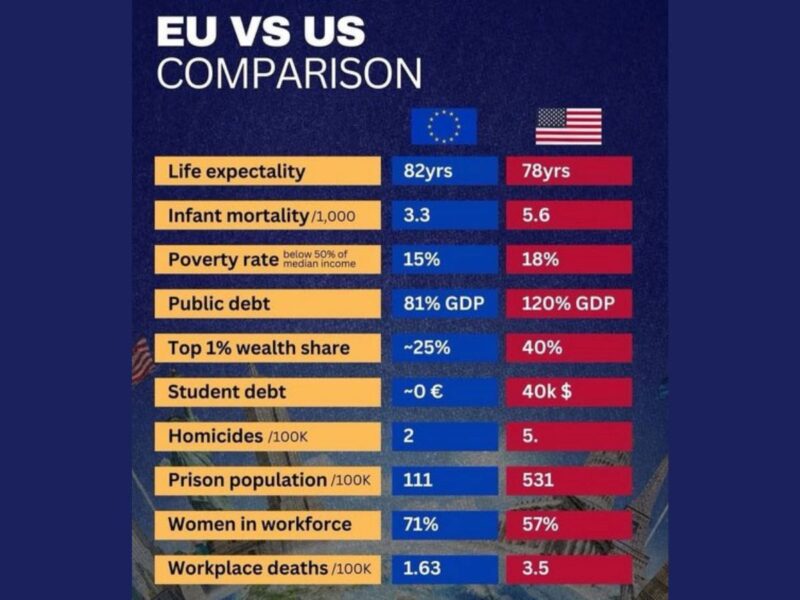
When U.S. Senator Marco Rubio criticized European culture on X this week, France’s foreign ministry didn’t let the comment slide. Their “French Response” account swiftly published a comparative table of key life-standard indicators showing how the European Union outperforms the United States in areas ranging from life expectancy to student debt.
This digital retort exemplifies France’s increasingly assertive approach to combating what it perceives as online misinformation. Since September, the English-language account has been methodically countering false information from Russian sources and American accounts—including those linked to the White House under President Donald Trump.
“Information has become a new battleground,” explained French foreign ministry spokesman Pascal Confavreux. “We’re choosing to occupy the space by turning up the volume and raising our voice.”
The account has amassed 100,000 followers—a modest number compared to X owner Elon Musk’s 230 million, but significant for a diplomatic initiative. Managed by a team of diplomats, former journalists, and fact-checkers, “French Response” has been particularly active during this week’s World Economic Forum in Davos, Switzerland.
At the forum, French President Emmanuel Macron made headlines by appearing in aviator sunglasses—reportedly due to a burst blood vessel—while declaring that France does not appreciate “bullies,” in what was widely interpreted as a veiled reference to Trump. The next day, newspapers featured images of Macron in his shades, with commentators comparing him to Maverick from “Top Gun.”
The “French Response” account capitalized on the moment, posting “When the world does your French response for you” shortly after Trump mocked Macron’s eyewear choice.
The account also tackles Russian disinformation. When a Russian account falsely claimed Macron had departed Davos early to avoid Trump—when in fact the French leader had never planned to be there the same day as the former U.S. president—the account responded with a touch of irony: “Another impeccably planned French leave.”
However, experts caution that this approach carries risks. Ruslan Trad, a global security specialist at the Digital Forensic Research Lab, told AFP: “When official diplomatic channels adopt trolling tactics, they implicitly validate the information ecosystem’s descent into provocation-based discourse. More problematically, matching adversaries’ tone risks creating equivalence in audiences’ minds between democratic institutions and disinformation actors.”
The account’s scope extends beyond simple fact-checking. When Trump recently backed away from threats to seize Greenland by force and agreed to talks, “French Response” had already addressed a related claim. Earlier in January, when a U.S. user suggested Trump would easily take over France after “we conquer Greenland and Canada,” the account quipped: “Breaking: Statue of Liberty reportedly spotted swimming back across the Atlantic. Said she ‘preferred the original terms and conditions,'” referencing the 19th-century French gift to America.
This initiative represents part of a broader shift in how nations conduct diplomacy in the digital age. As misinformation proliferates across social platforms, traditional diplomatic channels are adapting to engage more directly with global audiences. France’s approach combines factual corrections with humor and cultural references to make its messaging more accessible and shareable.
While “French Response” has garnered attention for its witty comebacks, its underlying purpose highlights the serious challenges democracies face in maintaining factual discourse in international relations. As digital platforms continue to reshape global communication, France’s experiment in digital diplomacy may offer lessons for other nations navigating the complex landscape of online information warfare.
Fact Checker
Verify the accuracy of this article using The Disinformation Commission analysis and real-time sources.

7 Comments
The rise of online misinformation is a serious threat to democratic discourse, so I’m glad to see France taking a proactive stance. Providing factual, data-driven responses is a good approach to combat false narratives. It will be interesting to see how this digital diplomacy strategy plays out.
This highlights the growing challenge of digital diplomacy and the need for countries to actively shape the narrative online. France’s comparative data makes a compelling case for the strength of European social standards compared to the US. It will be worth watching how this initiative evolves.
Agreed, France is setting an important precedent in how governments can leverage social media to counter misinformation and promote facts. Curious to see if other countries follow suit with similar initiatives.
Interesting to see France taking a more assertive approach to combating online misinformation. It’s important that governments work to counter false narratives, especially from bad actors like Russia. The “French Response” account seems like a smart way to directly engage and provide factual information.
France’s “French Response” account is a smart move to confront misinformation campaigns. In an age of rampant online falsehoods, it’s crucial for governments to directly engage and provide authoritative information. This initiative could serve as a model for other nations to follow.
Absolutely. Digital diplomacy is becoming increasingly important, and France is demonstrating an effective way to leverage social media to counter misinformation. Curious to see if this approach gains traction with other governments.
This is an encouraging development in the fight against online misinformation. France’s use of data and direct engagement through the “French Response” account is a smart strategy. It will be interesting to see how this initiative evolves and whether other countries adopt similar approaches.