


Listen to the article
Dr. Anthony Fauci Warns of Declining Trust in Science, Government Health Policy Shifts
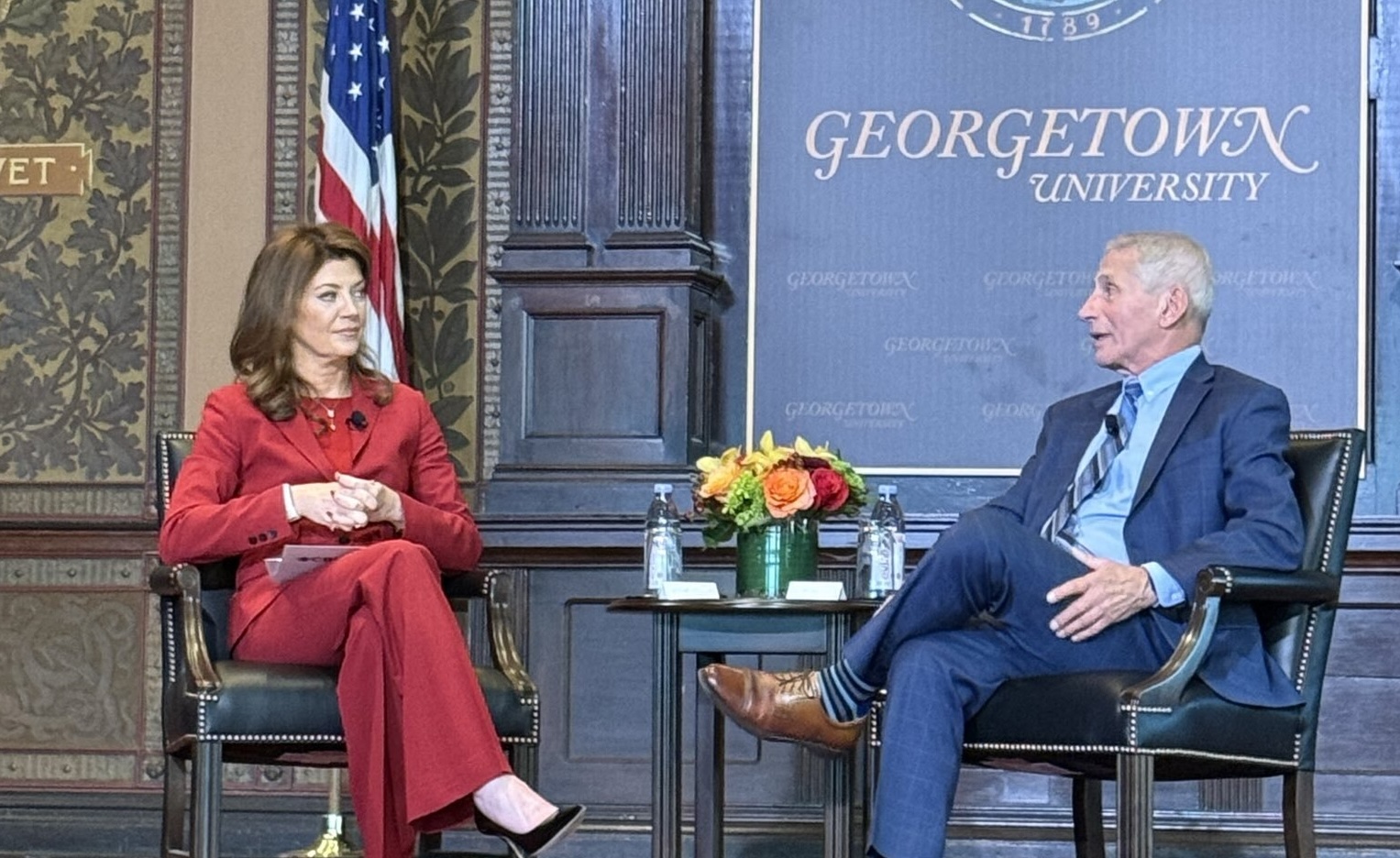
Dr. Anthony Fauci delivered a stark assessment of the current state of public health in America during an October 23 event at Georgetown University, expressing deep concern over growing skepticism toward science, the proliferation of health misinformation, and recent policy shifts at federal health agencies.
Speaking in conversation with CBS News senior correspondent Norah O’Donnell (CAS ’95, GRD ’03), Fauci, who led the National Institute of Allergy and Infectious Diseases (NIAID) for over 35 years before joining Georgetown as a distinguished professor, painted a troubling picture of America’s preparedness for future health crises.
“The thing that pains me and worries me more than anything else is the lack of trust and the vilification of science and scientists,” Fauci told the audience, pointing to recent developments at the Centers for Disease Control and Prevention (CDC) as particularly alarming.
Fauci criticized the removal of career scientists at the CDC under Secretary of Health and Human Services Robert F. Kennedy Jr., who has laid off thousands of workers and fired senior officials since taking office in January. Kennedy has faced accusations of corruption and of prioritizing political connections over scientific expertise.
“We’re not prepared because we’re pulling back on scientists,” Fauci warned. “The CDC is having all of its center people essentially be removed and be replaced by people who have political connections. That’s not the way you scientifically prepare for the next pandemic.”
The renowned infectious disease expert also expressed concern about the United States withdrawing support from international health organizations, including the World Health Organization (WHO), the Vaccine Alliance (GAVI), and the President’s Emergency Plan for AIDS Relief (PEPFAR), a program he helped establish.
“The idea of pulling back from WHO, pulling back from GAVI and now pulling back from PEPFAR is something that I think years from now, history is not going to judge us very favorably for doing,” he stated.
Reflecting on his own career, Fauci described how his decision to focus on HIV/AIDS research in 1981 was initially questioned by colleagues who thought he was making a “career-destroying decision.” That work ultimately transformed understanding of the disease and saved millions of lives through initiatives like PEPFAR, which has expanded from 15 to 50 countries and saved an estimated 26 million lives globally.
Fauci attributed PEPFAR’s success to bipartisan cooperation, specifically highlighting his partnership with former President George W. Bush. “That would never have happened had it not been for the feeling and the leadership of a conservative Republican President George W. Bush,” he noted.
Social media’s role in amplifying health misinformation emerged as another significant concern. “When you accept the normalization of untruths, then nothing is true. And when nothing is true, the confidence that people have in science and the trust in science essentially disappear,” Fauci explained.
This resonated with attendees like Alessandra Figueroa (SFS ’28), an international student from the Philippines, who has witnessed similar challenges in her home country. “A lot of propaganda is spread through social media, so I could definitely relate to his thoughts about that,” Figueroa told The Hoya.
Declining vaccination rates across the United States have led to the resurgence of previously controlled diseases, a trend Fauci views with alarm. “My biggest fear is that we are going to see a re-emergence of things that were responsible for the unnecessary death, mostly of children, but also of adults, before the era of vaccines,” he said, specifically mentioning measles, pertussis, rubella, and polio.
When addressing how healthcare providers should respond to patients influenced by misinformation, Fauci advocated for a compassionate approach. “You’ve got to be very gentle in trying to guide them through the process of what is the evidence upon which you’re making this decision,” he advised, acknowledging that many people simply want answers to ensure their children’s health.
Despite the challenges, Fauci concluded with a message of hope directed at young people considering careers in public health and medicine. “Please don’t give up, particularly the young people,” he urged. “We need you. You are the future. The worst thing that could happen is that people pull back and say, ‘Well, this is terrible. I’m going to go do something else.’ This is not going to be sustainable, it can’t be.”
Fact Checker
Verify the accuracy of this article using The Disinformation Commission analysis and real-time sources.

10 Comments
Interesting to hear Fauci’s perspective on the erosion of trust in public health institutions. Misinformation is certainly a growing concern, but it’s important to have open and honest dialogue about policy decisions as well.
I agree, transparency and scientific integrity need to be prioritized, even when there are difficult tradeoffs. Rebuilding public confidence will be crucial for weathering future health crises.
As an investor in mining and commodities, I’m curious to see how these broader trends impact the industry. Regulatory uncertainty and public skepticism could create challenges, but also opportunities for companies that prioritize transparency and scientific integrity.
Good point. Mining companies will need to carefully navigate this landscape, proactively addressing concerns and aligning their practices with evolving public health priorities.
The politicization of public health is very concerning. Fauci’s warnings about the dangers of science skepticism and misinformation deserve serious attention from policymakers on both sides of the aisle.
Absolutely. Restoring trust in institutions like the CDC will require a concerted, nonpartisan effort. Fauci’s credibility as a respected scientist could be invaluable in that process.
Fauci’s remarks highlight the complex and delicate balance between public health, science, and politics. Restoring faith in expert guidance will be crucial for weathering future crises, both in healthcare and the broader economy.
Well said. Maintaining scientific credibility and public trust should be a top priority for policymakers and industry leaders alike.
As an energy/mining professional, I’m concerned about the potential impact of this erosion of trust on policies and regulations affecting our sector. We’ll need to stay vigilant and engage constructively with the public and policymakers.
Agreed. Proactive communication and a commitment to transparency will be key for energy and mining companies to navigate this challenging environment.