


Listen to the article
Trump’s Autism Claims Filled with Misinformation, Doctors Say
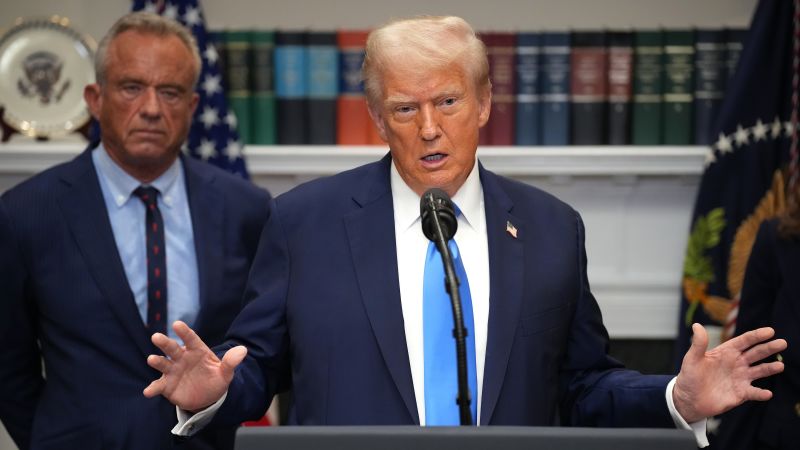
President Donald Trump’s Monday press conference on autism and public health contained numerous falsehoods and misleading statements that alarmed medical experts across the country.
While media coverage largely focused on Trump’s advice for pregnant women to avoid Tylenol due to a purported link to autism that has not been scientifically proven, the president made several additional claims about vaccines, autism rates, and hepatitis B that ranged from unsubstantiated to demonstrably false.
Trump repeatedly suggested breaking up the combination measles, mumps, and rubella (MMR) vaccine into separate shots, claiming he’s “been hearing” the combination is “bad.” However, medical experts strongly disagree with this assessment, pointing to decades of evidence supporting the vaccine’s safety and efficacy.
“Numerous studies and many decades of experience have showed us that they are safe and that they work well when given together,” said Dr. Adam Ratner, a pediatric infectious diseases physician in New York City and author of “Booster Shots: The Urgent Lessons of Measles and the Uncertain Future of Children’s Health.”
The anti-MMR sentiment Trump expressed appears to stem from a fraudulent, thoroughly debunked 1998 study that wrongly suggested a connection between the MMR vaccine and autism. Numerous subsequent studies have found no such link. Additionally, Trump’s suggestion to “break up the MMR shot into three totally separate shots” is currently impossible for Americans, as individual vaccines for measles, mumps, and rubella are not available in the United States.
Trump also advised delaying the hepatitis B vaccine until age 12, incorrectly stating it’s only needed to prevent sexual transmission. “Hepatitis B is sexually transmitted. There’s no reason to give a baby that’s almost just born hepatitis B,” he claimed.
Medical experts point out this advice contradicts established public health recommendations and ignores crucial facts. While hepatitis B can be sexually transmitted, it is also commonly passed from mother to child during birth and can spread through contact with small amounts of blood on household items like razors or toothbrushes.
Dr. Ofer Levy, professor of pediatrics at Harvard Medical School and director of the Precision Vaccines Program at Boston Children’s Hospital, explained why the first-day vaccination is so important: the virus is far more dangerous to infants than adults. Nearly 90% of infected infants develop chronic infections, putting them at significantly higher risk for liver scarring, cancer, or needing a liver transplant later in life. Approximately one in four children with chronic hepatitis B will die prematurely from their infections.
Trump greatly exaggerated the number of vaccines children receive, incorrectly claiming babies are injected with “a vat of 80 different vaccines.” In reality, according to the CDC’s recommended childhood vaccination schedule, U.S. children typically receive between 20 and 30 shots from birth to 15 months of age.
The president also made misleading claims about vaccination procedures, suggesting children receive all their vaccines in “one visit” when they are actually administered over multiple doctor visits throughout childhood. While children may receive multiple vaccines during some appointments, this practice has proven both safe and effective.
“We give multiple vaccines in a single visit because we try to get kids protection against important diseases as early as possible,” Ratner explained. “The diseases that we vaccinate against cause serious disease or even death in young children.”
Trump also made unsubstantiated claims about autism rates in certain populations, suggesting the Amish “have essentially no autism” because they “don’t take vaccines and don’t take any pills.” This assertion is false on multiple counts.
Braxton Mitchell, professor at the University of Maryland School of Medicine who has worked with Amish communities for over 30 years, confirmed: “Regarding vaccines: some Amish choose to vaccinate their kids and some do not. So it is incorrect to say that Amish do not vaccinate.” He added that many Lancaster Amish do use Tylenol and other modern medications, though sometimes preferring alternative treatments.
While it’s true that autism diagnosis rates have increased significantly over the past several decades, Trump exaggerated this trend, claiming rates went from “1 in 20,000” to the current “1 in 31” over just 18 years. CDC data shows the known prevalence was already 1 in 150 in 2000, and 1 in 125 by 2004. Experts attribute the rising diagnosis rates largely to increased awareness and improved diagnostic practices.
The president also repeated an unfounded rumor that Cuba has “virtually no autism” because they “don’t have Tylenol,” when in fact Cuba does have documented cases of autism and paracetamol (generic Tylenol) is widely available there, though sometimes subject to shortages.
Medical experts emphasize that the existing U.S. vaccine schedule has prevented more than one million deaths and tens of millions of hospitalizations in just the past 20 years, underscoring the danger of spreading vaccine misinformation, particularly from such a prominent platform.
Fact Checker
Verify the accuracy of this article using The Disinformation Commission analysis and real-time sources.

6 Comments
The President’s remarks on vaccines and autism are concerning. I hope public health officials can provide clear, objective information to counter any misinformation and maintain confidence in essential immunization programs.
Vaccines have been extensively studied and proven safe. I hope the President and his advisors will consult credible medical experts before making claims that could undermine public trust in vaccination.
It’s troubling to see the President make unfounded claims about vaccines. As a leader, he should be promoting proven science, not sowing doubts that could put lives at risk.
I agree. The President’s statements go against decades of research showing the safety and efficacy of vaccines like the MMR. Responsible leadership requires respecting scientific consensus.
While I appreciate the President’s desire to address concerns, his claims about vaccines and autism seem to contradict the overwhelming medical evidence. This is a complex issue that requires nuanced, fact-based dialogue.
Concerning claims from the President on vaccine safety. I hope medical experts can provide clear, evidence-based guidance to the public on this important public health issue.