


Listen to the article
Earthquake Safety Experts Debunk “Triangle of Life” Method, Uphold “Drop, Cover, Hold On” Protocol
Earthquake safety experts around the world continue to endorse the “drop, cover and hold on” protocol as the most effective way to protect oneself during seismic events, while strongly cautioning against a widely-shared alternative known as the “triangle of life” method.
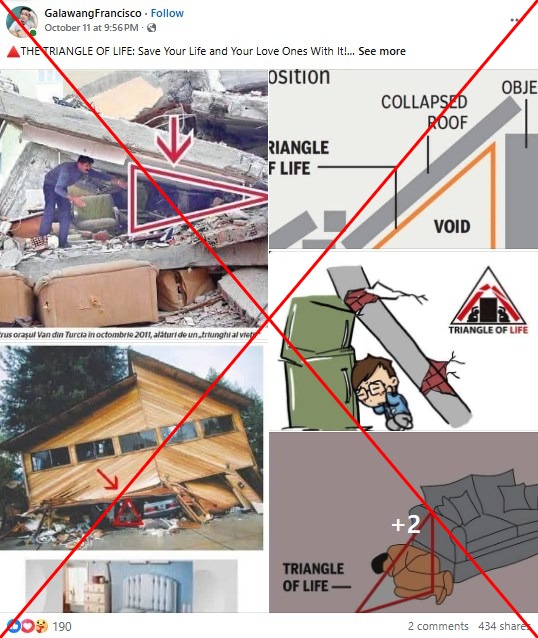
The controversial “triangle of life” approach has recently gained traction on social media, particularly in the Philippines following a series of deadly earthquakes that claimed at least 83 lives. A Facebook post shared on October 11, 2025, garnered over 30,000 shares, presenting multiple illustrations showing people positioned beside furniture like couches or beds, supposedly forming protective triangle-shaped “survival voids” during building collapses.
The viral post challenges established safety protocols, citing claims from Doug Copp, described as an experienced rescuer who allegedly developed the method after observing collapse patterns. According to the post, a 1996 “scientific test” in Turkey validated this approach, boldly asserting that “mostly everyone who simply ‘ducks and covers’ when buildings collapse are crushed to death.”
However, authorities and seismic safety organizations have unequivocally rejected these claims. Melissa Mae Garcia, a science research specialist at the Philippine Institute of Volcanology and Seismology (Phivolcs), told AFP on October 14, “The ‘Triangle of Life’ is based on conditions that do not accurately reflect what occurs during an earthquake, and following its advice could increase the risk of injury or entrapment.”
Garcia explained that the method incorrectly assumes furniture remains stationary during earthquakes. “In reality, earthquakes cause intense shaking that can move or topple heavy objects, making spaces around them extremely dangerous rather than safe,” she said.
The Philippine Red Cross similarly dismissed the “triangle of life” as “dangerous misinformation.” The organization emphasized that complete structural collapse is not the most common outcome in modern buildings, with falling objects posing the immediate danger. The Red Cross further noted that during strong tremors, it becomes difficult to crawl or move safely, increasing the risk of injury from falling debris while attempting to reach supposed “triangle” zones.
Earthquake prevalence is particularly high in the Philippines, which sits on the Pacific “Ring of Fire,” an arc of intense seismic activity stretching from Japan through Southeast Asia across the Pacific basin. This geological reality makes accurate safety information crucial for the population.
Despite the viral nature of the “triangle of life” post, both Phivolcs and the Red Cross reiterated that “drop, cover and hold on” remains the internationally recognized and most effective safety protocol during earthquakes. This approach involves dropping to hands and knees to avoid being knocked down, covering the head and neck or sheltering under sturdy furniture, and holding on until shaking stops. These steps specifically protect against falling and flying debris, which cause most earthquake injuries.
The U.S. Geological Survey (USGS) also supports this position, explicitly describing the “triangle of life” as a “misguided idea” that doesn’t apply to buildings constructed in the United States. The USGS notes that the theory is based on observations from a specific earthquake in Turkey, making its application questionable in other structural and geological contexts.
Social media users’ responses to the viral post reflected genuine belief in its potential lifesaving value, with comments expressing gratitude for what they perceived as valuable information. “Thank you, this is very helpful information,” wrote one user, while another claimed it was “a proven-and-tested life saver over the years.”
This widespread misinformation underscores the challenge authorities face in promoting evidence-based safety measures during natural disasters. As earthquake-prone regions like the Philippines continue to face seismic threats, accurate public education about emergency protocols remains essential for reducing casualties and injuries during these unpredictable events.
Fact Checker
Verify the accuracy of this article using The Disinformation Commission analysis and real-time sources.

6 Comments
The ‘triangle of life’ sounds like a risky alternative to the standard ‘drop, cover, hold on’ protocol. I trust the experts who say the established methods are the safest way to respond during an earthquake. Safety should always come first.
The ‘triangle of life’ approach sounds risky. I trust earthquake experts when they say the standard protocol of dropping, covering, and holding on is the safest option. It’s best to stick with the advice from those with deep knowledge and experience in emergency preparedness.
Agreed. Relying on unproven methods like the ‘triangle of life’ could put people in serious danger during a quake. Safety protocols are based on thorough research and real-world testing – it’s wise to follow the experts’ recommendations.
I’m glad to see earthquake safety experts unanimously reject the ‘triangle of life’ method as ineffective and potentially dangerous. When it comes to protecting myself during a quake, I’ll definitely stick with the proven ‘drop, cover, and hold on’ approach.
Interesting, I wasn’t aware of the ‘triangle of life’ method for earthquake safety. Experts seem to have compelling reasons for sticking with the tried-and-true ‘drop, cover, and hold on’ approach. I’ll be sure to follow official safety guidelines in an earthquake.
Good to see experts clearly debunking the ‘triangle of life’ as an unsafe alternative to the established ‘drop, cover, hold on’ protocol. Earthquake preparedness is crucial, so I’ll be sure to follow the advice of those with the relevant expertise.