


Listen to the article
Journalist Highlights Data Literacy as Key Weapon Against Misinformation
In an era where AI-generated content and digital manipulation have transformed the information landscape, Elon University alumnus Bryan Anderson believes the antidote to misinformation begins with something surprisingly simple: a spreadsheet.
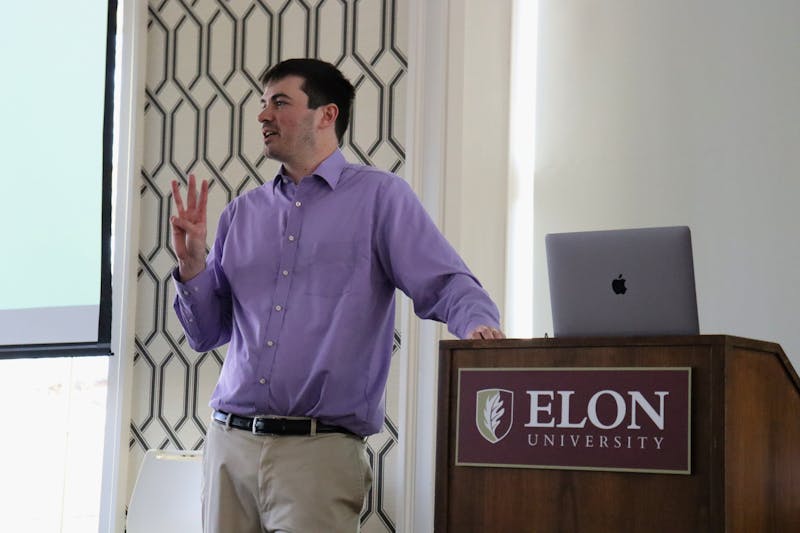
Anderson, a North Carolina politics reporter for The Assembly who has spent a decade covering the state’s General Assembly and Governor’s Office, returned to his alma mater on February 10 to lead a discussion on “Combating Misinformation.” The event was part of “Love Data Week,” a national initiative coinciding with Valentine’s Day that promotes data literacy across college campuses.
Speaking to students at the LaRose Student Commons, Anderson warned that while politicians have always stretched the truth, today’s technology has dramatically enhanced the capabilities for deliberate manipulation. “AI-generated audio recordings and deepfake videos in political advertisements represent a new frontier of misinformation challenges,” Anderson explained during his presentation organized by Elon’s Data Nexus program.
The veteran political reporter demonstrated the importance of evidence-based reporting by reflecting on his own past mistakes as a student journalist at Elon. He recalled writing an article about a whiteboard message reading “Bye Bye Latinos Hasta La Vista,” which he characterized as hateful without sufficient supporting evidence.
“I labeled the note as hateful without the necessary data to support this claim,” Anderson admitted, using his experience to illustrate how even well-intentioned reporting can contribute to information disorder when not grounded in verifiable facts.
Social media’s role in amplifying misinformation was a central theme of Anderson’s talk. “Students are very heavily engaged on social media,” he noted. “It’s very easy to go down a rabbit hole and feel your views are reinforced. I’m hoping people come away with some strategies and tools for spotting, identifying, and putting good information out there.”
For Crista Arangala, director of Data Nexus at Elon, inviting a journalism graduate to speak about misinformation served a strategic purpose in demonstrating that data literacy transcends traditional STEM boundaries.
“Data shows up in almost every field,” Arangala said. “The theme of combating misinformation from the point of view of a journalist would be both interesting to students but also very relevant.”
The event underscores Elon University’s five-year Quality Enhancement Plan focused on data competency, now in its third year. The initiative has already led to the approval of more than 60 “data-intensive” courses across various disciplines, including specialized investigative journalism programs designed to equip students with the analytical skills necessary in today’s information environment.
The timing of Anderson’s presentation comes as concerns about information integrity have intensified nationwide ahead of the 2024 presidential election. Media literacy experts have warned that synthetic media—including deepfakes and AI-generated content—could significantly disrupt the electoral process if voters lack the tools to distinguish authentic information from manipulation.
Anderson emphasized that breaking out of information echo chambers represents an essential strategy for students navigating today’s complex media landscape. “You want to challenge yourself and challenge what you are seeing,” he advised. “Data is the basis for almost everything we do.”
The journalist’s return to campus highlights a growing recognition among educational institutions that data literacy constitutes a fundamental aspect of citizenship in the digital age. As technology continues to evolve, the ability to analyze, interpret, and verify information using data-driven approaches may become as important as traditional reading and writing skills.
For students preparing to enter a workforce increasingly shaped by both artificial intelligence and misinformation, Anderson’s message served as both caution and call to action: in a world where seeing no longer guarantees believing, the capacity to critically evaluate data has never been more essential.
Fact Checker
Verify the accuracy of this article using The Disinformation Commission analysis and real-time sources.

8 Comments
As someone who closely follows the mining, metals, and energy sectors, I’m really glad to see this emphasis on data competency in journalism. Accurate, well-researched reporting is crucial for these technical industries that can be rife with misinformation. Kudos to Elon University for taking this initiative.
It’s refreshing to see a university like Elon taking proactive steps to address the challenges of misinformation. Developing data analysis skills in future journalists is a smart move that will serve them well in their careers.
As someone who follows mining and energy news closely, I’m really interested in this discussion on data competency in journalism. Accurate, fact-based reporting is so important, especially for technical industries like ours that can be vulnerable to misinformation.
Absolutely. Data literacy allows journalists to dig deeper, spot inconsistencies, and present a more complete, unbiased picture. This is crucial for complex topics like mining and energy.
Excellent point about the importance of data literacy in journalism. With AI-generated content and deepfakes on the rise, fact-checking and data analysis skills are crucial for journalists to combat misinformation. It’s great to see Elon University taking this issue seriously.
Couldn’t agree more. Journalists need to be armed with the right tools and training to navigate this changing landscape and provide accurate, trustworthy reporting.
This is a timely and important topic. With the rise of AI-generated content, deepfakes, and other manipulation tactics, data competency is essential for journalists to maintain credibility and trust with their audiences. Kudos to Elon for highlighting this critical skill set.
Agreed. Fact-checking and data analysis are the best defenses against the spread of misinformation. Equipping the next generation of journalists with these tools is a wise investment.