


Listen to the article
Misinformation Fuels Post-Election Tensions in Bangladesh
Violence has erupted across Bangladesh following the February 12 national parliamentary election and referendum, with tensions amplified by a wave of misinformation spreading rapidly through social media channels. While post-election clashes are not uncommon in the South Asian nation, fact-checkers have identified numerous false narratives deliberately crafted to inflame political divisions.
Dismislab, a prominent fact-checking organization, has documented a troubling pattern in the aftermath of the polls. Their analysis reveals that most fabricated claims attempt to portray Bangladesh Jamaat-e-Islami activists as victims of attacks perpetrated by the Bangladesh Nationalist Party (BNP). Other misleading content falsely implicates Jamaat as the aggressor in various violent confrontations.
In just the first 48 hours following the election—February 13 and 14—nine fact-checking organizations published at least 13 distinct verifications addressing false claims about post-election violence or protests. The scale of this misinformation campaign suggests a coordinated effort to manipulate public perception of political events.
One particularly widespread piece of misinformation involved a Facebook video allegedly showing homes being set ablaze in Debidwar, Cumilla, because residents had voted for the “Daripalla,” Jamaat’s electoral symbol. Fact-checkers determined this video had actually been circulating for at least a month before the election, rendering the connection to recent polling impossible.
Another video sparked confusion by carrying multiple contradictory claims. Some posts alleged BNP activists had attacked minority community homes in Cumilla following the election, while others claimed houses were vandalized simply because residents had supported Jamaat. Upon investigation, both narratives proved false.
In a striking example of temporal manipulation, a seven-year-old video resurfaced with claims that the BNP’s student wing, Chhatra Dal, was forcibly evicting members of the National Citizen Party (NCP) and Jamaat’s student organization, Islami Chhatra Shibir, from Dhaka University residential halls. The recontextualized footage was designed to suggest ongoing persecution despite having no connection to current events.
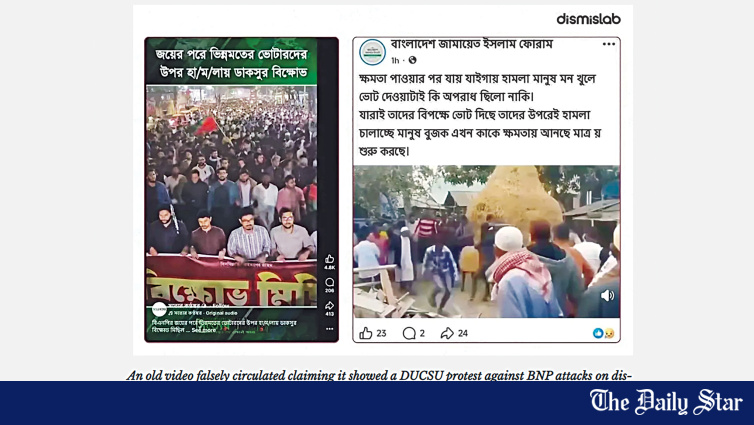
The BNP has also been targeted by similar misinformation campaigns. One Facebook video purported to show post-election attacks, with captions accusing “the party that came to power” of assaulting people for voting for opposition candidates. Fact-checkers revealed the footage actually depicted a pre-election clash between BNP and Jamaat supporters, not post-election violence.
In a particularly disturbing instance of false information, social media posts claimed BNP activists had gang-raped a female leader of the NCP—an allegation fact-checkers quickly debunked.
Religious tensions have also been inflamed by misinformation. A video shared on X (formerly Twitter) falsely alleged that Islamist groups were attacking Hindu communities following Jamaat’s electoral defeat. Fact-checkers determined the video was completely unrelated to the 2026 election, instead showing an incident where a man was assaulted for chanting “Joy Bangla” during former Prime Minister Begum Khaleda Zia’s funeral.
The proliferation of such misinformation presents a significant challenge to Bangladesh’s already fragile political stability. With a history of post-election violence, the intentional spreading of false narratives targeting specific political and religious groups risks escalating tensions beyond what genuine political disagreements might naturally produce.
Media literacy experts warn that the speed at which misinformation spreads on platforms like Facebook often outpaces fact-checking efforts, allowing false narratives to take hold before corrections can reach the same audience. This phenomenon is particularly dangerous in politically polarized environments where confirmation bias leads users to accept claims that align with their existing beliefs.
As Bangladesh navigates this volatile post-election period, the battle against misinformation has become nearly as important as addressing genuine incidents of political violence, with the line between truth and fabrication increasingly blurred in the digital information landscape.
Fact Checker
Verify the accuracy of this article using The Disinformation Commission analysis and real-time sources.

15 Comments
The scale of this misinformation campaign is truly alarming. It’s a stark reminder of the urgent need for greater investment in media literacy and fact-checking initiatives to combat the spread of falsehoods and protect the integrity of our democratic institutions.
Spreading misinformation to inflame political tensions is a deeply concerning tactic. I commend the fact-checking organizations for their efforts to identify and debunk these false claims. Maintaining public trust in the democratic process should be a top priority.
This is a sobering example of how misinformation can fuel tensions and unrest. I commend the fact-checking organizations for their efforts to verify the claims and provide accurate information.
Yes, their work is crucial in these situations. Dismantling false narratives and promoting truth is vital for maintaining social stability and protecting democratic processes.
It’s troubling to see such a coordinated effort to manipulate public perception through false narratives. Responsible journalism and diligent fact-checking are essential to upholding democratic transparency.
Absolutely. We must remain vigilant against the spread of misinformation, especially around sensitive political events. Fact-based reporting is the best defense against these tactics.
This is a concerning trend. Spreading misinformation to inflame political tensions is highly irresponsible and dangerous. Fact-checking is crucial to counter false narratives and maintain public trust.
I agree, misinformation can have serious real-world consequences. It’s important that credible organizations like Dismislab work to identify and debunk false claims.
This is a troubling development. Coordinated campaigns to spread misinformation and manipulate public opinion undermine the integrity of democratic processes. Robust fact-checking and accountability measures are crucial to counter these tactics.
This is a deeply troubling development. Coordinated campaigns to spread misinformation and manipulate public perception pose a serious threat to democratic stability. Fact-checking and media literacy efforts must be strengthened to counter these tactics.
The scale of this misinformation campaign is quite alarming. It’s a stark reminder of the need for robust fact-checking and media literacy efforts to combat the spread of falsehoods.
Agreed. Coordinated disinformation campaigns pose a serious threat to public discourse. Strengthening our ability to identify and counter these tactics should be a top priority.
It’s concerning to see misinformation being used as a tool to manipulate public perception and sow discord. Fact-checking is essential, but more needs to be done to prevent the spread of these false narratives in the first place.
Absolutely. Proactive measures to identify and remove the sources of misinformation, as well as educating the public on media literacy, should be a priority.
This is a troubling situation. Fabricated claims that inflame political divisions are extremely concerning. I hope the relevant authorities take appropriate action to address the root causes of this misinformation.