


Listen to the article
Gulf of Guinea Journalists Trained to Combat Maritime Misinformation
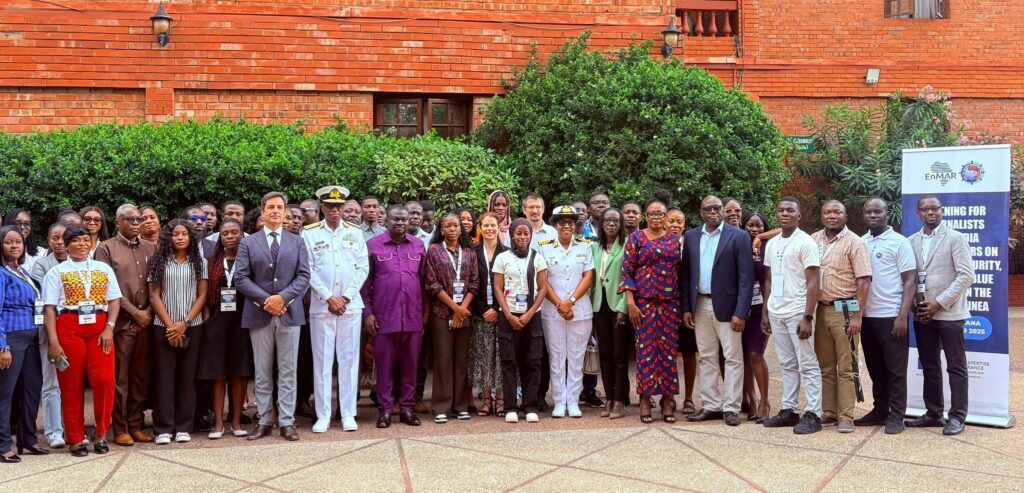
A specialized journalism training in Accra has highlighted the critical need to address growing misinformation and disinformation in maritime reporting across the Gulf of Guinea region. The three-day workshop, held from October 7-9, 2025, focused on equipping media professionals with tools to accurately report on complex maritime security issues in an often underreported sector.
Organized by the Gulf of Guinea Maritime Institute (GoGMI) in partnership with the Enhanced Maritime Action in the Gulf of Guinea (EnMAR), the initiative brought together journalists from across the region to improve reporting standards on maritime security, safety, and blue economy developments.
Air Vice Marshal Frank Hanson of the Ghana Navy delivered the keynote address, noting that despite its critical importance to regional trade and security, the Gulf of Guinea remains “the least spoken about in the public sphere.” He emphasized the media’s responsibility to bridge this awareness gap through accurate, well-informed reporting that corrects public misconceptions.
Emmanuelle Lecuyer of EnMAR reinforced this sentiment, observing that “journalists in the region are now becoming more aware of the necessity to fight against disinformation in this critical domain.”
The Gulf of Guinea, which spans approximately 6,000 km of coastline from Senegal to Angola, has faced persistent security challenges including piracy, illegal fishing, and trafficking. These issues have significant economic implications for the region, which depends heavily on maritime resources and shipping routes for trade.
During the first day’s sessions, GoGMI Executive Chairman Vice Admiral Issah Yakubu (Rtd.) stressed the importance of precise terminology and geographic verification in maritime reporting. “We (Ghana) have 12 nautical miles to claim… Verify where it happens before reporting. Is it in our territorial waters? Is it armed robbery or is it piracy?” he questioned, highlighting how mischaracterization of maritime incidents can lead to diplomatic tensions and security misconceptions.
The distinction between piracy (which occurs in international waters) and armed robbery (which happens within territorial waters) is not merely semantic but carries significant legal and jurisdictional implications. Inaccurate reporting on these matters can mislead public perception and complicate international cooperation efforts.
On the third day, David Dembele, founder of the Malian Network of Investigative Journalists (RMJI), conducted an extensive training on investigative techniques and open-source intelligence tools. Participants were introduced to practical verification resources including Wayback Machine, Archive.VN, GeoSpy.net, and PimEyes, alongside maritime-specific databases such as the International Maritime Organisation (IMO), Global Fishing Watch, and the Investigative Dashboard maintained by the International Consortium of Investigative Journalists.
Dembele emphasized the concept of “data teasers” – small verifiable clues hidden within open-source information that can help journalists uncover complex maritime crimes like illegal fishing, unauthorized transhipment operations, or piracy activities.
The legal dimensions of maritime reporting received particular attention from Naval Captain Naa Ayeley Akwei-Aryee, Director of Ghana Navy Legal Affairs. She described the maritime industry as “a complex and highly regulated sector” requiring journalists to understand frameworks like the United Nations Convention on the Law of the Sea (UNCLOS), IMO regulations, and national maritime legislation.
“By understanding the legal authorities in the maritime domain, journalists can provide more accurate, informed, and nuanced reporting on maritime issues,” Captain Akwei-Aryee explained.
The training comes at a crucial time when maritime security in the Gulf of Guinea has seen evolving challenges. While incidents of piracy have decreased in recent years due to international naval cooperation and regional initiatives like the Yaoundé Architecture, other threats including illegal fishing, environmental crimes, and trafficking continue to impact coastal economies.
For the journalists participating, the workshop represented an opportunity to develop specialized knowledge in a niche but vitally important beat. Maritime issues intersect with numerous public interest concerns, from food security and environmental protection to international trade and regional development.
As the workshop concluded, participants were reminded that combating misinformation is essential to the credibility and impact of maritime journalism. By adopting investigative approaches, verifying claims through reliable sources, and understanding the legal context of maritime issues, journalists can play a crucial role in ensuring transparency and accountability in maritime governance across the Gulf of Guinea region.
Fact Checker
Verify the accuracy of this article using The Disinformation Commission analysis and real-time sources.

18 Comments
The media’s role in bridging awareness gaps and correcting misconceptions around maritime issues is critical. This training program seems like a step in the right direction.
Agreed. With the right tools and knowledge, journalists can play a key part in promoting transparency and public understanding of the complex security, safety, and economic dynamics at play.
Curious to learn more about the specific reporting techniques and best practices covered in this training program. Addressing maritime misinformation requires a multi-faceted approach.
Curious to know if this training initiative will have any tangible impact on the quality and quantity of maritime reporting in the Gulf of Guinea. It’s an ambitious goal to take on.
Addressing misinformation and strengthening ethical reporting standards in the maritime sector is a noble goal. I hope this training program can make a meaningful difference in the long run.
Agreed. Even small improvements in maritime journalism across the Gulf of Guinea region could have significant positive ripple effects for trade, security, and the blue economy.
Curious to learn more about the specific topics and reporting techniques covered in this three-day journalism training. Addressing maritime misinformation seems like a complex challenge.
I agree, the training curriculum would be interesting to examine. Properly navigating maritime security, safety, and blue economy developments requires specialized expertise.
This is an important initiative, but I wonder how effective it will be in the long run. Changing reporting habits and correcting public misconceptions is an uphill battle in many parts of the world.
That’s a fair point. Sustained commitment and follow-up will be crucial to ensure the lessons from this training translate to tangible improvements in maritime journalism across the region.
This is an important and timely initiative. With growing challenges like piracy, illegal fishing, and environmental degradation in the Gulf of Guinea, accurate, well-informed reporting is crucial.
This training program sounds really important for improving maritime reporting in the Gulf of Guinea region. Accurate and ethical coverage of complex security issues in this sector is crucial for public awareness and understanding.
Agreed. Combating misinformation and strengthening journalistic standards in this underreported area will have significant benefits for trade, security, and the blue economy.
I appreciate the emphasis on equipping journalists with the right tools and knowledge to cover complex maritime issues. Misinformation and disinformation can have serious consequences in this sector.
Agreed. Strengthening journalistic standards and building regional expertise on maritime security, safety, and blue economy developments is a worthy long-term investment.
Glad to see efforts being made to improve the quality and accuracy of maritime reporting in the Gulf of Guinea. This underreported sector deserves more attention and better-informed coverage.
It’s good to see the media being proactive in addressing information gaps around maritime issues in the Gulf of Guinea. Equipping journalists with the right tools and knowledge is a smart approach.
Yes, this initiative by the Gulf of Guinea Maritime Institute and EnMAR is a positive step. More transparent and well-informed reporting can go a long way in this critical region.