


Listen to the article
Critical Thinking Essential to Combat Misinformation Crisis, Expert Warns
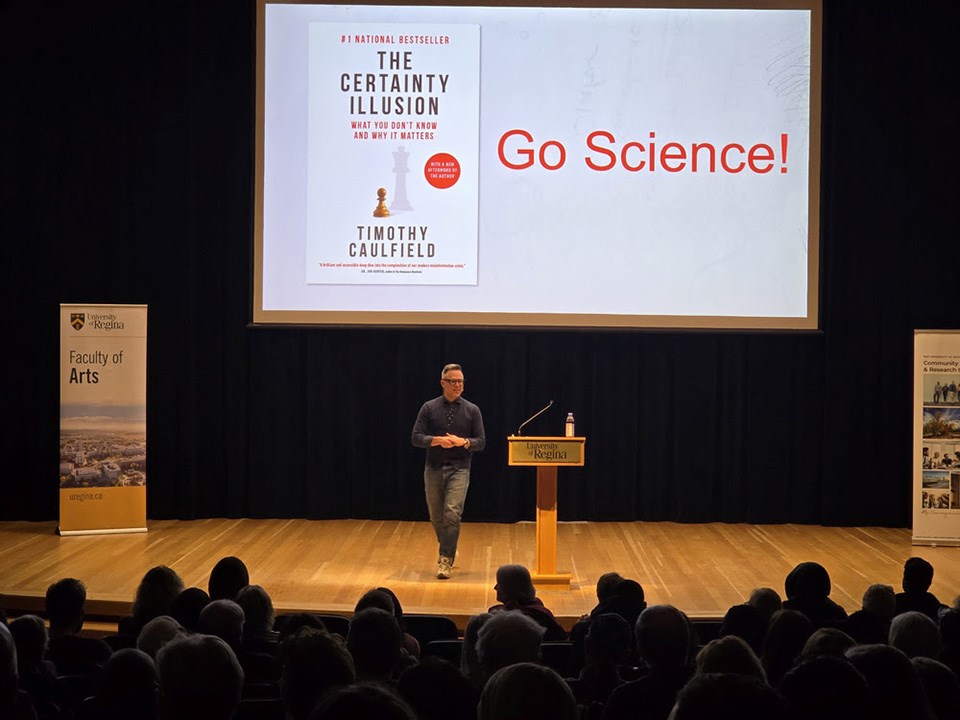
A packed Education Auditorium at the University of Regina witnessed one of the largest gatherings for the Woodrow Lloyd Lecture series since before the pandemic, as Timothy Caulfield delivered a stark message about the growing threat of misinformation in society.
Caulfield, a professor at the University of Alberta’s Faculty of Law and School of Public Health and a member of the Order of Canada, warned attendees that the world faces a knowledge crisis that threatens democratic institutions.
“We are living in the middle of a knowledge crisis, and it is threatening our democracy,” Caulfield told the diverse audience of faculty, students, healthcare professionals, and community members.
The 2026 Woodrow Lloyd Lecture, presented by the Faculty of Arts, honors Saskatchewan’s eighth premier, who was instrumental in implementing Medicare and expanding post-secondary education in the province. Lloyd laid the cornerstone for what would eventually become the University of Regina.
Caulfield traced the evolution of health misinformation from its roots in 1960s counterculture through the commercialization of wellness and the rise of celebrity influencers like Dr. Oz and Gwyneth Paltrow. He emphasized how misinformation has become increasingly politicized and dangerous.
“Misinformation is killing people,” Caulfield stated, pointing to declining vaccination rates in developed nations as evidence of the real-world consequences.
The proliferation of social media has intensified the problem. Caulfield cited research showing 75 percent of content on Meta platforms is shared without users ever clicking through to read it. This behavior creates an information ecosystem that rewards outrage and extremism rather than thoughtful engagement.
Artificial intelligence represents the next frontier in this battle, according to Caulfield. “AI is the next battleground,” he warned, noting that algorithms are evolving so rapidly that research struggles to keep pace with developments.
Despite the sobering assessment, Caulfield offered a framework for addressing the problem. His multi-faceted approach includes prebunking (providing accurate information before exposure to misinformation), debunking, behavioral nudges, and appropriate regulation.
Education forms the cornerstone of his strategy. “The first thing we need to do is teach critical thinking skills,” Caulfield emphasized. “We should start teaching critical thinking skills in kindergarten and continue teaching them throughout grade school, high school, and university. It should be fundamental. This is a generational problem.”
Caulfield stressed that empathy must accompany education. “We should never blame the individuals who are looking for answers,” he said. “We have an information environment largely shaped by emotional responses, not by critical thinking. We need to be compassionate.”
The lecture resonated deeply with attendees. During the question-and-answer session, a Grade 11 student from Campbell Collegiate asked for guidance on discerning truth from falsehood. Caulfield advised looking for red flags, comparing claims against scientific consensus, and practicing “lateral reading” – checking multiple sources to verify information.
For the University of Regina, the event exemplified its mission of fostering critical inquiry and public discourse. The Faculty of Arts aims to develop precisely the analytical skills and communication expertise that Caulfield described as essential for navigating an increasingly complex information landscape.
Associate Dean Tom McIntosh noted in his closing remarks that the exceptional turnout demonstrated the community’s appetite for substantive intellectual engagement on challenging topics. For an institution founded on principles of accessible, public-minded education, addressing the knowledge crisis begins with creating spaces for open dialogue and critical thinking.
As digital misinformation continues to evolve and artificial intelligence introduces new challenges, Caulfield’s call for both rigorous analysis and compassionate engagement offers a roadmap for individuals and institutions seeking to preserve the integrity of public discourse in an age of information overload.
Fact Checker
Verify the accuracy of this article using The Disinformation Commission analysis and real-time sources.

10 Comments
Caulfield’s lecture sounds like a wake-up call for all of us. Combating the knowledge crisis will require a concerted effort to promote scientific literacy and fact-based decision-making.
Absolutely. As citizens, we each have a responsibility to be discerning consumers of information and to support institutions and initiatives that uphold the truth.
It’s alarming to hear how misinformation is threatening democratic institutions. This highlights the urgent need for improved regulation and accountability around online content and influence.
Agreed. Policymakers and tech companies must take bold steps to combat the spread of misinformation and protect the integrity of public discourse.
This is a sobering reminder of the dangers of misinformation, especially when amplified by celebrity culture and algorithms. Critical thinking and media literacy are essential to combat this growing crisis.
Agreed. Promoting factual, evidence-based information is key to protecting democratic institutions and public wellbeing.
Timothy Caulfield’s warnings about the knowledge crisis and threats to democracy are deeply concerning. As a society, we must prioritize science, reason, and reliable information sources.
Well said. Addressing the misinformation epidemic requires a multi-faceted approach involving education, regulation, and increased accountability for tech platforms and influencers.
The commercialization of wellness and the role of celebrity culture in spreading misinformation is a troubling trend. We need to be more vigilant in scrutinizing claims and sources, especially online.
Absolutely. Developing critical thinking skills and media literacy from a young age should be a priority in our education system.