


Listen to the article
CDC Vaccine Panel Delays Hepatitis B Vote Amid Controversy and Confusion
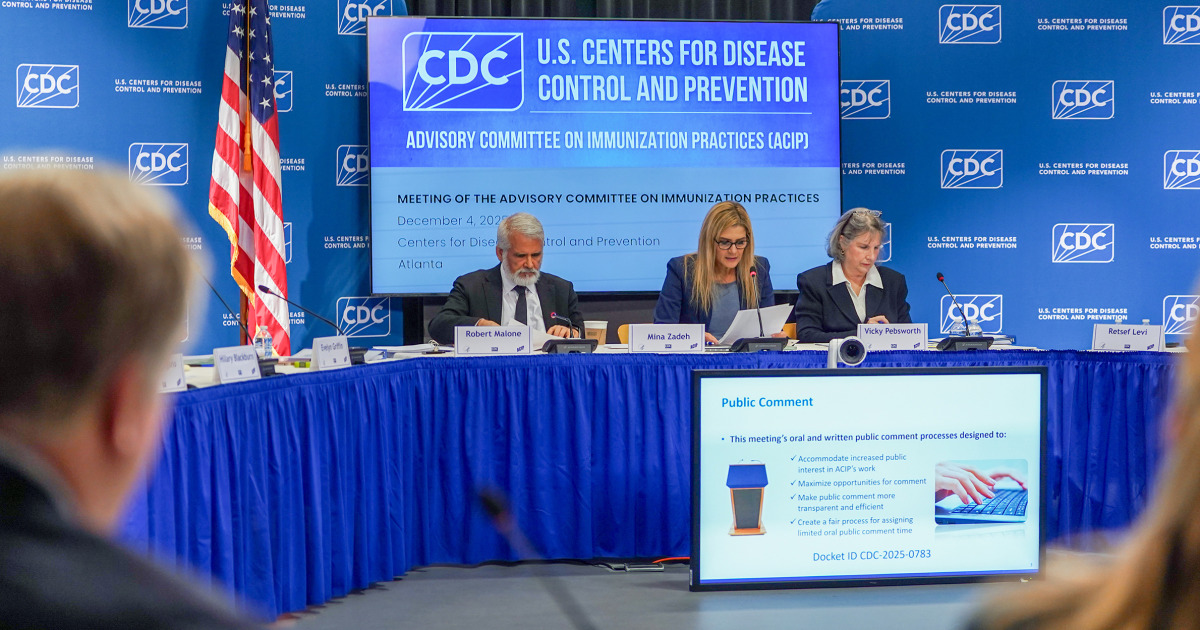
The CDC’s vaccine advisory committee postponed a critical vote on hepatitis B vaccination recommendations Thursday amid a chaotic meeting characterized by procedural confusion, scientific disputes, and allegations of political interference. The Advisory Committee on Immunization Practices (ACIP) will now attempt to vote Friday morning on potential changes to a 34-year-old recommendation that all newborns receive their first hepatitis B vaccine dose within 24 hours of birth.
The meeting represented a stark departure from the committee’s traditional approach, taking place in the CDC’s broadcast studio rather than its usual conference room setting. A Health and Human Services spokesperson explained the venue change was intended to “accommodate increased public interest in the committee.”
The current ACIP, whose members were appointed by Health Secretary Robert F. Kennedy Jr. after he fired the previous panel in June, is considering whether to revise longstanding guidance on hepatitis B vaccination. The proposal under consideration would recommend that women who test negative for hepatitis B consult with healthcare providers about whether their newborns should receive the birth dose.
This potential policy shift has alarmed public health experts who argue it contradicts decades of scientific consensus. Hepatitis B is an incurable infection that can lead to liver disease, cancer, and death. The virus can be transmitted from mother to child during delivery, and not all pregnant women are tested for it during pregnancy.
CDC data estimates that hepatitis B vaccination has prevented more than 6 million infections and nearly 1 million hospitalizations among children born between 1994 and 2023.
Thursday’s proceedings featured unusual presenters, including anti-vaccine activists and a climate scientist with connections to anti-vaccine publications, rather than the medical experts who typically present peer-reviewed data at ACIP meetings. Several presenters and panel members questioned the vaccine’s safety and efficacy despite extensive evidence supporting both.
In one notable exchange, anti-vaccine activist Mark Blaxill, who was recently hired at the CDC despite having no medical credentials, suggested that common infant symptoms might be “possibly connected” to brain swelling. Committee member Dr. Cody Meissner, the only current ACIP member who previously served on the committee, immediately challenged this assertion: “That is absolutely not encephalitis,” he said. “That’s not a statement that a physician would make.”
The meeting descended into further confusion when committee members expressed uncertainty about the voting language. Dr. Joseph Hibbeln, an ACIP member, quipped that the language “was written by the department of redundancy department.” This confusion ultimately led to the vote’s postponement.
Dr. Jason Goldman, president of the American College of Physicians, criticized the proceedings during the public comment period, calling them “political theater” and adding, “You are wasting taxpayer dollars by not having scientific, rigorous discussion on issues that truly matter.”
Senator Bill Cassidy (R-La.), who chairs the Senate’s health committee and voted to confirm Kennedy as health secretary, took to social media to call the advisory panel “totally discredited” and “not protecting children.” Cassidy, a liver doctor who has treated hepatitis B patients, expressed particular concern about the scheduled presentation from Aaron Siri, an anti-vaccine lawyer who has represented Kennedy and advocated for revoking FDA approval of the polio vaccine.
Beyond the hepatitis B vote, the committee is also expected to discuss the entire childhood immunization schedule and aluminum salts used in many vaccines. Both topics are controversial among vaccine skeptics, who claim without scientific support that children receive too many vaccines and that aluminum additives increase risks of various conditions.
The meeting continues Friday with additional presentations and the delayed vote, reflecting the ongoing tension between established public health practices and the new direction under Kennedy’s leadership at HHS.
Fact Checker
Verify the accuracy of this article using The Disinformation Commission analysis and real-time sources.

13 Comments
Postponing a vote on such an established vaccine recommendation seems unusual. I wonder what specific concerns or data points are driving this review. Looking forward to seeing the final ACIP decision and rationale.
Yes, it will be important to understand the ACIP’s reasoning, especially given the allegations of political interference mentioned in the article.
The change in venue to accommodate public interest is interesting. Signals this is a high-profile issue. Hopefully the ACIP can cut through the noise and focus on the medical evidence as they work to update the hepatitis B guidance.
Interesting development with the CDC vaccine panel postponing the hepatitis B vote. Seems there are some complex scientific and procedural issues at play that need further review. Curious to see how this plays out and what the final recommendations will be.
Yes, it sounds like a contentious meeting with a lot of debate. Hopefully the panel can work through the details and come to a well-informed decision that prioritizes public health.
The reported political interference allegations are worrying. I hope the ACIP can set aside any outside pressures and focus solely on the scientific evidence and public health implications as they work to update the hepatitis B vaccine guidance.
Yes, maintaining independence and objectivity will be critical in this process. Transparency around the decision-making will be important for public trust.
Curious to see how the ACIP’s revised hepatitis B vaccine recommendations, if any, might impact mining, metals, and energy companies that rely on a healthy workforce. This is an issue worth monitoring closely.
As an investor in mining and energy companies, I’m keeping an eye on this. Vaccination policies can impact workforce availability and productivity, which are key factors for these industries. Hoping the ACIP strikes the right balance.
As someone invested in the mining and metals sector, I’ll be watching this story closely. Hepatitis B vaccination policies could have downstream impacts on commodity supply chains and pricing. Cautious optimism that the panel will make a balanced decision.
Good point. The vaccine recommendations could affect industries like mining that rely on a healthy workforce. Transparency and scientific rigor will be key in this process.
Procedural confusion and scientific disputes around a longstanding vaccine recommendation are concerning. Transparency and rigor will be crucial as the ACIP works to update the hepatitis B guidance. Public trust is at stake here.
Agreed. Clear communication of the evidence and rationale will be vital, especially given the political backdrop mentioned in the article.