


Listen to the article
California Mail Ballot Design Sparks Controversy Amid Special Election
Accusations of election tampering are swirling across social media as Californians prepare to vote on Proposition 50, a constitutional amendment that would temporarily change congressional district maps ahead of the 2026 midterm elections. The controversy centers on the design of mail ballot return envelopes that some claim intentionally expose “no” votes to potential tampering.
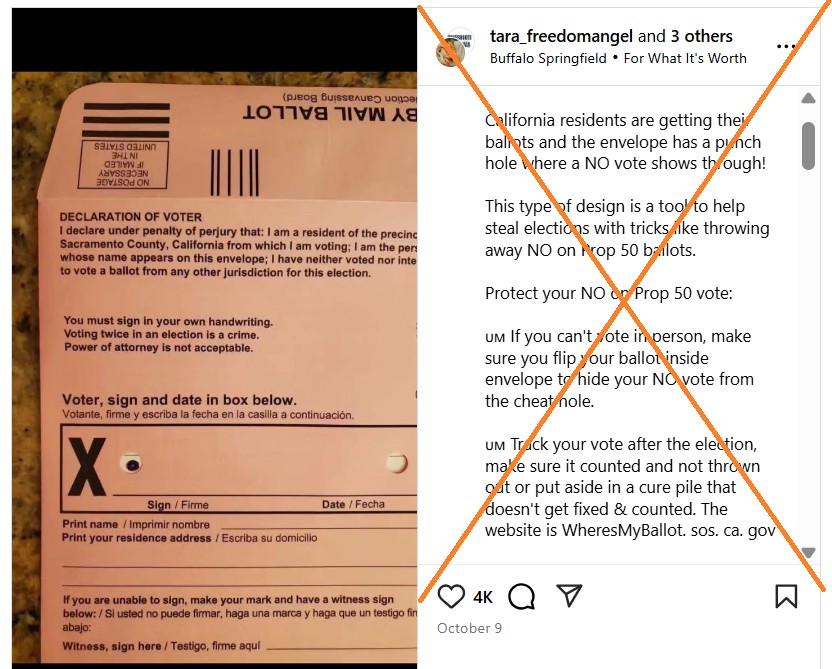
“California residents are getting their ballots and the envelope has a punch hole where a NO vote shows through!” claimed an October 9 Instagram post that gained significant traction. “This type of design is a tool to help steal elections with tricks like throwing away NO on Prop 50 ballots.”
The posts show envelopes for mail ballots sent to Sacramento County residents with small holes punched through them. Steve Hilton, a former Fox News contributor and Republican gubernatorial candidate, even called for the election to be “suspended until all ballot irregularities are fixed.”
These claims have spread rapidly across social media platforms as the November 4 special election approaches, with more than $140 million invested in the battle over Proposition 50, also known as the Election Rigging Response Act.
However, election officials have quickly moved to debunk these allegations. The California Office of the Secretary of State told AFP: “There is no need for any concern.” According to officials, the envelope holes serve as an accessibility feature for visually impaired voters, helping them locate where to sign.
Sacramento County, which has been specifically highlighted in many of these social media posts, responded on its website that “there is no way to determine how a voter voted through this small hole.” The county clarified that there are “at least eight ways to insert a ballot card into the return envelope, and only two of these might result in a bubble being visible through the hole.” They also released a video demonstrating proper ballot return procedures.
Importantly, these envelope holes are not new to the 2025 special election. Sacramento County confirmed they have been using this design since 2008, and similar claims were debunked during Governor Gavin Newsom’s 2021 recall election.
The nonprofit Center for Civic Design, which develops templates for vote-by-mail envelopes, specifically recommends these holes “as a signature guide helping blind voters complete the form independently.” Whitney Quesenbery, the center’s chief program officer, told AFP: “We always recommend this.”
The organization has worked with counties in California and numerous other states to design materials that comply with the Help America Vote Act, ensuring all voters can participate independently and privately. Similar envelope designs with holes are used in Oregon, Washington state, and Pennsylvania, which requires counties to hole-punch return envelopes provided to blind and low-vision voters.
Quesenbery pointed out another practical benefit of the holes: helping election workers ensure all ballots are counted. “When you have a stack of envelopes that have been opened and the ballots taken out, and you’re about to store those envelopes, you can see through the hole that you haven’t left any ballots behind.” Election officials often string zip ties through these holes to secure empty envelopes, a practice documented in AFP photos from Washington and Utah in 2020.
The high-stakes nature of Proposition 50 adds context to the controversy. Governor Newsom introduced the measure to allow California to create temporary congressional districts for the next two elections before returning this power to an independent commission. Democrats argue this counters efforts by Republicans in Texas, where Governor Greg Abbott, acting at President Trump’s behest, redrew electoral districts to benefit his party—a process known as gerrymandering.
This redistricting battle has significant implications for the 2026 midterm elections, which will determine whether Republicans maintain control of the U.S. Senate and House of Representatives.
As election day approaches, officials continue to emphasize that the ballot envelope design is a standard accessibility feature rather than evidence of potential fraud, urging voters to focus on the substantive issues at stake rather than unfounded conspiracy theories.
Fact Checker
Verify the accuracy of this article using The Disinformation Commission analysis and real-time sources.

7 Comments
This is a sensitive topic, and I can understand the desire for secure and tamper-proof elections. However, any claims of irregularities should be supported by concrete evidence to avoid fueling misinformation.
Proposition 50 seems to be a divisive issue, and the ballot design concerns only add to the controversy. It’s crucial that the electoral process remains fair and transparent for all voters.
Absolutely. Maintaining the integrity of elections should be the top priority, regardless of one’s political leanings. Voters need to feel confident that their voices are being heard.
Interesting to see the controversy around the mail ballot envelopes in California. While transparency is important, any potential tampering concerns should be thoroughly investigated to ensure the integrity of the electoral process.
While the envelope design may seem questionable, it’s important to rely on authoritative sources and official election information rather than unsubstantiated claims on social media. Voters should stay informed but also vigilant against misinformation.
The exposure of ‘no’ votes through the envelope design is concerning and warrants close scrutiny. Voters deserve confidence that their ballots will be securely handled, regardless of their position on the proposition.
Agreed. Election officials should address this issue promptly and transparently to maintain public trust. Voters need assurance that their votes will be counted accurately.