


Listen to the article
California Voting Officials Dismiss Ballot Envelope Conspiracy Claims
Californians are casting votes in a special election on Proposition 50, but misleading claims about mail ballot return envelopes have fueled unfounded fraud allegations across social media. Election officials and experts have quickly debunked these concerns, explaining that the envelope design features are longstanding accessibility measures, not evidence of election tampering.
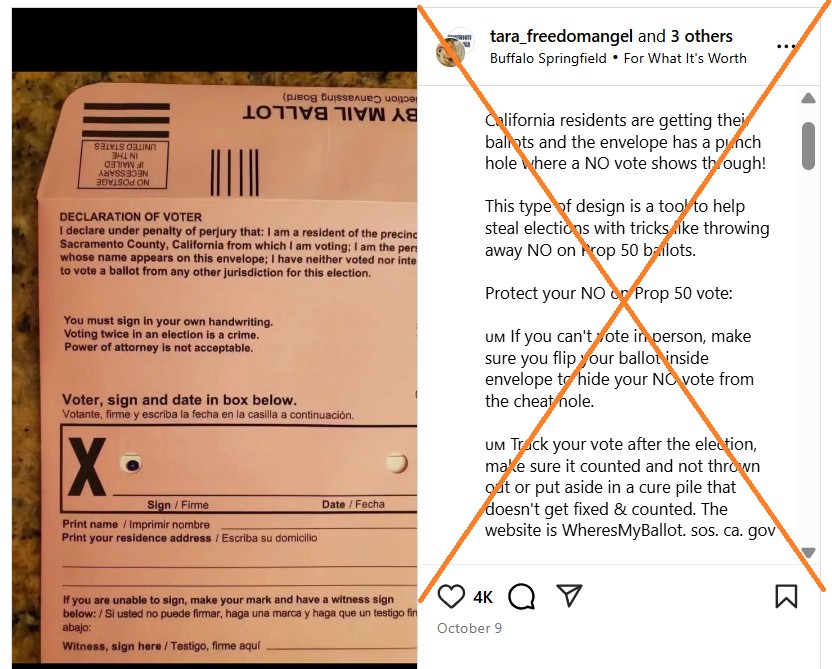
The controversy centers around holes punched in ballot return envelopes that some voters claim were deliberately placed to reveal “no” votes on Prop 50, potentially allowing election workers to identify and discard ballots opposing the measure.
“This type of design is a tool to help steal elections with tricks like throwing away NO on Prop 50 ballots,” claimed one widely-shared Instagram post showing an envelope from Sacramento County.
Steve Hilton, a former Fox News contributor and Republican candidate for California governor, even called for the election to be “suspended until all ballot irregularities are fixed.”
The California Secretary of State’s office firmly rejected these claims, stating: “There is no need for any concern.” Officials explained that the envelope design serves as an accessibility feature for sight-impaired voters, who use the holes as guides for signature placement. The office noted that ballot envelope design falls under county jurisdiction, not state oversight.
Sacramento County, which features prominently in many viral posts, responded directly to the controversy on its website, emphasizing that “there is no way to determine how a voter voted through this small hole.” The county also clarified that the punched holes have been a standard feature on ballot envelopes since 2008, long predating the current election.
“There are at least eight ways to insert a ballot card into the return envelope, and only two of these might result in a bubble being visible through the hole,” the county explained, also releasing an instructional video demonstrating proper mail ballot handling.
Proposition 50, formally known as the Election Rigging Response Act, would temporarily change California’s congressional district maps ahead of the 2026 midterms. The high-stakes measure has generated over $140 million in campaign spending.
California Governor Gavin Newsom proposed the measure to allow the state to create temporary congressional districts for the next two elections, with redistricting authority returning to an independent commission afterward. Democrats argue this counterbalances redistricting efforts in Republican-controlled Texas, where Governor Greg Abbott redrew electoral boundaries at former President Donald Trump’s urging.
Whitney Quesenbery, chief program officer for the nonprofit Center for Civic Design, confirmed to AFP that her organization specifically recommends holes in ballot envelopes as accessibility features. “We always recommend this,” she said, noting that such designs help states comply with the Help America Vote Act by enabling all voters to cast ballots independently and privately.
California isn’t unique in implementing this envelope design. Similar features exist in Oregon, Washington, and Pennsylvania, where some counties are required to hole-punch return envelopes for blind and low-vision voters.
Quesenbery highlighted another practical benefit of the envelope holes: “When you have a stack of envelopes that have been opened and the ballots taken out, and you’re about to store those envelopes, you can see through the hole that you haven’t left any ballots behind.”
Election workers in multiple states have been photographed threading zip ties through these holes in stacks of empty envelopes—a standard practice to ensure ballot processing is complete and accurate.
These latest ballot design conspiracy theories echo similar unfounded claims debunked by fact-checkers during California’s 2021 gubernatorial recall election, demonstrating how routine election administration features can be misrepresented to sow doubt in electoral processes.
Fact Checker
Verify the accuracy of this article using The Disinformation Commission analysis and real-time sources.

14 Comments
It’s worrying to see attempts to sow doubt about mail-in voting through unsubstantiated fraud allegations. Good on California election officials for firmly rejecting these conspiracy theories and reaffirming the integrity of the process.
Ballot return envelope features are meant to assist voters, not enable fraud. Kudos to California officials for quickly addressing these misleading claims and providing clarity on the purpose of these longstanding accessibility measures.
It’s concerning to see attempts to undermine faith in mail-in voting through misinformation. Kudos to California election officials for quickly debunking these unfounded fraud allegations and providing clarity.
Ballot return envelope design is meant to assist voters, not enable fraud. Good on California authorities for firmly rejecting these unsubstantiated claims and providing clarity on the longstanding purpose of these accessibility measures.
Interesting to see misinformation campaigns targeting mail ballot accessibility features. Sounds like election officials are quickly debunking these unfounded fraud claims. It’s important to rely on authoritative sources when it comes to election integrity.
Misinformation campaigns targeting mail ballot features are concerning. Props to California officials for swiftly debunking these conspiracy theories and reaffirming the integrity of the voting process.
Ballot envelope design for accessibility is a longstanding practice, not evidence of election tampering. Good to see election officials firmly rejecting these conspiracy theories and providing clear explanations.
Agreed, maintaining voter trust is crucial. Dismissing these kinds of unsubstantiated fraud claims helps uphold the integrity of the democratic process.
Ballot envelope design should facilitate accessibility, not fuel misinformation. Glad to see California authorities promptly addressing these unfounded claims and providing clear explanations on the purpose of these longstanding practices.
Absolutely, maintaining public trust in elections is critical. Dismissing unsupported fraud allegations helps uphold the democratic process.
Ballot return envelope features are meant to help voters, not enable fraud. Glad to see California officials swiftly addressing these misleading social media claims. Reliable information from authoritative sources is key during elections.
Misinformation campaigns targeting mail ballot features are troubling. Glad to see California officials swiftly addressing these concerns and reaffirming the longstanding purpose of these accessibility measures.
Exactly, maintaining voter trust is crucial. Dismissing unfounded fraud claims helps uphold the integrity of elections.
Ballot envelope design should facilitate accessibility, not fuel conspiracy theories. Good to see election officials firmly rejecting these unsubstantiated claims and reaffirming the integrity of the voting process.