


Listen to the article
In a groundbreaking approach to combating climate misinformation, researcher John Cook has spent over 15 years developing innovative tools to help people identify and resist false climate claims. His work, rooted in inoculation theory, has evolved from academic research to practical applications that reach diverse audiences worldwide.
“Inoculation theory is about building resilience against misinformation by exposing people to weakened forms of misleading content,” explains Cook, a research fellow at Monash University’s Climate Change Communication Research Hub. This approach helps individuals recognize the rhetorical techniques commonly used to spread climate falsehoods before they encounter them in real-world settings.
Cook’s strategy draws on his pre-academic career as a cartoonist, incorporating humor and visual elements to make complex concepts more engaging. This unique combination of scientific rigor and creative communication has proven particularly effective in reaching audiences who might otherwise tune out technical explanations.
“Explaining the many techniques used to mislead presents a significant communication challenge because there are just so many of them,” Cook notes. His solution has been to treat science communication as a team sport, collaborating with specialists from other fields to amplify his research impact.
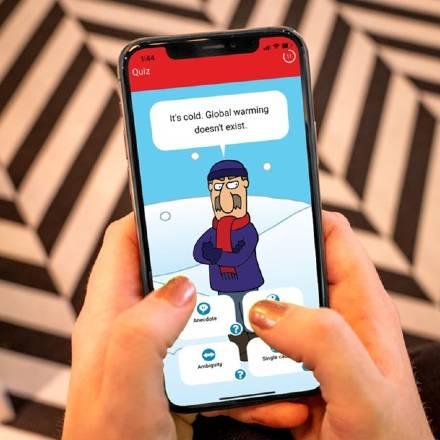
One such partnership emerged from a chance meeting with developers from creative agency Goodbeast at a misinformation conference. This collaboration led to the development of “Cranky Uncle,” a smartphone game designed to teach critical thinking skills through interactive play.
The game, which launched in December 2020 after a successful crowdfunding campaign, leverages gamification principles to transform the mentally demanding task of critical analysis into an engaging activity. Players earn points by identifying misleading techniques in examples of climate misinformation, gradually building their cognitive resilience through repeated practice.
“Our brains are hard-wired for fast, instinctive reactions rather than slow, critical thinking tasks,” Cook explains. “Games incentivize players to practice tasks repeatedly, making difficult mental processes become quicker and easier over time.”
While the game initially attracted climate-engaged individuals already familiar with Cook’s work, its real breakthrough came when adapted for educational settings. In January 2021, Cook published a Teachers’ Guide and updated the platform to allow educators to create group codes for their students.
The response from classrooms across the United States was immediate and enthusiastic. “Teachers were crying out for engaging educational resources that taught critical thinking,” Cook says. The game’s adoption has crossed disciplinary boundaries, appearing in math, English, history, geography, psychology, philosophy, and media studies classrooms—far beyond the science classes Cook initially envisioned.
This widespread educational uptake reflects the universal nature of the critical thinking skills the game develops. The techniques of misinformation identified in climate denial apply equally to falsehoods in other domains, making the game relevant to virtually any subject area.
Building on this success, Cook and his team are now preparing to launch a multilingual version of the game translated into more than a dozen languages. Additionally, they have partnered with UNICEF to expand the game’s content to address vaccination misinformation, with the goal of reducing vaccine hesitancy across Africa, Asia, and South America.
“Addressing complex, ubiquitous societal problems like misinformation requires ambitious, interdisciplinary solutions,” Cook emphasizes. His journey from academic researcher to educational innovator demonstrates how collaborative partnerships can transform theoretical insights into practical tools that reach audiences conventional academic channels might never engage.
The success of the Cranky Uncle game illustrates a broader principle in science communication: effective public engagement often requires scientists to venture beyond traditional academic approaches, partnering with communicators who possess complementary skills and access to different audiences. By combining rigorous research with creative delivery mechanisms, Cook’s work offers a promising model for addressing the growing challenge of misinformation in public discourse.
Fact Checker
Verify the accuracy of this article using The Disinformation Commission analysis and real-time sources.

11 Comments
This is a fascinating approach to combating misinformation. Exposing people to ‘weakened forms’ of misleading content to build their resilience is a clever and innovative strategy. I’m curious to learn more about the specific techniques used in the cartoon game.
I appreciate how this research combines scientific rigor with creative communication to make complex concepts more engaging. Reaching diverse audiences is crucial in the fight against misinformation, and this project seems well-designed to achieve that goal.
Agreed. Utilizing humor and visual elements to explain rhetorical techniques used to spread falsehoods is a smart way to make the information more accessible and memorable.
Building resilience against misinformation is so important, and this project’s focus on practical applications is really encouraging. I’d be interested to learn more about the specific target audiences and how the game is being tailored to reach them effectively.
As someone who is concerned about the spread of climate misinformation, I’m really intrigued by this approach. Exposing people to ‘weakened forms’ of misleading content in an engaging, visual format could be a powerful way to help them recognize and resist such tactics. I’ll be following this research with great interest.
This is a really intriguing concept. Using a cartoon game to expose people to ‘weakened forms’ of misleading content in order to build their resilience is a clever and novel approach. I’m curious to see how it performs in real-world settings.
Agreed. Explaining the rhetorical techniques used to spread misinformation through an engaging, visual medium could be a highly effective way to help people recognize and resist such tactics.
Misinformation is a serious challenge, especially when it comes to critical issues like climate change. This cartoon game sounds like a promising tool to help people develop the skills to identify and resist false claims. I’m curious to see the results of the research.
Combating misinformation is such an important and challenging task, so I’m glad to see researchers exploring innovative approaches like this. The use of humor and visuals to make complex concepts more accessible is a smart strategy that could have a real impact.
This is a really fascinating project. I’m impressed by the way it combines scientific rigor with creative communication to address the complex challenge of misinformation. I’m curious to learn more about the specific game mechanics and how they’re designed to build resilience.
As someone who is concerned about the spread of misinformation, I’m glad to see this kind of innovative approach being developed. The combination of scientific rigor and creative communication is a unique and promising strategy. I look forward to seeing how this project evolves.