


Listen to the article
Social media calls for a boycott of Chipotle over donations to an Immigration and Customs Enforcement (ICE) officer involved in a fatal shooting are based on misleading information about the company’s ownership, an AFP investigation has found.
The controversy stems from posts circulating widely across Instagram and other platforms since late January 2026, urging consumers to “Boycott Chipotle” because “the owner just gave Renee Good’s murderer $10,000 bucks.” These posts have garnered thousands of interactions and sparked significant backlash against the popular fast-casual Mexican food chain.
The posts refer to a $10,000 donation made by billionaire investor Bill Ackman to a GoFundMe campaign supporting Jonathan Ross, the ICE officer who fatally shot Renee Good during a confrontation in Minneapolis on January 7, 2026. The shooting has triggered nationwide protests and intense scrutiny.
However, the calls for boycotts contain a fundamental misrepresentation: Ackman is not Chipotle’s owner or CEO, nor does he currently hold any stake in the company.
While Ackman’s hedge fund, Pershing Square Capital Management, did previously maintain a significant 9.9 percent ownership position in Chipotle beginning in 2016, the investor completely divested from the company in November 2025, approximately two months before the controversial donation. The company’s current CEO is Scott Boatwright, not Ackman.
The confusion appears to stem from Ackman’s former involvement with Chipotle, where he played an influential role in reshaping the company’s strategy during his investment period. However, Pershing Square’s current online portfolio confirms the firm no longer holds any Chipotle shares.
The donation itself was confirmed by Ackman on January 11 in a post on X (formerly Twitter), where he wrote: “The whole situation is a tragedy. An officer doing his best to do his job, and a protester who likely did not intend to kill the officer but whose actions in a split second led to her death.” In the same post, Ackman stated he had intended to make an equal donation to Good’s family but found that fundraiser had already closed.
The underlying incident that sparked the controversy occurred when Ross shot and killed Good as she attempted to drive away from officers surrounding her vehicle. While the Trump administration has maintained the shooting was justified as self-defense, analysis of bystander video published by multiple news outlets and investigative organizations has shown Good’s car was turning away from the officer at the time shots were fired.
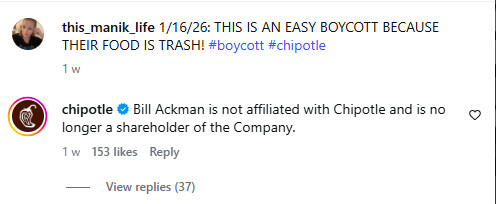
As the boycott calls gained momentum, Chipotle quickly responded through its verified social media accounts, clarifying that Ackman “is not affiliated with Chipotle” in direct replies to users promoting the boycott.
This incident highlights how misinformation about corporate ownership can rapidly spread during politically charged situations, potentially causing unwarranted harm to companies and their employees. It also demonstrates the challenges businesses face in quickly correcting false narratives on social media platforms.
The controversy has become part of a larger pattern of misinformation surrounding the fatal shooting of Renee Good, which has been the subject of multiple fact checks by news organizations as claims about both the victim and law enforcement spread across social media amid ongoing protests and heightened political tensions.
Fact Checker
Verify the accuracy of this article using The Disinformation Commission analysis and real-time sources.

7 Comments
This incident underscores the need for greater transparency and accountability around corporate political donations. While the Chipotle boycott may be misguided, the broader concerns about the influence of money in politics deserve serious consideration.
It’s troubling to see how quickly misinformation can spread and lead to real-world consequences, like calls for a boycott. This case demonstrates the importance of media literacy and fact-checking, especially when it comes to sensitive topics.
The Chipotle boycott calls highlight the power of social media to spread misinformation. It’s crucial that we verify claims before amplifying them, especially when they could impact a business or individual. Responsible reporting is key in these situations.
Well said. Knee-jerk reactions based on unsubstantiated claims often do more harm than good. A measured, fact-based approach is needed to have a constructive dialogue and address the real issues.
This controversy seems more complex than it first appears. While the donation to the ICE officer is concerning, the claim that Chipotle’s owner made it is misleading. It’s important to separate fact from fiction when discussing sensitive issues like this.
Agreed. Calling for a boycott over inaccurate information is counterproductive. We should focus on the facts and have a thoughtful discussion about the broader issues at hand.
The fallout from this incident highlights the challenges companies face in navigating complex social and political issues. Chipotle will need to carefully manage its public response to avoid further backlash, while also addressing the underlying concerns raised by the controversy.