


Listen to the article
The case of a missing Australian child has become a troubling example of how artificial intelligence can distort reality and hamper legitimate search efforts, as fake images spread rapidly across social media platforms.
Police in South Australia have recently scaled back their search for four-year-old Gus Lamont, who disappeared on September 27, shifting to what they now describe as a “recovery operation.” Authorities have stated there is “little hope for us to find Gus alive” as the extensive search enters its second week.
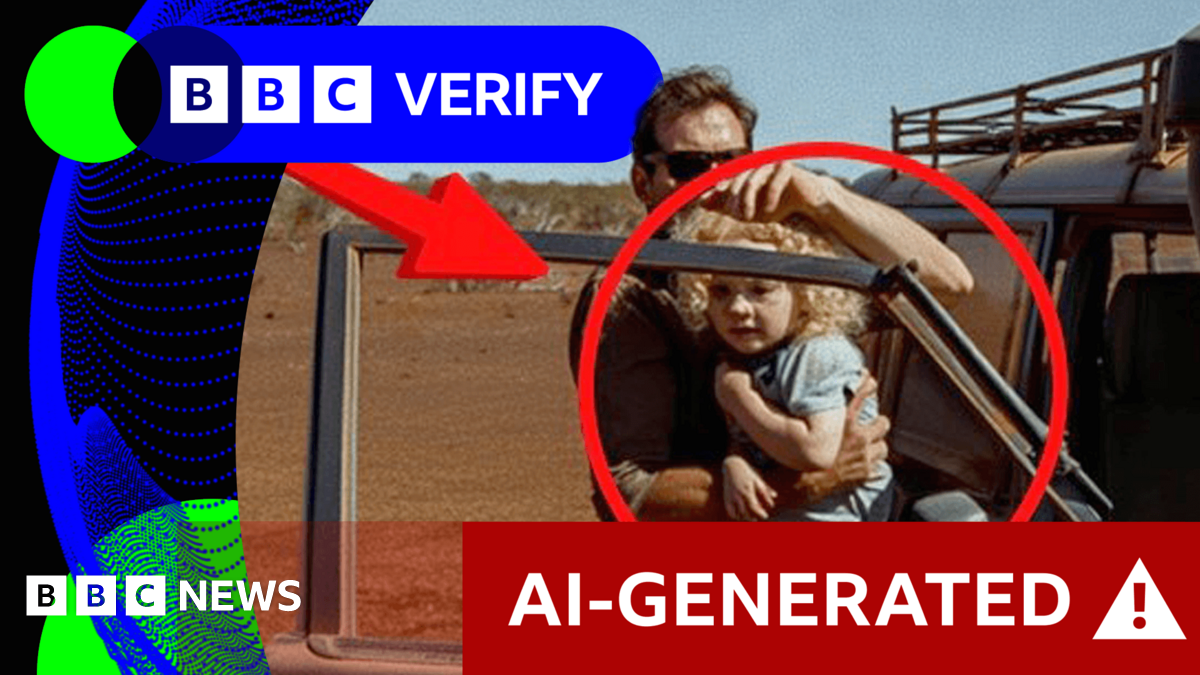
As the search intensified, misleading AI-generated images began circulating widely on social media, complicating an already sensitive situation. One particularly concerning fabricated image showed a man supposedly carrying “Gus” into a car with the provocative caption: “Is this a kidnapping case?” BBC Verify has confirmed this image is entirely artificial.
South Australia Police have been forced to address the spread of misinformation, urging the public to exercise caution when encountering information online. “Police urge caution when using artificial intelligence in internet searches and recommend cross-referencing the information with trusted sources,” a police statement noted, highlighting growing concerns about AI’s role in muddying crucial public safety communications.
The fabricated imagery has gained significant traction despite being clearly artificial to trained observers. A Facebook account named “Celebrity Today” shared one such image to its 815,000 followers, garnering approximately 5,000 reactions and more than 2,500 shares—demonstrating how rapidly such content can spread regardless of authenticity.
When BBC Verify consulted Michael Wooldridge, professor of artificial intelligence at Oxford University, about these images, he immediately identified telltale signs of AI generation. The professor pointed to anatomical impossibilities: in one fake image, a man’s forefinger appears unnaturally elongated, while in another, a woman holding a picture of Gus has only three fingers on her left hand—physical impossibilities that reveal the images’ artificial nature.
The Facebook account responsible for spreading these images employs a particularly deceptive tactic, mixing legitimate photographs with AI-generated content. This blending of real and fake material makes it increasingly difficult for casual viewers to distinguish between authentic news and fabricated scenarios.
This case represents a growing trend of AI-generated misinformation affecting high-profile incidents. As artificial intelligence technology becomes more accessible and its outputs more convincing, the potential for misuse during critical situations like missing person cases presents serious challenges for law enforcement, media organizations, and the public.
Digital literacy experts have long warned about this exact scenario—where emotionally charged situations become magnets for misinformation, particularly when the content plays into existing fears or narratives. Missing children cases are especially vulnerable to such exploitation due to the high public interest and emotional investment they generate.
For families like the Lamonts, this additional layer of misinformation adds unnecessary pain to an already traumatic situation. It also potentially diverts police resources toward addressing false leads and managing public perceptions rather than focusing solely on investigative work.
Social media platforms continue to grapple with effective policies for identifying and labeling AI-generated content. While some have implemented measures requiring disclosure of synthetic media, enforcement remains inconsistent across different platforms and contexts.
As the search for Gus Lamont continues, authorities emphasize the importance of relying on official channels and verified news sources for accurate information about the case. The spread of these fabricated images serves as a stark reminder of the evolving challenges facing both the public and authorities in an era where digital imagery can no longer be taken at face value.
Fact Checker
Verify the accuracy of this article using The Disinformation Commission analysis and real-time sources.

13 Comments
The spread of AI-generated misinformation in this case is incredibly concerning. It’s crucial that the public remains vigilant and verifies information from trusted sources, rather than blindly accepting content that may be fabricated. My heart goes out to Gus’s family and the authorities working tirelessly to find him.
Absolutely. The police are right to urge caution, as false information can easily distract from the real search efforts and lead people down the wrong path. I hope the authorities are able to get a handle on the misinformation and focus on finding Gus.
It’s deeply troubling to see how AI can be used to create and spread false information, especially in a sensitive case like this. The police are right to warn the public about the dangers of relying on unverified online content. I hope the authorities are able to get a handle on the misinformation and focus on finding Gus safe and sound.
Agreed. The spread of AI-generated misinformation is a serious problem that can have real-world consequences. I hope the authorities are able to find Gus and that his family can find some closure, despite the challenges posed by the false information.
The spread of AI-generated misinformation in this case is deeply troubling. It’s a stark reminder of the potential for this technology to be misused and the importance of verifying information from trusted sources. I hope the authorities are able to get a handle on the false content and focus on the search for Gus. My heart goes out to his family during this incredibly difficult time.
Absolutely. The police are right to urge caution, as false information can easily distract from the real search efforts and lead people down the wrong path. I hope the authorities are able to find Gus and bring him home safely.
This is a heartbreaking case, and the use of AI to spread misinformation is truly concerning. While the technology has many beneficial applications, it’s clear that there need to be stronger safeguards in place to prevent it from being exploited in ways that can hinder legitimate search efforts and investigations. My thoughts are with Gus’s family and the authorities working to find him.
This is a tragic case, and I hope the authorities can find Gus safe and bring him home soon. The spread of AI-generated misinformation is really concerning and can hinder legitimate search efforts. It’s crucial for the public to be cautious about information online and verify it with trusted sources.
Agreed, the police are right to urge caution with AI-generated content. Spreading unverified information, even if well-intentioned, can do more harm than good in sensitive situations like this.
This is a harrowing situation, and the spread of AI-generated misinformation is only making it more difficult for the authorities to do their job. While the technology has many positive uses, it’s clear that more needs to be done to prevent it from being exploited in ways that can hinder real-world investigations and search efforts. My thoughts are with Gus’s family during this incredibly difficult time.
This is a sobering example of how AI can be misused to create and spread false information. While the technology has many beneficial applications, it’s clear that we need robust safeguards to prevent it from being weaponized in ways that interfere with real-world events and investigations. I hope the authorities are able to bring Gus home safely.
The use of AI in this case is deeply troubling. While the technology can be powerful, it can also be exploited to create false narratives that mislead and distract from the real search efforts. I hope the authorities are able to get the misinformation under control and focus on finding Gus.
It’s a shame to see AI being used to spread misinformation and hinder legitimate investigations. The police are right to warn the public about relying on unverified online content, especially in such a sensitive case.