


Listen to the article
US Hindu Groups Rally Against Bangladesh Violence Ahead of Elections
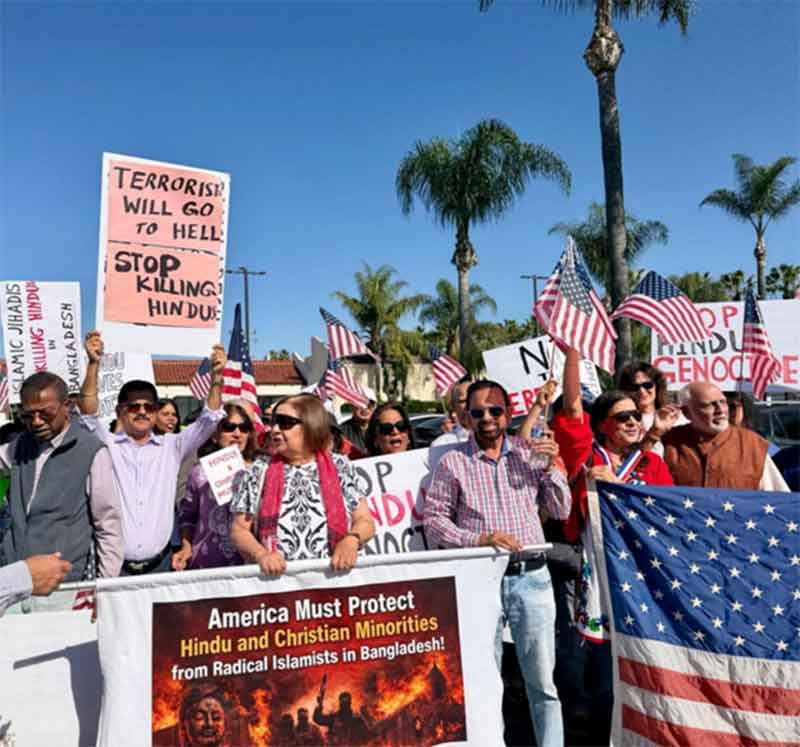
Demonstrators gathered across the United States on Saturday in coordinated, peaceful rallies to raise awareness about alleged violence against Hindu and other minority communities in Bangladesh. The events, held in more than 22 cities, were timed ahead of Bangladesh’s upcoming national elections, with one of the largest turnouts occurring in Artesia, where hundreds assembled demanding protection for Hindu minorities.
The protests come amid heightened tensions between India and Bangladesh following the collapse of Sheikh Hasina’s government in August 2024. The interim government led by Muhammad Yunus has faced criticism for allegedly failing to protect minority communities, particularly Hindus, amid reports of violence against these groups.
The relationship between the two neighboring countries has deteriorated to its lowest point since Hasina’s fall. India has allowed the former prime minister, who fled to India after being ousted, to remain in the country despite an extradition treaty signed during her own regime.
In a controversial move that further strained relations, Hasina delivered her first public speech since leaving office at a press club in Delhi on January 23. During her address, she described Yunus as a “corrupt, power-hungry traitor” and called on Bangladeshis “to overthrow the foreign-serving puppet regime of this national enemy at any cost.”
The Bangladesh government responded with a strongly worded statement expressing shock that India would allow “mass murderer Hasina” to deliver what they called a “hate speech,” warning it could “seriously impair bilateral relations.”
Hasina’s claims about persecution of religious minorities contrast sharply with the Bangladesh government’s recent report, which analyzed police records from January to December 2025. According to these findings, of 645 documented incidents involving minority communities, only 71 had communal elements, while 574 were assessed as non-communal in nature, stemming from criminal activity unrelated to religion, such as land disputes or personal conflicts.
“The Bangladesh government has suggested that the issue has been politicized internationally, particularly by the Indian media and officials, since the fall of Hasina’s government,” reported Al Jazeera on February 1, 2026.
Critics note that Hasina’s own record on democracy was problematic. During her 15-year rule, she was accused of repeatedly rigging elections and imprisoning political rivals, including Begum Khaleda Zia of the Bangladesh Nationalist Party (BNP), who spent over six years in detention. In several elections under Hasina’s rule, the opposition boycotted the polls amid allegations of manipulation and violence.
The BNP, founded by Zia ur Rehman, represents another strand of Bangladesh’s independence movement. Rehman was the military leader who announced the Declaration of Independence in March 1971, before being assassinated in 1981, after which his widow Khaleda Zia took over the party leadership.
Despite India’s current sheltering of Hasina, Foreign Minister S. Jaishankar met with BNP Chairperson Tarique Rahman in Dhaka in December 2025 during the funeral of former Prime Minister Begum Khaleda Zia. This diplomatic engagement suggests India is seeking to reset bilateral relations once Bangladesh returns to an elected government after the February 12 elections.
India maintains significant economic interests in Bangladesh, including various infrastructure projects, and has expressed concerns about the potential rise of Islamist groups such as Jamaat-e-Islami, which is now leading a coalition of ten parties in the upcoming elections.
The protests in the United States appear to be influenced by what some observers call “Hindutva lobbies” – referring to Hindu nationalist groups with connections to India’s ruling party. Critics suggest these demonstrations are part of a broader misinformation campaign aimed at influencing not only Bangladesh’s politics but also upcoming elections in the Indian state of West Bengal, where Hindu-Muslim tensions can be a polarizing electoral issue.
As Bangladesh approaches its election on February 12, international observers continue to monitor developments closely, with India’s role and influence remaining a significant factor in the country’s political landscape.
Fact Checker
Verify the accuracy of this article using The Disinformation Commission analysis and real-time sources.

12 Comments
The political turmoil in Bangladesh is certainly concerning. I hope the upcoming elections can be held in a peaceful and transparent manner, with all parties respecting the will of the Bangladeshi people.
Agreed. Free and fair elections are crucial for any democracy. Let’s hope the international community can play a constructive role in ensuring a stable political transition in Bangladesh.
This is a complex issue with a lot of historical context. I appreciate the factual background provided, but would encourage readers to seek out additional sources to form a well-rounded understanding of the situation in Bangladesh.
Absolutely. Consulting a variety of credible news outlets and expert analyses is important when dealing with sensitive political and social issues like this. Staying informed and vigilant is key.
This background on the Bangladesh elections is helpful, but I’d be interested to know more about the specific allegations of violence against minority groups. Have there been credible reports from independent sources? Transparency and accountability are key.
That’s a good question. Verifying claims of violence and human rights abuses should be a priority for journalists covering this story. Relying on multiple reliable sources is important to paint an accurate picture.
This is a complex and sensitive situation. It’s important to get accurate information and avoid spreading unverified claims, especially around topics like religious or ethnic tensions. Objective and fact-based reporting is crucial.
Good point. Maintaining impartiality and relying on credible sources is essential when covering issues like this. Emotions can run high, but balanced journalism is needed to shed light on the situation.
Interesting background on the Bangladesh elections. It’s concerning to hear about allegations of violence against minority groups. I hope the interim government can improve security and protect all citizens equally, regardless of religion or ethnicity.
Agreed, protecting minority rights should be a top priority. The relationship between Bangladesh and India also seems quite tense – hopefully they can work to improve diplomatic ties.
The political tensions between Bangladesh and India are concerning, especially given the potential impact on minority communities. I hope both governments can work to de-escalate the situation and find constructive solutions.
Agreed. Diplomatic cooperation and respect for human rights should be the top priorities. Avoiding further inflaming ethnic or religious tensions will be crucial for stability in the region.