


Listen to the article
Visualizing Fake News: Northeastern Professor Turns Data into Immersive Art
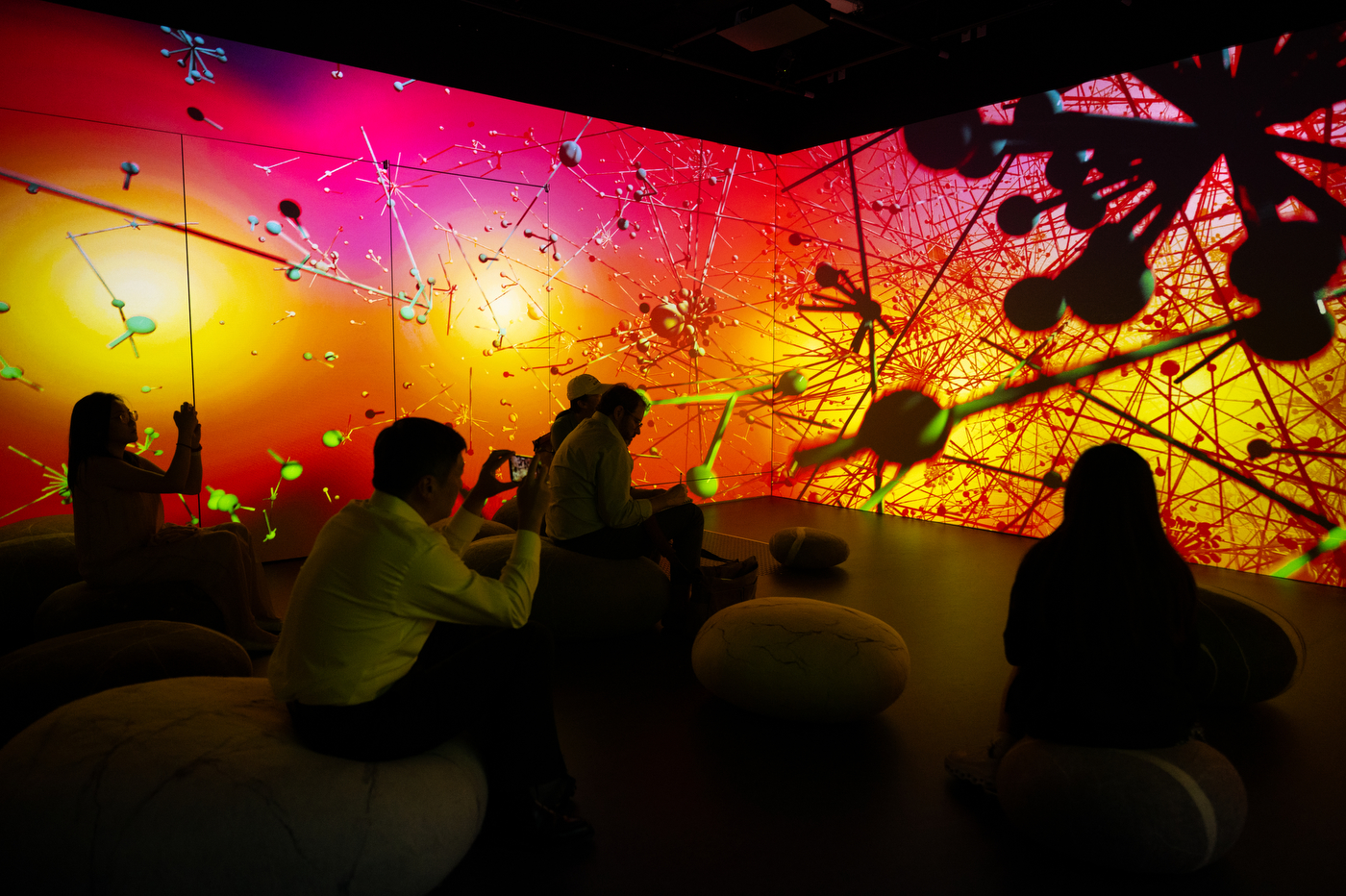
When most people think of fake news, they envision social media posts or suspicious websites. But in the hands of Northeastern University professor Albert-László Barabási and his research team, misinformation becomes a multisensory art experience where colorful spheres bubble across darkened walls while unintelligible whispers grow increasingly unsettling.
“It’s an animation of how conveyors of fake news are actually sending their messages out, and how they are effectively infecting the social network behind Twitter with their messaging,” explains Barabási, the Robert Gray Dodge professor of network science and distinguished university professor of physics at Northeastern. “Art and the language and the medium of art offer us a way to engage with this data in a way that is different from what we normally do.”
This month, Barabási’s lab displayed four pieces at Harvard’s CAMLab in Cambridge as part of a collaborative exhibition. The show also featured work by Kim Albrecht, a former student of Barabási who now teaches information design at a university in Germany.
The immersive experience transformed complex data into sensory encounters. Visitors sat on deceptively soft boulder-shaped pillows in a darkened room as animations played sequentially on the surrounding walls, visualizing how information networks form and evolve.
Three of the installations visualized fundamental network concepts: the Barabási-Albert network model from 1999 showing how virtual networks grow over time; physical networks such as neural connections; and how these networks develop “detours” as spaces become crowded or “hot,” rather than connecting in straight lines.
The final and most provocative piece visualized the spread of COVID-19 misinformation on Twitter (now X) during 2020. This culminating work revealed the disturbing efficiency with which false information can travel through social networks.
“We focused on COVID-19 because the project travels across boundaries, like the virus itself,” Barabási explained. “If you do something on political fake news, that’s not interpretable in Europe, for instance.”
The research identified 12 individuals responsible for the majority of COVID misinformation tweets. “We call them the COVID Apostles because there happened to be exactly 12 of them,” said Barabási, noting with irony that “One of them is our health secretary.”
What sets this exhibition apart is its commitment to conveying not just visual data but emotional experiences. Moving from a previous virtual reality format to a fully immersive installation allowed the team to capture the discomfort associated with the pandemic.
“COVID is a very uncomfortable experience,” Barabási noted.
To recreate this discomfort, the installation incorporated camera shakes that made the room seem to move, disorienting whispers that forced viewers to strain to understand, and the maddening sound of dripping water—all designed to mirror the anxiety and uncertainty of the pandemic period.
“The data is suggesting those feelings, and the question is how do you use this visual language to express that,” Barabási said. “Always the question is, how do you use these mediums to be in line with the content?”
The exhibit represents a growing movement at the intersection of data science and artistic expression. While scientists typically present findings through charts and graphs in academic journals, this approach brings research into public spaces where it can engage audiences on multiple sensory levels.
For Barabási, whose pioneering work on network theory has influenced fields from biology to social media analysis, the art exhibit represents an innovative approach to science communication. By transforming abstract data into immersive experiences, his team makes complex research findings accessible to broader audiences.
The exhibition also raises important questions about misinformation in the digital age. As social networks continue to serve as primary information sources for millions, understanding how false information spreads—and visualizing those patterns—becomes increasingly vital to media literacy efforts.
The collaboration between Northeastern’s Center for Complex Network Research and Harvard’s CAMLab highlights the value of interdisciplinary approaches to addressing contemporary challenges like misinformation, blending rigorous data analysis with creative visualization techniques.
As visitors exited the darkened exhibition space, they carried with them not just a intellectual understanding of how fake news spreads, but a visceral experience of its disorienting effects—perhaps the most powerful way to comprehend the real-world impact of digital misinformation.
Fact Checker
Verify the accuracy of this article using The Disinformation Commission analysis and real-time sources.

15 Comments
Turning data on COVID-19 misinformation into an immersive art experience is a unique and thought-provoking approach. Kudos to the Northeastern team for this innovative project.
I’m interested to see how the public responds to this exhibit. Raising awareness through art can be a powerful way to address complex societal issues.
The use of immersive, multisensory art to address the serious issue of COVID-19 misinformation is a creative and engaging approach. Kudos to the team behind this exhibit.
I’m curious to learn more about the specific data visualization techniques employed. Translating complex information into an artistic medium must have been a challenge.
Interesting how art can visualize the spread of misinformation on social media. Raises awareness of this important issue in an engaging way.
Agree, using art and multimedia to convey complex data is an effective way to communicate with the public.
Visualizing the mechanics behind the dissemination of misinformation online is a thought-provoking concept. This art exhibit seems like an impactful way to educate the public.
Kudos to the Northeastern professor and his team for finding an innovative way to address the spread of fake news. Art and science can work together to make an impact.
I agree, blending data analysis with artistic expression is an intriguing approach. It will be interesting to see how this exhibit is received.
Bravo to the researchers for finding an engaging way to highlight the dangers of online misinformation. Transforming data into art is a creative and impactful approach.
This art exhibit seems like an effective way to educate people about the spread of COVID-19 misinformation on social media. Visualizing complex data in an immersive setting is a clever idea.
I’m curious to learn more about the specific techniques used to translate the data into an artistic medium. Blending science and art is an intriguing concept.
This art exhibit sounds like a fascinating way to shine a light on the spread of fake news. Visualizing the mechanics behind social media misinformation is an important task.
This exhibit sounds like a powerful way to highlight the dangers of COVID-19 misinformation. Raising awareness through immersive art experiences is a creative approach.
I’m curious to learn more about the techniques used to transform the data into an art installation. Visualizing abstract concepts can be challenging.