


Listen to the article
In a groundbreaking study published in the journal Interface, Cornell researchers have proposed that misinformation—long considered a uniquely human problem—affects organisms across the natural world, from fish and flies to microscopic bacteria.
The research comes at a critical time. In 2025, the National Academies of Sciences, Engineering and Medicine issued a stark warning about the proliferation of scientific falsehoods on social media platforms. From claims that the Earth is flat to assertions that climate change is a hoax, such misinformation poses substantial threats to public health and environmental protection efforts.
Rather than viewing misinformation as a purely human phenomenon, the Cornell team suggests that experts should look to other species for insights into how false information spreads and impacts communities. According to their findings, misinformation appears to be an inherent characteristic of all communication systems in nature.
“What we’re seeing is that the challenge of distinguishing reliable information from falsehoods isn’t unique to human social networks,” explains Dr. Andrew Hein, who led the research team. “It’s a fundamental challenge that has shaped evolutionary processes across the tree of life.”
The researchers developed sophisticated mathematical models that can be applied to analyze misinformation in any species. These tools allow scientists to estimate both how accurately organisms perceive their environment and how significantly their beliefs are influenced by information from other organisms.
What makes this research particularly valuable is its potential application to human systems. By understanding how different species have evolved mechanisms to filter out unreliable information, researchers may discover novel approaches to combating misinformation in human societies.
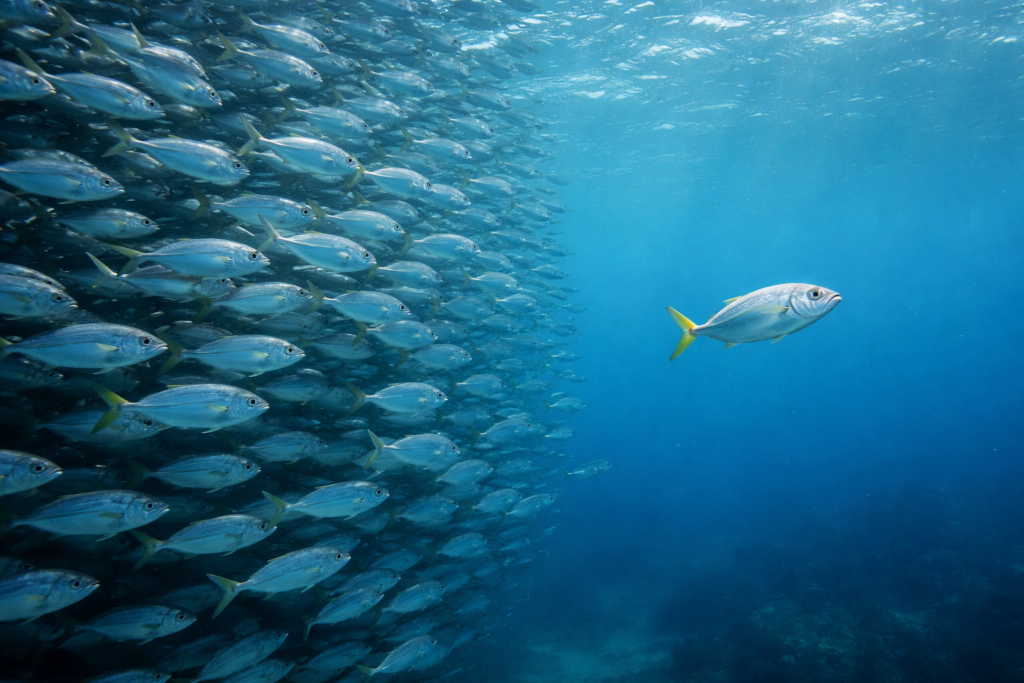
The findings reveal that misinformation isn’t merely a nuisance—it represents a significant threat to survival across species. For example, in fish schools, if certain individuals communicate false information about predator locations, it could lead the entire group into danger. Similarly, bacterial colonies that misinterpret chemical signals may fail to respond appropriately to environmental threats.
“When we look at information networks in nature, we see that reliability is constantly being tested,” notes one of the study’s co-authors. “Natural selection has favored organisms that can effectively filter out misleading signals while remaining receptive to valuable information.”
The timing of this research is particularly relevant as human societies grapple with unprecedented levels of misinformation. Public health initiatives, climate change policies, and democratic processes have all faced challenges from the rapid spread of false information through digital networks.
Experts in misinformation studies have greeted the Cornell research with enthusiasm. “This cross-species approach gives us an entirely new perspective,” comments Dr. Elena Marquez, a specialist in information science who wasn’t involved in the study. “Instead of treating misinformation as a modern technology problem, we can now examine it through an evolutionary lens.”
The research may ultimately inform new strategies for building resilience against misinformation. By understanding how other organisms have evolved to maintain accurate collective knowledge despite the presence of misleading signals, human institutions might develop more effective approaches to preserving information integrity.
As social media platforms continue to struggle with content moderation policies and governments worldwide debate regulatory approaches to misinformation, this biological perspective offers a fresh direction for research and intervention.
The study serves as a reminder that while digital technologies have amplified the scale and speed of misinformation, the challenge of distinguishing truth from falsehood has deep evolutionary roots—and solutions may be found by looking beyond our own species to the broader natural world.
Fact Checker
Verify the accuracy of this article using The Disinformation Commission analysis and real-time sources.

7 Comments
This is a concerning but important study. If even bacteria can spread misinformation, it highlights just how pervasive and challenging this problem is. I hope the findings spur new efforts to understand and address misinformation across all domains.
Agreed. Misinformation is a threat to scientific progress and public wellbeing. Identifying ways to strengthen communication systems and promote truth is crucial, whether for human or non-human communities.
Very thought-provoking stuff. I wonder if there are any parallels between misinformation in the natural world and online echo chambers or filter bubbles. Seems like an area ripe for further interdisciplinary study.
Fascinating research on the prevalence of misinformation in the natural world. I wonder if species have developed any evolutionary strategies to combat the spread of false information and promote truth. Curious to learn more about the implications for human communication.
This is a fascinating and unsettling finding. If even the smallest lifeforms can fall victim to misinformation, it really underscores the universality and tenacity of this problem. Kudos to the Cornell team for shedding light on this critical issue.
Agreed. The implications are quite profound. I hope this inspires new approaches to combating misinformation at every level, from interpersonal communication to global information ecosystems.
As someone interested in mining and energy issues, I’m curious how this research might apply to the spread of misinformation around things like climate change, renewable energy, and resource extraction. Fact-checking and media literacy seem more important than ever.