


Listen to the article
As artificial intelligence continues to blur the line between reality and fiction online, religious content has become a prime target for both harmless entertainment and malicious deception.
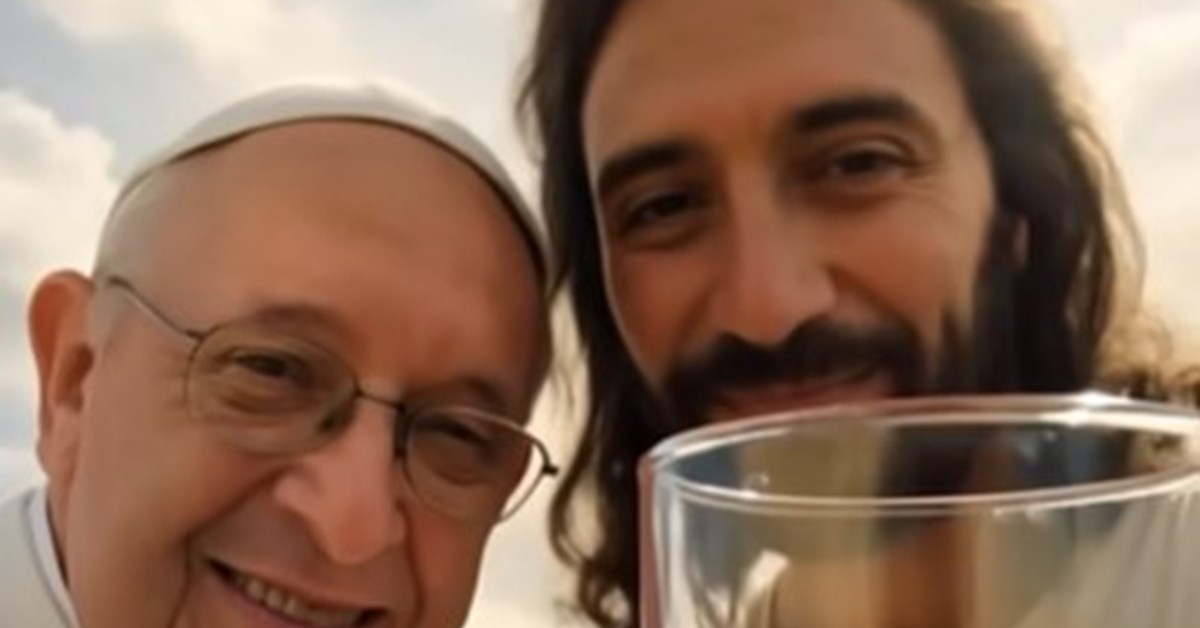
In early 2025, shortly after Pope Francis’s death, a TikTok video showing the Pope performing miracles with Jesus garnered over 26 million views. The minute-long clip featured the pontiff turning water into wine before soaring through cloud-filled skies alongside a suspiciously European-looking Jesus, accompanied by Bob Dylan’s “Knockin’ on Heaven’s Door.” Though clearly labeled as AI-generated, the video exemplifies the growing phenomenon of AI-created religious content flooding social media platforms.
More concerning are sophisticated scams targeting Christian audiences. One Facebook post featured “Edward and Helen,” an elderly couple supposedly making handcrafted religious items to save their dying parish in Bradford from closure. The heartfelt plea included fabricated photos of the couple, their workshop, and their threatened church. In reality, the post linked to a generic online store selling mass-produced Christian trinkets, using completely fictional characters and scenarios to manipulate believers into purchasing products.
“It is increasingly difficult to know as you look at something online whether it is real or fake,” notes Hannah Mudge, a member of the Church of England’s national digital team. Her team is currently developing an official guide to AI in church contexts in response to growing concerns from clergy members.
The technology driving this content revolution has evolved dramatically in recent years. New AI tools like Sora, Veo 3, and others can transform simple text prompts into convincing images, audio, and videos for as little as £20 monthly, with some basic tools available for free. What once required hours of skilled Photoshop work can now be generated in minutes by virtually anyone.
Stephen Driscoll, who ministers to students in Canberra and authored “Made in Our Image: God, artificial intelligence and you,” describes AI misinformation as a “massive issue” that threatens the “erosion of trust at the core of democracy.” He estimates that as much as two-thirds of content shared online about recent tragic events contains incorrect or fabricated information.
The Vatican addressed these concerns directly in its 2025 document “Antiqua et Nova,” warning that AI-generated false content causes people to “question everything” and erodes “trust in what they see and hear.” The document emphasizes that “polarisation and conflict will only grow. Such widespread deception is no trivial matter; it strikes at the core of humanity, dismantling the foundational trust on which societies are built.”
Within the Church of England, Dr. Steven Croft, Bishop of Oxford until his retirement in May 2026, has been a leading voice on AI ethics, regularly addressing the House of Lords about the dangers of “deepfakes” and calling for ethical frameworks in AI development and usage.
Christian technologist James Poulter identifies multiple threat levels from AI misinformation. Public figures face immediate risks from spoofed images or videos showing them in compromising situations. But everyone should worry about the “compounding, cumulative effect of people feeling that they can’t trust what they see,” he warns.
The Reverend Dr. Simon Cross, who advises Church of England bishops on AI, offers a stark assessment: “Actually, there really aren’t that many benefits [to AI], but there are an astronomical number of risks and harms. This stuff is being developed and deployed without any duty of care, without any product-safety testing.”
Identifying AI-generated content has become increasingly challenging. Just two years ago, examining human hands for abnormalities was a reliable method to spot AI images. Today, as AI capabilities advance rapidly, such telltale signs have largely disappeared. Experts now suggest focusing on broader contextual clues: Who posted the content? What else do they share? Do they appear to be a real person with a genuine following?
Despite the risks, some see potential for positive applications. Churches are experimenting with AI for creating sermon slides, social media content, and Bible-based imagery. TikTok creator HolyVlogz has amassed millions of views with 60-second videos reimagining biblical figures in contemporary settings, such as Daniel vlogging his experience in the lion’s den or Jesus podcasting with Judas.
The Reverend Chris Goswami, a Baptist minister and technology writer, acknowledges the appeal: “It’s much easier to take in a 60-second TikTok video filmed from Moses’s perspective than sit through one of my sermons on the patriarch.”
However, all experts emphasize the need for transparency when using AI in religious contexts. “If you’ve used AI, just name it,” advises Dr. Cross. This “widespread silent adoption” of technology without acknowledgment concerns many religious leaders.
For Christians specifically, the question of truth remains paramount. “If Jesus is the truth, ultimately there have to be black-and-whites,” Goswami says. “We need to get our act together as Christians and say ‘No, truth actually matters.'”
Beyond misinformation, other ethical concerns include AI’s environmental impact, the exploitation of workers who tag data for training models, and the appropriation of creative works without compensation or consent. By 2030, AI data centers could consume as much as 20 percent of the world’s electricity.
As Canon Tim Bull reflects, perhaps the Church’s greatest contribution during this technological transition is its embodied witness: a community that worships in person and shares physical communion might serve as a beacon of “genuine, bona fide human relationship” in an increasingly virtual world.
Fact Checker
Verify the accuracy of this article using The Disinformation Commission analysis and real-time sources.

10 Comments
Interesting to see how AI is impacting religious content online. While some of it may be harmless entertainment, the malicious scams targeting vulnerable audiences are concerning. We’ll need to be vigilant about verifying the authenticity of religious content we encounter.
Agreed, the potential for misinformation to spread through AI-generated religious content is worrying. Oversight and education will be key to combating this issue.
The blurring of the line between reality and fiction through AI-generated religious content is a complex challenge. On one hand, it could be used for harmless entertainment, but the potential for malicious misinformation is alarming. Maintaining trust in online religious information will be crucial.
While the AI-generated Pope video may be eye-catching, I worry about the potential for this kind of content to mislead people, especially those who are religiously devout. We’ll need to be very careful about verifying the authenticity of online religious information as AI technology continues to advance.
Agreed. The ease of creating convincing but false religious content is a growing concern that will require vigilance and education from both platforms and users.
The AI-generated video of the Pope performing miracles is certainly eye-catching, but I wonder about the potential for this kind of content to mislead people. As technology advances, we’ll need to be increasingly discerning consumers of online information, especially around sensitive topics like religion.
Good point. With the ease of creating convincing AI-generated media, we all need to be more critical about what we see and share online, especially when it comes to religious and other high-stakes content.
I’m concerned about the sophisticated scams targeting Christian audiences with fabricated stories and images. Manipulating people’s faith for financial gain is quite troubling. Stricter regulation and public awareness campaigns may be needed to address this issue.
Absolutely. Exploiting people’s religious beliefs for profit is a deplorable practice that needs to be cracked down on. Robust verification processes and public education will be crucial going forward.
The scams targeting Christian audiences with fabricated stories and images are particularly concerning. Manipulating people’s faith for financial gain is a despicable practice that needs to be addressed through stronger regulations and public awareness campaigns.