


Listen to the article
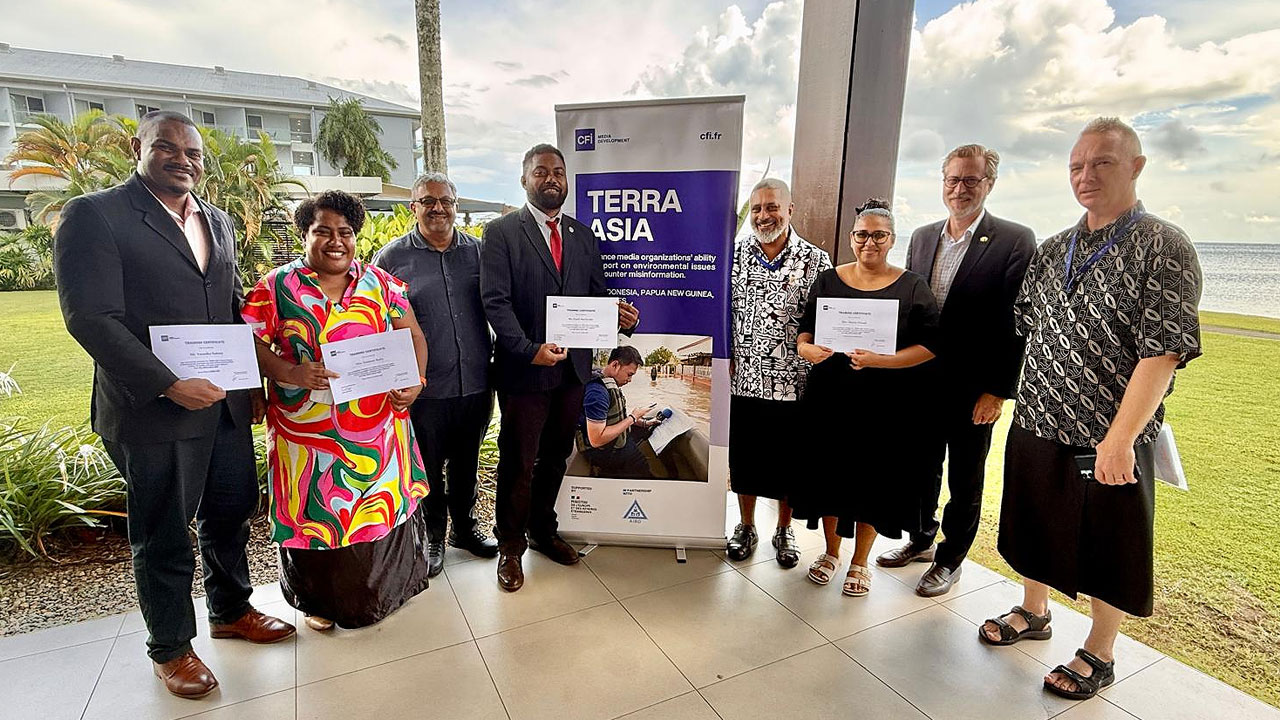
At the intersection of rapid technological change and climate reporting, journalists are facing unprecedented challenges in maintaining accuracy and credibility. This concern took center stage during the recent Terra Asia Environmental Journalism Training, where media professionals gathered to address the dual threats of artificial intelligence advancement and climate misinformation.
Training facilitator Robert Bourgoing delivered a sobering assessment of the current media landscape, noting that even seasoned journalists are struggling to keep pace with AI developments. “The challenges are significant,” Bourgoing stated, highlighting climate reporting and the proliferation of false information as among the most pressing global issues confronting today’s journalists.
The Terra Asia Program was established specifically to address these challenges, with a mission to strengthen evidence-based reporting while providing journalists with the tools needed to identify and counter misinformation in climate-related coverage. This initiative comes at a critical time when accurate environmental reporting is essential for informed public discourse and policy development across the Asia-Pacific region.
Regional Coordinator Tatine Faylona emphasized the program’s practical approach, focusing on accessible resources that journalists can readily implement in their daily work. “We’re promoting tools that are both powerful and accessible,” Faylona explained. “By utilizing free and open-source platforms, we’re ensuring that financial constraints don’t prevent media organizations from producing high-quality climate journalism.”
The impact of the training is already being felt in local media operations. Felix Chaudhary, General Manager of FBC News and Sports, acknowledged the value of the initiative, noting that journalists who have participated in the program are already applying their new skills in their reporting work.
“We’re seeing tangible improvements in how our journalists approach climate stories,” Chaudhary said. “The training is helping build stronger, more informed environmental journalism across Fiji.” He expressed gratitude to the program organizers for their commitment to strengthening regional media capacity.
The Fiji Broadcasting Corporation has integrated deeply with the Terra Asia Program, with four of its journalists selected to participate in the comprehensive training initiative. This partnership represents a significant investment in building local expertise in environmental reporting at a time when Pacific Island nations face disproportionate impacts from climate change.
For these island nations, accurate reporting on climate issues isn’t merely an academic exercise—it’s a matter of national survival. Rising sea levels, increasing storm intensity, and changing weather patterns pose existential threats to communities across the Pacific. Quality journalism plays a crucial role in informing public understanding and adaptation strategies.
The training program addresses several dimensions of modern environmental reporting, including techniques for explaining complex scientific concepts to general audiences, methods for verifying information sources, and strategies for using digital tools to enhance storytelling without compromising journalistic integrity.
Participants are learning to navigate the growing challenge of AI-generated content, which can sometimes be difficult to distinguish from human-created work. The program teaches journalists to apply rigorous verification standards and to use technology as an ally rather than seeing it as merely a threat.
Media experts observe that this type of specialized training is becoming increasingly necessary as both the climate crisis and the information landscape grow more complex. News organizations worldwide are grappling with similar challenges—balancing the need for timely reporting with thorough fact-checking in an era when false information can spread globally in minutes.
As the Terra Asia program continues to expand its reach, organizers hope to create a network of well-trained environmental journalists across the region who can collaborate on cross-border stories and share best practices. This regional approach recognizes that climate challenges transcend national boundaries and require collaborative reporting.
For communities across Fiji and the broader Pacific, the stakes couldn’t be higher. As climate impacts intensify, the quality of information available to the public will play a crucial role in shaping adaptation strategies and policy responses in the years ahead.
Fact Checker
Verify the accuracy of this article using The Disinformation Commission analysis and real-time sources.

8 Comments
AI advancements are a double-edged sword when it comes to climate journalism. On one hand, AI can enhance reporting capabilities, but on the other, it can also be used to spread misinformation. Maintaining credibility is key.
Absolutely. Journalists will need to stay vigilant and adapt their practices to navigate this evolving landscape effectively. Rigorous fact-checking and source verification will be essential.
Accurate and impartial climate coverage is vital for informing public discourse and policy decisions. I hope the training and initiatives mentioned in this article can help journalists rise to the challenge.
Agreed. Educating the public with factual, science-based information is crucial in the fight against climate change. Kudos to the journalists working to uphold integrity in their reporting.
The intersection of AI, misinformation, and climate reporting is a complex issue that requires a multifaceted approach. I’m interested to see how this evolves and what other solutions emerge to address these challenges.
This is a timely and important issue. I’m curious to learn more about the specific tools and strategies the Terra Asia Program is using to strengthen evidence-based climate reporting and counter misinformation.
The challenges highlighted in this article are concerning, but I’m glad to see initiatives like the Terra Asia Program working to address them. Fact-based climate reporting is critical, especially with the growing threat of misinformation.
Agreed. It’s crucial that journalists have the tools and support to identify and counter climate misinformation. This is a global issue that requires a collaborative effort.