


Listen to the article
Supreme Court’s Dobbs Decision Triggers State Actions to Protect Contraceptive Rights
In the wake of the Supreme Court’s Dobbs ruling that overturned Roe v. Wade, states across the country are moving to codify protections for contraceptive access amid growing concerns that these rights could be at risk. While the Court’s majority opinion stated that the decision does not “cast doubt on precedents that do not concern abortion,” Justice Thomas’s concurring opinion specifically called for reconsidering landmark cases including Griswold v. Connecticut, which established the right of married people to obtain contraceptives in 1965.
This judicial uncertainty has spurred legislative action at both state and federal levels, with lawmakers introducing measures to protect contraceptive access. The issue gained further prominence when former President Donald Trump recently suggested contraception rights should be left to states—a statement he later walked back with assurances he would not limit contraception.
With several state ballot initiatives headed to voters in November 2024 and Senate Majority Leader Chuck Schumer promising a Senate vote on national contraceptive protections, reproductive rights are emerging as a significant election issue this fall.
Current Constitutional Protections for Contraception
The right to contraception currently rests on two Supreme Court decisions: Griswold v. Connecticut (1965) and Eisenstadt v. Baird (1972). Prior to these rulings, many states prohibited contraceptives entirely, barring clinicians from even discussing birth control with patients. Griswold established constitutional privacy protections for married couples seeking contraception, while Eisenstadt later extended these protections to unmarried individuals.
Despite these constitutional safeguards, widespread misconceptions about certain contraceptive methods have created gray areas in state policies. Polling indicates that 73% of Americans incorrectly believe emergency contraceptive pills can terminate early pregnancies, and many wrongly think that intrauterine devices (IUDs) primarily work by preventing implantation of fertilized eggs.
Medical experts and leading health organizations define pregnancy as beginning at implantation of a fertilized egg, not at fertilization. However, emergency contraceptives like Plan B and Ella—as well as IUDs—work by preventing ovulation or impeding sperm from reaching eggs. They do not terminate existing pregnancies or prevent implantation of fertilized eggs.
State Policies Creating Confusion
Several states have attempted to restrict access to emergency contraception through various policies. Texas received federal permission to exclude emergency contraceptives from its Medicaid-funded family planning program through December 2024. Missouri’s senate previously considered barring coverage of emergency contraceptives in its Medicaid program, though the measure ultimately failed. Iowa stopped reimbursing Plan B for sexual assault survivors through its Crime Victim Compensation Program in 2023.
More troubling are the definitions employed in some state abortion bans. Tennessee’s total abortion ban defines pregnancy as “the reproductive condition of having a living unborn child within [the pregnant person’s] body throughout the entire embryonic and fetal stages of the unborn child from fertilization until birth.” Similarly, Missouri defines an “unborn child” as existing “from the moment of conception” and defines conception as fertilization.
These definitions can create dangerous ambiguity. When Missouri’s abortion ban took effect, a major hospital system temporarily stopped providing Plan B out of fear of legal repercussions, resuming only after clarification from state officials. While most state abortion bans limit their definitions to “clinically diagnosable pregnancies,” the confusion demonstrates how misunderstandings about contraceptive mechanisms can threaten access.
State Protections Emerge
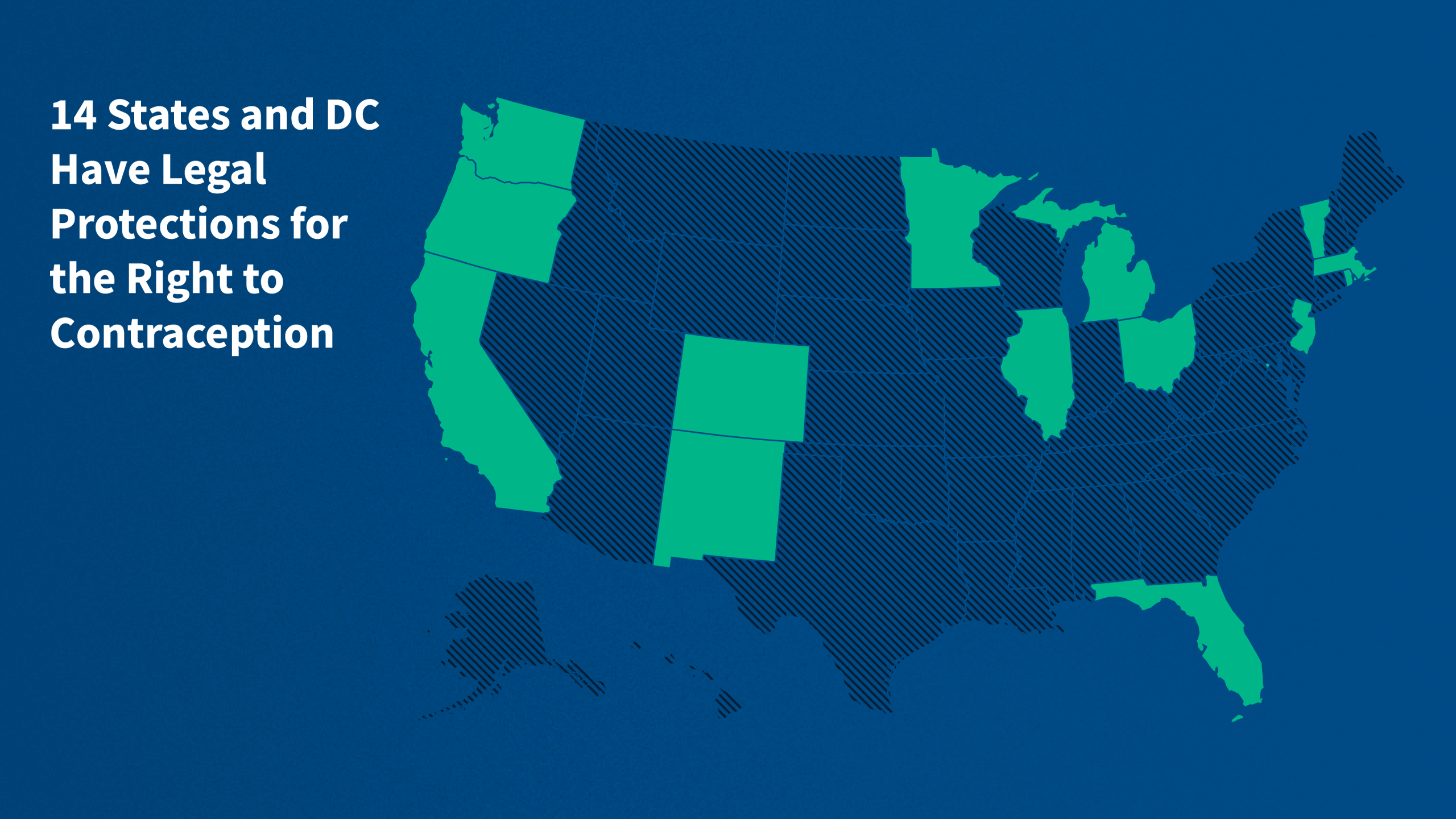
In response to these concerns, fourteen states and the District of Columbia have established legal or constitutional protections for contraceptive access. California, Michigan, Vermont, and Ohio have passed constitutional amendments through ballot measures that recognize a broad right to reproductive autonomy, including contraception. Six states and D.C. enacted these protections after the Dobbs decision in June 2022.
The remaining states with contraceptive protections—Colorado, Illinois, Massachusetts, New Jersey, Oregon, Rhode Island, Washington, and Florida—established them before Dobbs, with most acting between 2019 and 2022. Oregon, Washington, and Florida were early adopters, with laws dating to 2007, 1991, and 1972 respectively.
Constitutional amendments provide stronger protection than statutes, as they are harder to repeal or modify with changing political winds. Most laws protecting contraception also safeguard other reproductive health services, including miscarriage management, maternity care, and assisted reproduction.
Looking Ahead: Ballot Measures and Federal Action
The momentum continues in 2024, with legislators in Hawaii, Maryland, Nevada, and Washington proposing constitutional amendments to protect contraception. Maryland’s measure will appear on the November 2024 ballot, while Nevada’s could reach voters by 2026. Bills protecting contraceptive access have been introduced in Arizona, Iowa, and Virginia, though Virginia Governor Glenn Youngkin recently vetoed such legislation after it passed both chambers.
At the federal level, the Right to Contraception Act was reintroduced in June 2023 after failing to advance in the previous Congress. While it lacks sufficient support to pass the current divided Congress, Schumer has announced plans for a Senate vote on contraceptive rights, ensuring the issue remains prominent in election-year debates.
President Biden has issued executive orders directing federal agencies to ensure broad access to contraceptive services and supplies without barriers related to cost, coverage, or availability. The Department of Health and Human Services has issued guidance reminding pharmacies of their obligations under federal civil rights law when dispensing contraceptives.
Recent KFF polling shows that 21% of adults consider the right to contraception to be threatened, with higher concerns among Democrats (over one-third) and Democratic women (one in four). This concern may grow as contraceptive access receives more attention during the upcoming election cycle, potentially becoming a decisive issue for many voters in November.
Fact Checker
Verify the accuracy of this article using The Disinformation Commission analysis and real-time sources.

18 Comments
The potential threat to contraceptive rights highlighted in the Dobbs ruling is very concerning. Ensuring access to contraception is essential for personal liberty and reproductive health. Legislative efforts to protect these freedoms are crucial.
Absolutely. Preserving the right to access contraception, regardless of one’s views on abortion, is a fundamental freedom that must be protected. A patchwork of state policies could lead to unequal access, underscoring the need for federal action.
The prospect of states being able to restrict contraception access is very concerning. Reproductive autonomy should be a protected right, not subject to a patchwork of state policies. This is an issue worth following closely.
I agree. Contraceptive rights must be safeguarded at the national level to ensure equitable access across the country. The upcoming Senate vote will be an important step in that direction.
The potential threat to contraceptive rights raised in the Dobbs ruling is deeply troubling. Ensuring access to contraception is essential for personal liberty and reproductive health. I’m glad to see legislative efforts to protect these freedoms at the state and federal levels.
Agreed. Preserving the right to access contraception is a fundamental freedom that must be safeguarded, regardless of one’s views on other reproductive health issues. Equitable access across the country is crucial, so federal action is an important step.
Contraceptive access is a critical aspect of reproductive health and personal autonomy. I’m encouraged to see lawmakers taking steps to secure these rights amid the legal uncertainty following the Dobbs decision. This is an issue worth following closely.
Contraceptive access is a crucial aspect of reproductive health and personal autonomy. I’m glad to see lawmakers taking steps to secure these rights amid the legal uncertainty stemming from the Dobbs decision. This is an important issue to follow.
Reproductive health is a complex and sensitive issue. I’m glad to see lawmakers taking steps to enshrine contraceptive rights, given the potential risks highlighted by the Dobbs ruling. This is an important safeguard for personal liberty.
Absolutely. The right to access contraception is a fundamental freedom. Efforts to protect it, at both the state and federal level, are crucial in this uncertain legal landscape.
Ensuring access to contraception is a critical issue, especially given the potential implications of the Dobbs decision. I’m encouraged to see legislative efforts to enshrine these protections, both at the state and federal levels.
Ensuring access to contraception is crucial, especially in the wake of the Dobbs decision. It’s heartening to see legislative efforts at the state and federal levels to protect these essential rights.
Absolutely. Reproductive rights and bodily autonomy must be safeguarded, regardless of one’s personal views. A patchwork of state policies could lead to unequal access, so a federal standard is important.
Protecting access to contraception is crucial, especially in light of the legal uncertainty following the Dobbs decision. I’m encouraged to see lawmakers taking action to secure these rights at the state and federal levels. This is an important issue to follow closely.
The legal uncertainty around contraceptive rights in the wake of Dobbs is deeply troubling. Codifying protections is essential to preserve personal liberty and reproductive autonomy. This is a complex issue that deserves close attention.
Agreed. Protecting access to contraception is a fundamental right that must be safeguarded, regardless of one’s personal views on other reproductive health issues. Vigilance is needed to ensure these freedoms are not eroded.
The potential threat to contraceptive rights is very concerning. While the Court’s majority claimed the Dobbs ruling wouldn’t impact other precedents, the concurring opinion raises worrying questions. Vigilance is needed to preserve these fundamental freedoms.
Agreed. The uncertainty around Griswold v. Connecticut is alarming. Codifying protections at the state and federal levels is essential to ensure access to contraception remains secure for all.