


Listen to the article
In South Korea, while YouTube continues to gain popularity as a news source, most domestic users still heavily rely on web portals and search engines for their news consumption, according to a comprehensive study released by the Korea Press Foundation.
The “Digital News Report 2025 Korea” reveals that 63% of Korean news consumers primarily access news through aggregation services like web portals and search engines. This stands in stark contrast to direct consumption from media company websites, which accounts for just 6% of news access – ranking Korea 47th out of 48 countries surveyed globally.
Age demographics show significant variations in news consumption habits. Among those in their 20s, portal usage drops to 53%, while social media news consumption rises to 29%, the highest rate across all age groups. Older Koreans demonstrate stronger loyalty to traditional web portals, with 63% of people in their 50s and 68% of those over 60 continuing to rely on these platforms.
Researchers noted that while dependence on web portals is gradually declining, this shift isn’t benefiting news organizations directly. Instead, audiences are dispersing toward various social media platforms for news consumption.
YouTube has emerged as a particularly influential news platform in Korea. The report found that half of all Korean users access news through YouTube – significantly exceeding the 48-country average of 30%. Interestingly, YouTube news consumption is highest among older demographics, with 61% of people in their 50s and 53% of those 60 and above regularly using the platform for news.
Political affiliations appear to influence platform preferences as well. The study revealed that YouTube news consumption decreased by 9 percentage points among progressive users compared to the previous year, while increasing by 5 percentage points among conservatives. After YouTube, the most common platforms for news consumption were KakaoTalk (15%) and Instagram (11%).
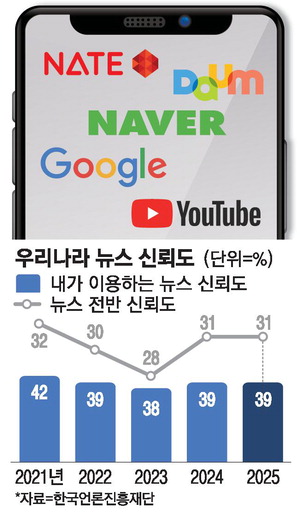
Trust in news remains a significant challenge in the Korean media landscape. Overall news trust among Korean users stands at just 31%, ranking 37th globally and falling 9 percentage points below the international average of 40%. However, the study identified an interesting paradox – trust in “the news I use” was 8 percentage points higher at 39%, suggesting that as personalized news consumption becomes more common, users place greater confidence in content they’ve personally selected or filtered.
Political polarization directly impacts media trust in Korea. While 36% of progressives expressed trust in news, this figure dropped to 31% among moderates and 27% among conservatives. Conversely, 42% of conservatives actively distrust news, compared to 37% of progressives and 24% of moderates.
News avoidance has increased dramatically in Korea, with 63% of users reporting they “intentionally avoided news” – a significant jump from 50% the previous year. Primary reasons cited were an overabundance of political news (41%) and perceptions that news is untrustworthy or biased (37%).
More than half of Korean users (55%) expressed concern about online misinformation, with particularly high worry among those over 60 (73%) and conservatives (74%). Despite YouTube’s popularity, it was paradoxically identified by more than half of respondents as the main platform responsible for producing and spreading misinformation – highlighting a contradictory relationship between platform usage and trust.
Regarding AI-generated news content, Koreans showed more openness than global counterparts. Only 31% reported discomfort with AI-written articles, compared to the international average of 40%. Some Korean users even expressed expectations that AI-generated news might be less biased (33%), more transparent (32%), and more accurate (31%) than human-written journalism.
The report concludes that Korea exhibits a complex news ecosystem characterized by low trust, high portal dependence, and increasing news avoidance. It urges news organizations to pivot their strategies toward rebuilding trust and developing direct relationships with readers.
The survey, commissioned by the Reuters Institute for the Study of Journalism and conducted by YouGov, included 98,072 participants across 48 countries, with 2,038 respondents from Korea.
Fact Checker
Verify the accuracy of this article using The Disinformation Commission analysis and real-time sources.

10 Comments
The findings from this study highlight the ongoing challenges faced by the news industry in the digital age. Adapting to changing consumer behaviors and addressing the proliferation of misinformation on platforms like YouTube will be critical for the long-term sustainability of quality journalism.
Collaborative efforts between media organizations, technology companies, and policymakers may be necessary to develop effective solutions to these complex issues.
The high levels of misinformation reported on YouTube are concerning, especially as the platform gains popularity as a news source. This underscores the need for improved content moderation and verification processes to ensure the integrity of information shared on such platforms.
YouTube and other social media platforms must take more responsibility in tackling the spread of misinformation, which can have serious consequences for public discourse and decision-making.
The disparity in news consumption habits between younger and older Koreans is intriguing. It will be interesting to see how traditional media organizations navigate this generational shift and find ways to engage with both demographics effectively.
Targeted content and distribution strategies may be required to cater to the unique preferences of different age groups within the Korean market.
It’s concerning to see that a majority of Korean news consumers still rely heavily on web portals and search engines, rather than directly engaging with media company websites. This dynamic underscores the need for news organizations to find ways to strengthen their direct relationships with their audience.
Developing engaging content, innovative distribution strategies, and building brand loyalty will be key for news outlets to thrive in the rapidly evolving digital landscape.
Interesting to see the shift in news consumption habits among different age groups in South Korea. Reliance on web portals seems to be declining, especially among younger demographics who are turning more to social media. This trend highlights the challenges traditional media organizations face in reaching their audience directly.
It will be crucial for news outlets to adapt their distribution strategies to cater to the evolving preferences of digital-native consumers.