


Listen to the article
Media censorship in Egypt has intensified significantly over the past two years, with a combination of old tactics reminiscent of pre-revolution methods and new approaches emerging to control information flow, according to a collaborative investigation between Visualizing Impact and Mada Masr released on World Press Freedom Day.
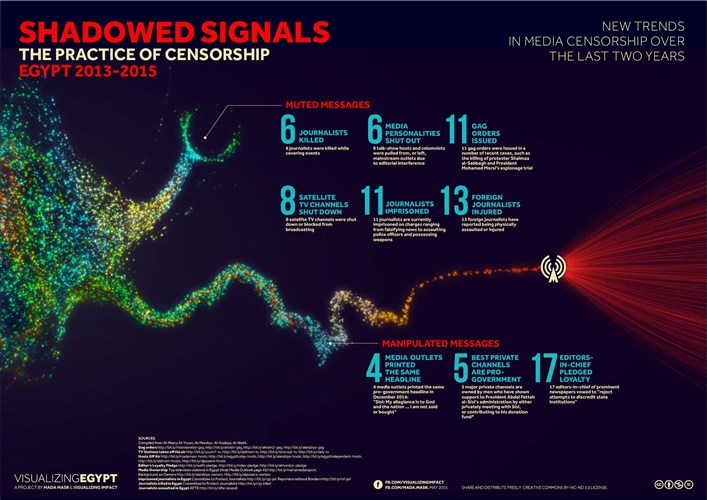
The investigation, titled “Shadowed Signals,” uses detailed infographics to document how the Egyptian government and media institutions are systematically filtering and manipulating news before it reaches the public. The visual report demonstrates how real-world events are either distorted or completely blacked out in both state-run and privately owned media outlets.
“The mainstream press in Egypt, regardless of ownership structure, has become either susceptible to or complicit in censorship practices,” notes the report, which aggregates data from numerous media monitoring organizations and press reports.
Egypt’s censorship mechanisms have evolved alongside the country’s media industry liberalization over the past two decades. On the formal level, the state deploys constitutional clauses and media legislation to create legal barriers for independent journalism. The judiciary has become an effective tool for suppressing speech, with numerous journalists facing prosecution and media outlets being shuttered through these legal instruments.
The 2014 Egyptian Constitution contains several provisions that directly restrict media freedoms, building upon existing restrictive legislation. This judicial harassment has had a chilling effect on the media landscape, with many journalists avoiding sensitive topics or government criticism out of fear of reprisal.
However, the report emphasizes that informal or “soft” censorship constitutes an even larger portion of Egypt’s media control apparatus. Self-censorship has become prevalent, partly from fear but also from deliberate alignment with the ruling regime. Many corporate media outlets have publicly pledged allegiance to current authorities, reflecting Egypt’s deeply polarized political environment.
Another significant aspect of informal censorship involves the systematic removal of critical voices from the media landscape. The disappearance of outspoken guests from television programs, opinion writers from newspapers, and investigative journalists from newsrooms has created substantial gaps in coverage. While the specific circumstances behind these disappearances often remain unclear, reports of television blacklists targeting activists and non-renewal of contracts for critical columnists and hosts point to coordinated efforts to silence dissent.
The visual report is the first in a planned series examining Egypt’s media environment. Future installments will explore the historical development of media in Egypt alongside the evolution of censorship regimes, as well as the infrastructure of media ownership and governance to identify the root causes of persistent censorship.
Visualizing Impact, one of the collaborators on the project, describes itself as “a laboratory for innovation at the intersection of data science, technology, and design,” creating tools that highlight critical social issues worldwide. Their partner, Mada Masr, is an independent Egyptian media organization founded two years ago that produces in-depth content in both Arabic and English.
The “Visualizing Egypt” collaboration leverages Visualizing Impact’s expertise in design and artistic direction with Mada Masr’s local knowledge and conceptual understanding to create compelling narratives on crucial issues affecting Egyptian society.
The report comes at a time when Egypt’s ranking in global press freedom indices continues to decline, with international organizations like Reporters Without Borders and the Committee to Protect Journalists regularly documenting arrests, intimidation, and legal harassment of media workers in the country.
The infographics released with the report are available under a Creative Commons license, allowing for republication and wider distribution to raise awareness about the state of press freedom in Egypt.
Fact Checker
Verify the accuracy of this article using The Disinformation Commission analysis and real-time sources.

6 Comments
This report sounds like an important documentation of the troubling trends around media freedom and transparency in Egypt. I appreciate the use of detailed infographics to illustrate the systematic filtering and censorship practices. It’s a concerning reminder of the need for vigilance in safeguarding independent journalism.
Agreed, comprehensive and visually impactful analysis is key to shedding light on these complex media control mechanisms. Curious to see if the report offers any insights on potential avenues for reform or greater press freedoms in Egypt.
As someone interested in media and information dynamics, this investigation into censorship and manipulation in Egypt is quite compelling. The visual approach seems well-suited to documenting these complex, multi-layered issues around press freedom. I’ll have to check out the full report to learn more.
This report on media manipulation in Egypt is a sobering reminder of the challenges facing independent journalism, even in seemingly liberalized media landscapes. The findings around censorship and distortion of information across state-run and private outlets are quite concerning. Curious to see if the report offers any insights on potential avenues for reform or greater transparency.
Fascinating look at the nuanced and complex issue of media manipulation in Egypt. It’s concerning to see how censorship and distortion of information can shape public perceptions, even in privately owned outlets. Curious to learn more about the evolving legal and regulatory landscape governing the media industry there.
The findings around state-run and private media outlets being ‘susceptible to or complicit in censorship practices’ are quite troubling. It speaks to the broader challenge of maintaining a free and independent press, even as media landscapes evolve. I’d be interested to learn more about potential solutions or pressure points for reform in this space.