


Listen to the article
Ukrainian Media’s International Funding: Separating Fact from Fiction
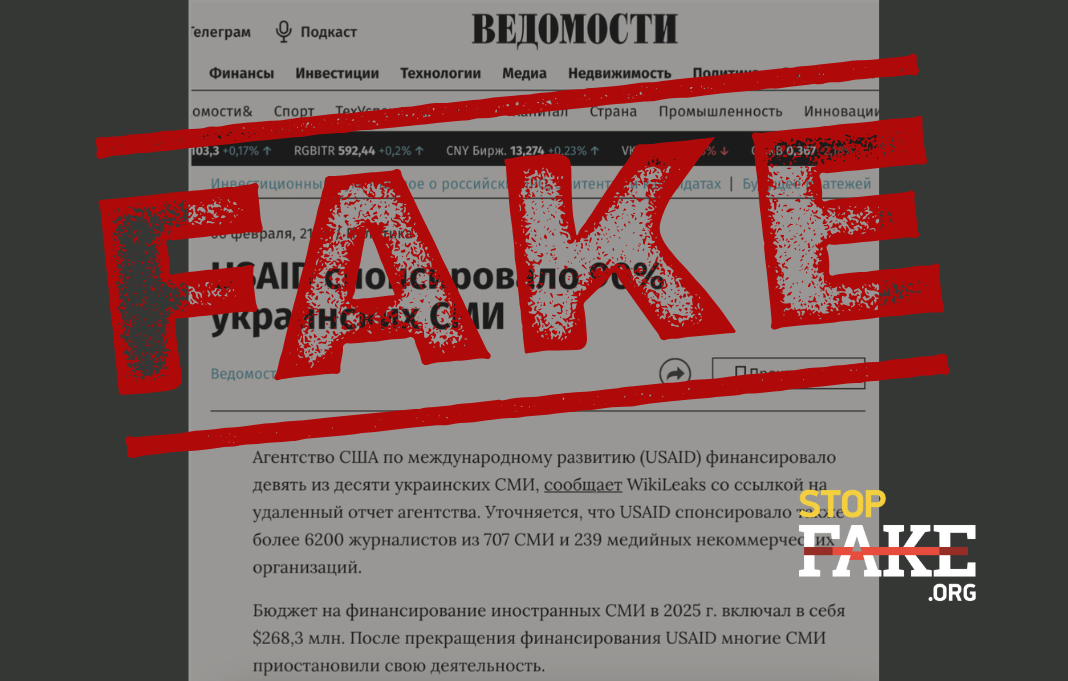
Russian media outlets recently began circulating claims that “90% of Ukrainian media lived on American money” through USAID funding, suggesting these outlets now face bankruptcy following President Donald Trump’s 90-day suspension of USAID grants. These assertions, which spread rapidly across propaganda channels and through WikiLeaks, paint a simplistic picture of Ukrainian media’s financial structures that distorts the reality.
An investigation into these claims reveals significant misrepresentations. The “90% figure” appears to trace back to a Reporters Without Borders article that was subsequently corrected. The organization clarified: “This article previously stated that nine out of 10 Ukrainian media outlets receive funding from USAID. The article now clarifies that nine out of 10 Ukrainian outlets receive international aid and USAID is the main donor.”
This correction highlights a crucial distinction – while international funding plays a substantial role in supporting Ukrainian media, the sources are diverse and extend well beyond a single U.S. agency.
Oksana Romaniuk, director of the Institute of Mass Information (IMI), provided important context in comments cited by Reporters Without Borders. “The problem is that almost everyone had grants. The question is that for some of them these grants amounted to 100% of their income and they could survive only thanks to the grants. For some it was 40-60%, for others it was less,” she explained.
Romaniuk emphasized that the funding ecosystem includes contributions from multiple international bodies: “Grants were provided not only by the USA, but also by the EU and the UN.” She acknowledged USAID’s significant role while noting, “Even though American grants have probably been the key to the market, and the U.S. has invested the most not only in the Ukrainian economy, but also in the Ukrainian media, we still have European institutions.”
To better understand the actual impact of potential U.S. funding disruptions, IMI conducted a survey of Ukrainian journalists. The results contradict the sweeping claims of near-universal dependence on American funding. Only 35% of surveyed media outlets reported that U.S. grants comprised more than 75% of their editorial budgets.
This finding suggests a more nuanced reality where many Ukrainian media organizations maintain diversified funding structures that include various international donors, domestic revenue streams, and other financial support mechanisms.
The accuracy of the original claims is further undermined by their sourcing. WikiLeaks, which Russian propaganda outlets cite as authoritative, has faced criticism for potential bias, with its founder Julian Assange having been accused of pro-Russian leanings and Kremlin connections. Moreover, the WikiLeaks claims reference a Medium article that doesn’t actually contain the “90%” figure being circulated.
This pattern of misrepresentation fits into a broader context of information manipulation surrounding Ukraine’s media landscape. Previously, fact-checking organization StopFake debunked similar false claims about USAID supposedly funding Hollywood celebrities’ visits to Ukraine during the war.
The situation highlights the complex relationship between international aid and media sustainability in conflict zones. For countries like Ukraine, facing both military aggression and information warfare, independent media represents a critical infrastructure that often requires external support to maintain operations during crisis periods.
As the temporary USAID funding pause continues, European donors and United Nations agencies may need to evaluate their support frameworks for Ukrainian media. The situation also raises questions about long-term sustainability models for independent journalism in regions experiencing prolonged conflict, where traditional revenue streams face severe disruption.
While the exact percentages of foreign funding vary significantly across Ukrainian media organizations, the exaggerated claims of universal dependence on American funding appear designed to undermine the credibility of Ukrainian journalism rather than accurately represent its financial reality.
Fact Checker
Verify the accuracy of this article using The Disinformation Commission analysis and real-time sources.

13 Comments
I’m curious to learn more about the specific breakdown of funding sources for Ukrainian media. While USAID is a major donor, it’s interesting that the outlets receive support from a range of international organizations.
Distinguishing fact from fiction is always a challenge when it comes to media reporting, especially around sensitive geopolitical issues. Appreciate the effort to provide a more nuanced perspective here.
This highlights the challenges of maintaining a free and independent media in a country facing ongoing geopolitical tensions. Transparency around funding sources is critical for public trust.
Agree, it’s important to avoid simplistic narratives and instead examine the nuances of media funding in Ukraine. This report provides a more balanced perspective.
This report highlights the complexity of media funding in Ukraine, with outlets relying on a range of international sources beyond just USAID. Maintaining transparency and independence is an ongoing challenge.
The report raises important questions about the independence and impartiality of Ukrainian media, given their heavy reliance on foreign funding. However, the details seem more complex than the initial Russian propaganda claims.
This report highlights the complex funding landscape for Ukrainian media outlets, which rely on diverse international sources beyond just USAID. The distinction between 90% receiving international aid vs. 90% from USAID alone is an important nuance.
It’s good to see the Reporters Without Borders article was updated to clarify the details. Accurate information is crucial when examining media funding and potential biases.
While the heavy international funding of Ukrainian media is concerning, the report indicates the sources are more diverse than the initial Russian claims suggested. Careful analysis is needed to understand the full picture.
The distinction between 90% receiving international aid vs. 90% from USAID alone is an important clarification. Painting a more accurate picture of media funding sources is crucial for assessing potential biases.
Appreciate the effort to provide a more nuanced perspective on this issue. Distinguishing fact from fiction is essential, especially around sensitive geopolitical topics.
While the initial Russian claims about Ukrainian media funding were likely exaggerated, the report indicates a heavy reliance on international aid that could raise concerns about impartiality. Careful analysis is needed to understand the full picture.
Agree, the nuances here are important. Simplistic narratives should be avoided in favor of a more balanced and well-researched assessment of the funding landscape for Ukrainian media.