


Listen to the article
Scientists at Queen Mary University of London have developed a revolutionary robotic hand that can grasp objects with human-like dexterity, potentially transforming industries from manufacturing to healthcare. The groundbreaking technology, detailed in a study published today in Nature Machine Intelligence, represents a significant advancement in robotic manipulation capabilities.
The F-TAC Hand features an unprecedented integration of high-resolution tactile sensors covering 70% of its surface area, allowing it to adapt to objects in real time. With a spatial resolution of just 0.1 millimeters, these sensors provide the robotic hand with feedback that closely mimics human touch perception.
“The massive spatial resolution combined with the enormous coverage are truly novel and were not possible previously,” explained Professor Kaspar Althoefer, Director of the Centre of Excellence Advanced Robotics at Queen Mary University of London. “Furthermore, the advanced perception algorithms significantly improve on existing approaches to better interpret the interaction with the environment, allowing for a superior understanding of the grasped object and its crucial parameters.”
While robotics has made substantial progress in replicating human hand movements and developing sophisticated control systems, achieving human-like adaptability in dynamic environments has remained elusive. Previous robotic hands have typically lacked the nuanced tactile feedback necessary for complex manipulation tasks, making them ineffective in unpredictable real-world scenarios.
The research team overcame traditional engineering challenges to integrate the high-resolution sensors without compromising the hand’s range of motion. This achievement represents a critical breakthrough, as previous attempts to add extensive sensory capabilities often resulted in limited mobility or functionality.
The F-TAC Hand’s capabilities were rigorously tested across 600 real-world trials. The system consistently outperformed non-tactile alternatives in complex manipulation tasks, demonstrating its superior ability to handle objects of varying shapes, sizes, and weights in dynamic conditions.
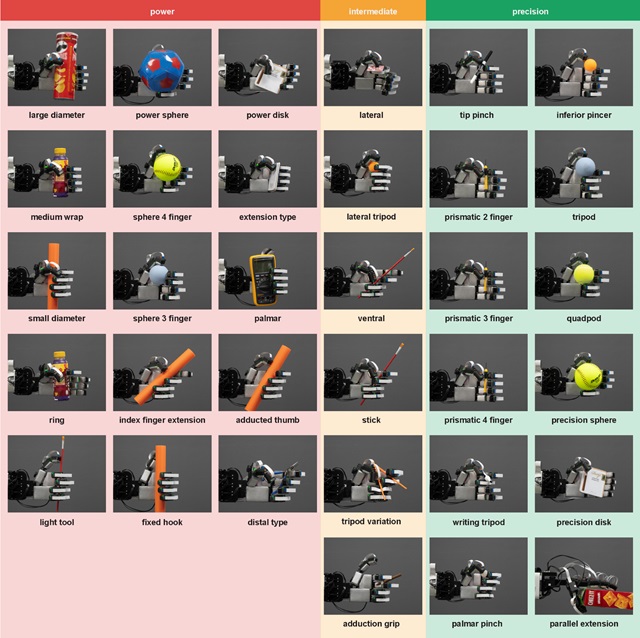
A key innovation in the F-TAC Hand is its generative algorithm that produces human-like hand configurations. This algorithm enables the robotic hand to adapt its grip pattern based on real-time tactile feedback, mimicking how humans unconsciously adjust their grip when handling objects.
The origins of this technology can be traced back to foundational research at Queen Mary University of London. “This work is based on research done at Queen Mary a few years back,” Professor Althoefer noted. “Wanlin Li was my PhD student, and together we developed camera-based tactile sensors like the ones in this paper. The Queen Mary sensors were capable of measuring tactile information with a high spatial resolution. This work and Wanlin’s PhD education form the foundation for this paper.”
The implications of this research extend far beyond laboratory settings. Professor Althoefer highlighted its potential: “This will lead to better manipulation of objects, including in-hand manipulation, opening up more application areas such as manufacturing, human-robot interaction, and assistive technologies. There’s immense potential to create robots, including humanoids with robotic hands, that can support humans in their daily tasks within their normal environments.”
In manufacturing, robots equipped with F-TAC Hand technology could handle delicate assembly tasks previously requiring human workers. In healthcare settings, robotic assistants might provide more natural physical support for patients. The technology also shows promise for prosthetics, potentially offering amputees more intuitive control and sensory feedback.
As robotics continues to advance, technologies like the F-TAC Hand are narrowing the gap between human and machine capabilities. By enabling robots to interact with their environment with unprecedented sensitivity and adaptability, this research marks a significant step toward a future where robots can seamlessly integrate into human environments, performing tasks that require both strength and delicacy.
Fact Checker
Verify the accuracy of this article using The Disinformation Commission analysis and real-time sources.

22 Comments
Interesting update on Robotic Hand with Human-Like Touch Poised to Transform Dexterous Manipulation. Curious how the grades will trend next quarter.
Production mix shifting toward Media Manipulation might help margins if metals stay firm.
Good point. Watching costs and grades closely.
Good point. Watching costs and grades closely.
Nice to see insider buying—usually a good signal in this space.
Good point. Watching costs and grades closely.
Silver leverage is strong here; beta cuts both ways though.
Uranium names keep pushing higher—supply still tight into 2026.
Good point. Watching costs and grades closely.
Good point. Watching costs and grades closely.
Nice to see insider buying—usually a good signal in this space.
If AISC keeps dropping, this becomes investable for me.
Good point. Watching costs and grades closely.
Production mix shifting toward Media Manipulation might help margins if metals stay firm.
Good point. Watching costs and grades closely.
If AISC keeps dropping, this becomes investable for me.
Interesting update on Robotic Hand with Human-Like Touch Poised to Transform Dexterous Manipulation. Curious how the grades will trend next quarter.
If AISC keeps dropping, this becomes investable for me.
Uranium names keep pushing higher—supply still tight into 2026.
Good point. Watching costs and grades closely.
Production mix shifting toward Media Manipulation might help margins if metals stay firm.
I like the balance sheet here—less leverage than peers.