


Listen to the article
Kosovo Conflict Illustrates How Media and Martyrdom Shaped International Intervention
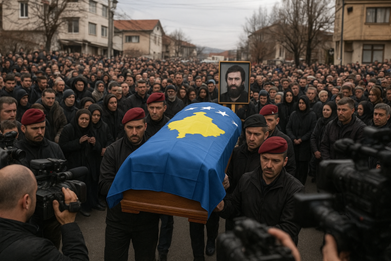
The dramatic emergence of the Kosovo Liberation Army (KLA) at a schoolteacher’s funeral on November 28, 1997, marked a pivotal moment in the Kosovo conflict. Three armed men interrupted the ceremony to proclaim revolution against Serbian authority, signaling the end of nonviolent reform efforts and the beginning of armed resistance that would eventually draw NATO into the Balkans.
This carefully staged proclamation represented years of strategic planning by Albanian nationalists who had struggled to gain popularity over Ibrahim Rugova’s pacifist League for a Democratic Kosovo (LDK). After years of fruitless reform efforts, the KLA capitalized on mounting public frustration, using the funeral as a platform to challenge the LDK’s approach and attract global media attention.
The Kosovo conflict emerged from the broader Yugoslav wars of 1991-2001, triggered by ethnic tensions and exacerbated by economic and political instability following the secession of several Yugoslav republics. Kosovo, as a province of Serbia rather than an independent state, initially avoided the worst of the fighting during the early 1990s, lacking conventional forces and political autonomy.
However, Kosovo’s unique demographic composition made conflict almost inevitable. Though officially Serbian territory, ethnic Albanians comprised approximately 80% of its two million residents, while Serbs numbered roughly 10%. This meant Albanians existed as a majority-minority region within Serbia, lacking adequate representation despite their local dominance.
Beginning in 1989, Ibrahim Rugova and his LDK employed nonviolent protests to petition for greater Albanian rights within Kosovo. While his movement enjoyed widespread Albanian support, it largely failed to achieve meaningful reform as Serbia focused on fighting other Yugoslav states. LDK leaders pinned their hopes on post-war negotiations.
Meanwhile, more radical elements viewed peaceful talks as insufficient for achieving true self-determination. Some envisioned a Greater Albania that would include Kosovo and surrounding Albanian-inhabited regions. However, these revolutionaries initially lacked weapons and popular support. They needed an asymmetric strategy to provoke tension and capture media attention.
The KLA recognized that generating Western support required exploiting liberal democratic values. In Western eyes, Serbian oppression of Albanians stood counter to principles of responsible state power, peace, and coexistence. This framing gave Albanian resistance a degree of legitimacy. Each Albanian death could be presented as a direct result of Serbian oppression, amplifying international sympathy regardless of the complex historical context.
KLA attacks against Serbian targets began in 1992. While these sporadic ambushes rarely inflicted more than a few casualties, the resulting headlines achieved their true objective: drawing international attention to the conflict. When the LDK failed to achieve peaceful reform during the 1995 Dayton Accords, many Kosovar Albanians shifted toward revolutionary KLA ideology as their final hope for independence.
The turning point came on March 5, 1998, when Adem Jashari became one of the first Albanian martyrs to achieve global attention. After participating in a KLA ambush that killed Serbian police officers, Jashari fled to his hometown of Prekaz. Serbian forces responded with overwhelming force, deploying tanks, armored vehicles, helicopters, and mortars. After a three-day siege, Jashari, his two comrades, and approximately 50 family members were killed.
This massacre provided precisely the propaganda opportunity the KLA needed to elicit international sympathy. Serbia’s actions made them appear indifferent to civilian life, an approach unacceptable to Western sensibilities. The incident both popularized KLA ideology and established an international perspective that, regardless of Serbian sovereignty over Kosovo, the local Albanian population deserved protection from Serbian abuse.
Western media began viewing the conflict as a David versus Goliath struggle, creating a moral imperative for intervention. As then-U.S. Secretary of State Madeleine Albright noted: “There did not appear to be much Jeffersonian thinking within the KLA. Often indiscriminate in their attacks, they seemed intent on provoking a massive Serb response so that international intervention would be unavoidable.”
The Račak massacre in January 1999 followed a similar pattern. After a KLA ambush on police, Serbian forces surrounded the village, resulting in 45 civilian deaths. This marked the final straw for Western powers, who compelled peace negotiations between Serbian and Albanian delegates. When Serbia refused the accords and launched a new counterinsurgency offensive, NATO intervened on March 23, 1999, continuing until Serbian President Slobodan Milosevic surrendered on June 11, 1999.
Analysis of media coverage reveals how effectively the KLA shaped the international narrative. Western media sources like Reuters focused more on Albanian civilian suffering than on KLA terrorism. As Serbian counterinsurgency operations intensified in mid-1998, media coverage increasingly emphasized humanitarian and refugee concerns, transforming the conflict from a sympathetic “David” narrative into a tangible humanitarian crisis demanding Western intervention.
The media also increasingly focused on the KLA over Rugova’s pacifist approach. By March 1999, Reuters mentioned the KLA 94.1% of the time compared to just 5.9% for Rugova, demonstrating how martyrdom and humanitarian crises captured public attention more effectively than peaceful reform efforts.
The Kosovo conflict demonstrates how effectively propaganda can shape Western media and public opinion to advance political and military objectives. The KLA’s strategy of provoking disproportionate Serbian retaliation created powerful narratives that guided Western perception, generated sympathy, and ultimately compelled NATO intervention. For modern military strategists and policymakers, Kosovo underscores a critical lesson: managing perception is integral to strategic success, as the interplay between actions and public narrative can fundamentally shape conflict outcomes and international response.
Fact Checker
Verify the accuracy of this article using The Disinformation Commission analysis and real-time sources.

17 Comments
I like the balance sheet here—less leverage than peers.
Good point. Watching costs and grades closely.
The cost guidance is better than expected. If they deliver, the stock could rerate.
Good point. Watching costs and grades closely.
Interesting update on Media, Martyrdom and Manipulation: The Power of Narrative in Modern Society. Curious how the grades will trend next quarter.
Exploration results look promising, but permitting will be the key risk.
Good point. Watching costs and grades closely.
Good point. Watching costs and grades closely.
I like the balance sheet here—less leverage than peers.
Good point. Watching costs and grades closely.
Production mix shifting toward Media Manipulation might help margins if metals stay firm.
Interesting update on Media, Martyrdom and Manipulation: The Power of Narrative in Modern Society. Curious how the grades will trend next quarter.
I like the balance sheet here—less leverage than peers.
Good point. Watching costs and grades closely.
Production mix shifting toward Media Manipulation might help margins if metals stay firm.
If AISC keeps dropping, this becomes investable for me.
Good point. Watching costs and grades closely.