


Listen to the article
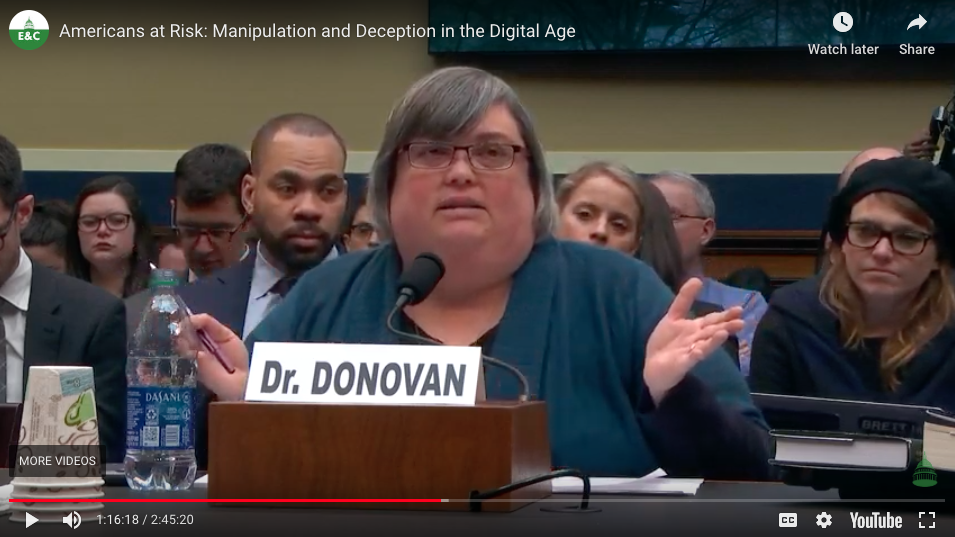
Congressional technology expert Dr. Joan Donovan delivered testimony before the House Subcommittee on Consumer Protection and Commerce on January 8, 2020, addressing growing concerns about online manipulation tactics and their impact on American consumers. The hearing, titled “Americans at Risk: Manipulation and Deception in the Digital Age,” examined the increasingly sophisticated methods used to spread misinformation across digital platforms.
Dr. Donovan, recognized for her extensive research on digital media manipulation and online extremism, presented evidence-based insights into how deceptive online practices have evolved and what potential regulatory responses might be appropriate. Her appearance comes at a critical juncture when lawmakers are grappling with the complex balance between free speech and protecting citizens from harmful digital content.
The hearing reflects growing bipartisan concern about digital manipulation tactics that range from deepfake videos and coordinated disinformation campaigns to microtargeted advertising and algorithm-driven content that can amplify extremist viewpoints. These techniques have raised alarms among policymakers concerned about their potential to undermine democratic processes, consumer protection, and public safety.
Industry observers note that the timing of this congressional inquiry is particularly significant, as it occurred shortly after the implementation of California’s Consumer Privacy Act and amid ongoing debates about federal privacy legislation. Technology companies have faced mounting pressure to take more responsibility for content shared on their platforms, especially after evidence of foreign interference in the 2016 presidential election.
During the three-hour session, committee members questioned witnesses about potential regulatory frameworks that could address digital deception without unduly restricting innovation or free expression—a balancing act that has proven challenging for legislators across the political spectrum.
Dr. Donovan’s testimony built upon her research at Harvard University’s Shorenstein Center on Media, Politics and Public Policy, where she has extensively documented how misinformation spreads through digital ecosystems and impacts public discourse. Her work has been particularly focused on the mechanics of how false information gains traction and the role platform design plays in amplifying or containing problematic content.
The hearing also explored the economic dimensions of digital deception, examining how misleading tactics can harm consumers through fraudulent products, investment schemes, and manipulative advertising. Representatives from consumer advocacy groups emphasized the disproportionate impact these practices have on vulnerable populations, including the elderly and those with limited digital literacy.
Industry representatives at the hearing acknowledged concerns while arguing for self-regulatory approaches rather than new legislation. They highlighted recent platform changes designed to identify and label manipulated content, though critics questioned whether these measures go far enough to address the scale of the problem.
Several committee members expressed frustration with what they characterized as inadequate responses from major technology companies. Democratic representatives generally pushed for stronger regulatory oversight, while Republicans voiced concerns about potential overreach and impacts on free speech.
The hearing represents part of a broader congressional effort to understand and potentially regulate the rapidly evolving digital landscape. Similar hearings have examined specific aspects of technology policy, but this session stood out for its comprehensive look at manipulation tactics across multiple platforms and contexts.
Experts suggest that congressional attention to these issues could signal forthcoming legislative proposals aimed at increasing platform accountability and transparency. However, the path to meaningful regulation remains complicated by jurisdictional questions, constitutional considerations, and the rapid pace of technological change.
The full video record of the hearing provides valuable insight into current congressional thinking on digital manipulation and the competing interests at stake as policymakers consider potential interventions in this complex technological landscape.
Fact Checker
Verify the accuracy of this article using The Disinformation Commission analysis and real-time sources.

16 Comments
The rise of deepfakes and coordinated disinformation campaigns is deeply concerning. I hope this testimony helps drive meaningful action to protect the integrity of our information landscape.
Me too. Maintaining public trust in media and democratic institutions should be a top priority.
Kudos to Dr. Donovan for providing such valuable, evidence-based insights on this critical issue. Policymakers must act swiftly to address the growing threat of digital manipulation.
Absolutely. The integrity of our information ecosystem and democratic processes is at stake, so a comprehensive, proactive approach is essential.
Fascinating to hear about the sophisticated methods used to manipulate public opinion through digital platforms. This underscores the need for greater transparency and accountability in online content distribution.
Absolutely. Policymakers will need to stay vigilant and adaptive as these tactics continue to evolve.
This is an important step in addressing the growing threat of digital manipulation. Dr. Donovan’s expertise on online extremism is crucial for understanding the full scope of this challenge.
Agreed. Policymakers must take a comprehensive approach to tackle the various tactics used to distort and exploit digital information.
This testimony highlights the urgent need for greater transparency and accountability in online content distribution. Policymakers must find ways to mitigate the harms of digital manipulation while protecting free speech.
Agreed. A delicate balance, but one that must be struck to safeguard the health of our information landscape and democratic institutions.
This testimony on media manipulation and disinformation is timely and important. Dr. Donovan’s insights on the evolving tactics used to spread misinformation online will help policymakers address this complex challenge.
Agreed. Protecting citizens from harmful digital content while preserving free speech is a delicate balance that requires careful consideration of evidence-based solutions.
Fascinating to learn about the evolving methods used to spread misinformation online. This underscores the importance of media literacy and critical thinking skills for all internet users.
Agreed. Empowering citizens to navigate the digital landscape more cautiously and skeptically is crucial for combating the effects of manipulation and deception.
While preserving free speech is critical, the potential harms of digital manipulation tactics cannot be ignored. This testimony highlights the need for nuanced, evidence-based solutions.
Absolutely. Finding the right balance will require careful collaboration between lawmakers, tech companies, and civil society.