


Listen to the article
In what archaeologists are calling a groundbreaking discovery, remains of potentially the world’s oldest surgical procedure have been unearthed at an Iron Age site in England. The finding centers on a Viking-age human skull with a carefully created oval hole measuring approximately 3 centimeters in diameter.
The remains belong to a young man, aged between 17 and 24, who lived during the ninth century. Experts believe the man underwent trepanation, an ancient surgical technique where physicians deliberately created holes in the skull of a living person to treat various ailments, including migraines and seizures.
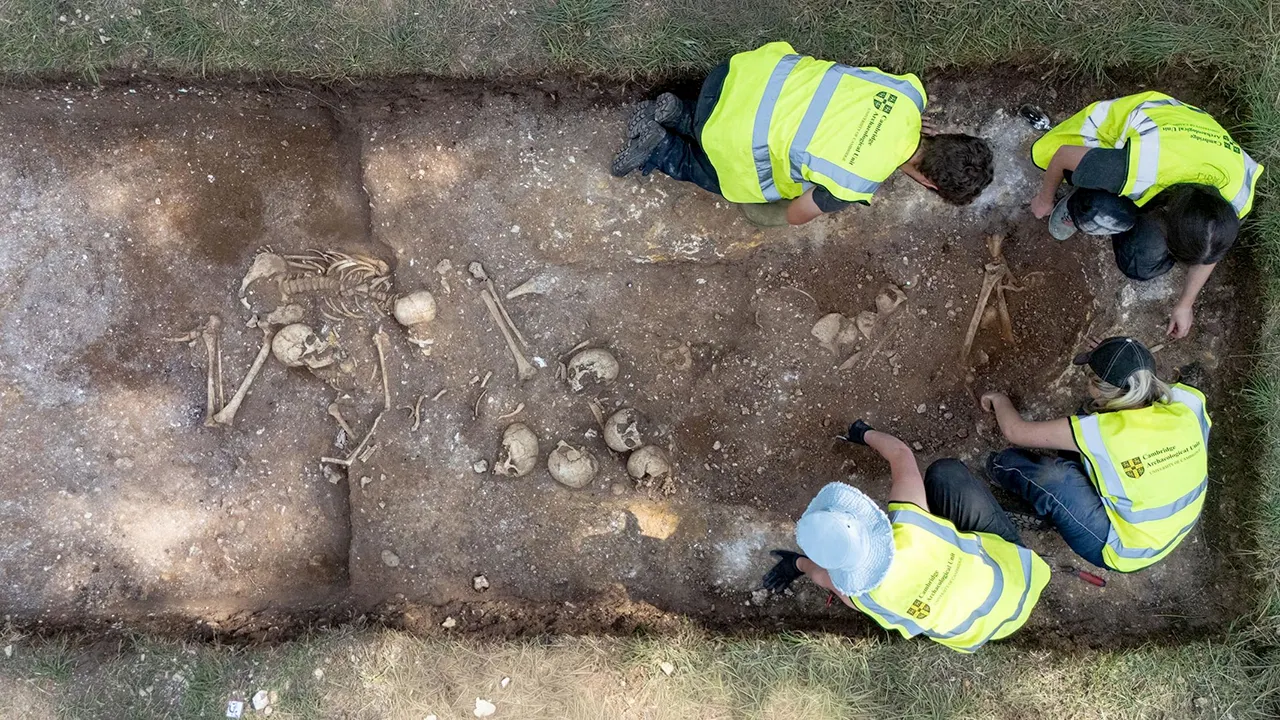
University of Cambridge students made the remarkable discovery last year during a training excavation at the Wandlebury Iron Age hill fort. The finding has since attracted significant attention from the archaeological community for its implications on early medical practices.
What makes this discovery particularly intriguing is not only the evidence of early surgical intervention but also the unusual physical characteristics of the patient. According to researchers, the man stood approximately 6 feet, 5 inches tall—towering nearly a foot above the average male of that era, who typically measured around 5 feet, 6 inches.
Dr. Trish Biers, curator of the Duckworth Laboratory at the University of Cambridge, suggests this unusual height may have been medically significant. “The individual may have had a tumor that affected their pituitary gland and caused an excess of growth hormones,” she explained. “We can see this in the unique characteristics in the long shafts of their limb bones and elsewhere on the skeleton.”
This pituitary condition would likely have increased intracranial pressure, resulting in severe headaches—a symptom that the trepanation procedure was likely attempting to alleviate. The surgical intervention represents an early example of medical practitioners recognizing and attempting to treat specific symptoms, a practice that continues in modern medicine for certain types of head trauma.
The burial context of the remains adds another layer of complexity to the discovery. The young man was found in what archaeologists describe as a mass grave containing a disturbing arrangement of both complete and dismembered bodies. The site included a cluster of skulls and what researchers characterized as a “stack of legs,” suggesting a violent incident rather than a standard burial ground.
Four complete skeletons were found among the remains, with some positioned in ways suggesting they had been bound before burial. Most of the individuals appear to have been young men whose bodies were disposed of without the customary care typically associated with proper burial practices of the era.
Oscar Aldred of the Cambridge Archaeological Unit believes the burial site may represent the aftermath of violence. “Those buried could have been recipients of corporal punishment, and that may be connected to Wandlebury as a sacred or well-known meeting place,” he noted. The arrangement of remains suggests a possible skirmish, battle, or mass execution took place.
Even more chillingly, Aldred hypothesizes that “some of the disarticulated body parts had previously been displayed as trophies and were then gathered up and interred with the executed or otherwise slaughtered individuals,” pointing to possible ritualistic aspects of the deaths.
The discovery provides a rare window into both early medical practices and Viking-age treatment of the dead. While trepanation has been documented in various ancient cultures worldwide, this particular example offers unique insights into how the procedure was conducted during the ninth century in what is now England.
As research continues on these remains, archaeologists and medical historians hope to gain further understanding of surgical techniques used over a millennium ago, potentially reshaping our understanding of the development of medical intervention in early European societies.
Fact Checker
Verify the accuracy of this article using The Disinformation Commission analysis and real-time sources.

22 Comments
Interesting update on Researchers Uncover Significant Medical Finding in Mass Grave Site. Curious how the grades will trend next quarter.
Good point. Watching costs and grades closely.
Production mix shifting toward Health might help margins if metals stay firm.
Good point. Watching costs and grades closely.
Good point. Watching costs and grades closely.
The cost guidance is better than expected. If they deliver, the stock could rerate.
Good point. Watching costs and grades closely.
The cost guidance is better than expected. If they deliver, the stock could rerate.
Good point. Watching costs and grades closely.
Uranium names keep pushing higher—supply still tight into 2026.
Good point. Watching costs and grades closely.
Good point. Watching costs and grades closely.
Silver leverage is strong here; beta cuts both ways though.
Uranium names keep pushing higher—supply still tight into 2026.
Exploration results look promising, but permitting will be the key risk.
Good point. Watching costs and grades closely.
Nice to see insider buying—usually a good signal in this space.
Good point. Watching costs and grades closely.
Good point. Watching costs and grades closely.
Uranium names keep pushing higher—supply still tight into 2026.
Good point. Watching costs and grades closely.
Good point. Watching costs and grades closely.