


Listen to the article
Viking-Age Skull Reveals Evidence of World’s First Surgery
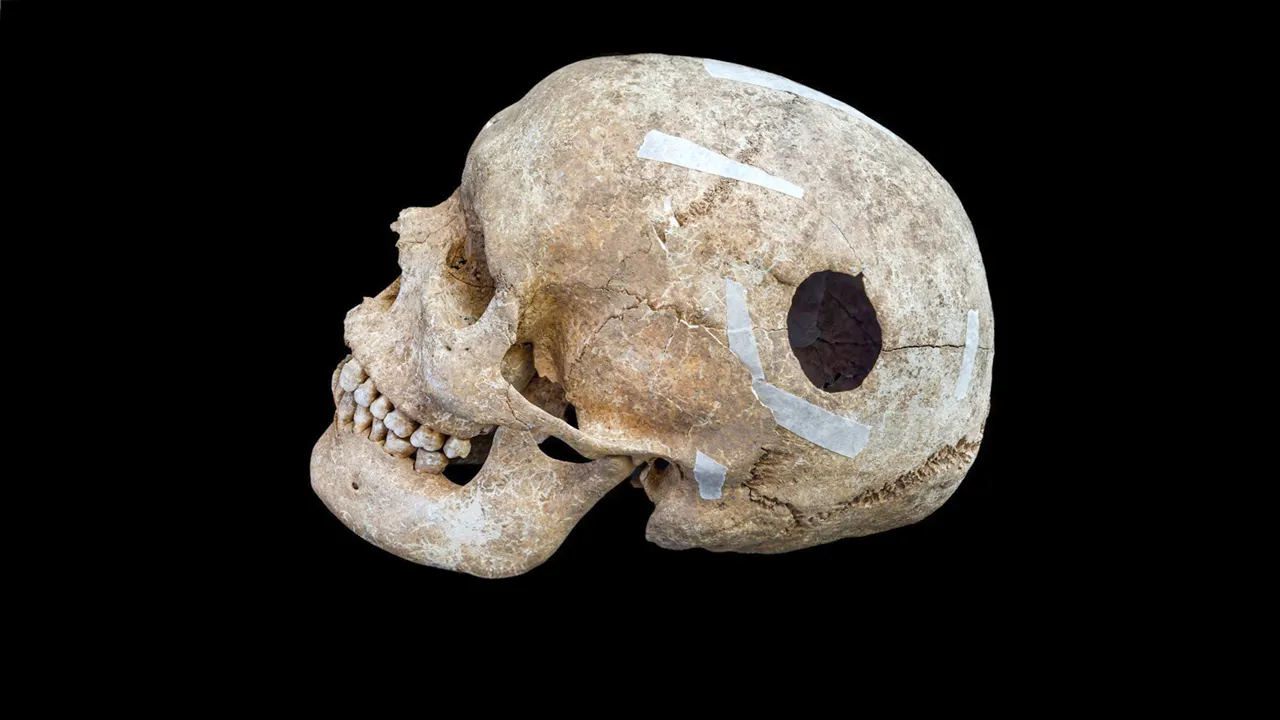
Archaeologists have unearthed what may be evidence of the world’s earliest surgical procedure: a Viking-age human skull with a precisely removed oval portion. The remarkable find was discovered during a training excavation at the Wandlebury Iron Age hill fort by University of Cambridge students last year.
The skull belongs to a young man who lived during the ninth century and was between 17 and 24 years old at the time of his death. What makes this discovery particularly significant is the oval hole measuring approximately 3 centimeters in diameter visible in the cranium, consistent with a procedure known as trepanation.
Trepanation, an ancient surgical technique where a hole is deliberately bored into a living person’s skull, was historically performed to treat various medical conditions including migraines, seizures, and intracranial pressure. According to Dr. Trish Biers, curator of the Duckworth Laboratory at the University of Cambridge, this particular case likely represents an attempt to alleviate severe symptoms.
“The individual may have had a tumor that affected their pituitary gland and caused an excess of growth hormones,” explained Dr. Biers. “We can see this in the unique characteristics in the long shafts of their limb bones and elsewhere on the skeleton.”
This medical theory is supported by the man’s extraordinary height. Standing 6 feet, 5 inches tall, he would have towered nearly a foot above the average ninth-century male, who typically reached only 5 feet, 6 inches. Such extreme growth is consistent with conditions affecting the pituitary gland.
Dr. Biers noted that such a condition would have created increased intracranial pressure, resulting in debilitating headaches. “The trepanation was likely an attempt to alleviate that pain, a goal that is not uncommon with head trauma today,” she said, highlighting the continuity between ancient and modern medical reasoning.
The burial context adds another layer of complexity to the discovery. The skull was found in a mass grave containing a disturbing arrangement of both complete and dismembered human remains. Archaeologists described finding a cluster of skulls and what they termed a “stack of legs” among the jumbled remains.
Four complete skeletons were recovered from the site, with some positioned in ways suggesting they had been bound before burial. The majority appeared to be young men who had been unceremoniously disposed of in the pit, leading researchers to theorize that the site represents the aftermath of violent conflict.
“Those buried could have been recipients of corporal punishment, and that may be connected to Wandlebury as a sacred or well-known meeting place,” suggested Oscar Aldred of the Cambridge Archaeological Unit. “It may be that some of the disarticulated body parts had previously been displayed as trophies and were then gathered up and interred with the executed or otherwise slaughtered individuals.”
The macabre nature of the burial site points toward either a skirmish, battle, or mass execution having occurred in the area during the Viking era. This period was marked by significant conflict and territorial disputes across the British Isles.
While trepanation was practiced across many ancient cultures, this discovery provides valuable insight into medical knowledge and practices during the Viking age specifically. The precision of the surgical intervention suggests a sophisticated understanding of anatomy and medical procedure, challenging perceptions about medieval medical capabilities.
Researchers continue to analyze the remains to gain further understanding of ninth-century medical practices and the circumstances surrounding this unusual burial site. The findings could reshape our understanding of early surgical interventions and Viking-age medical knowledge.
Fact Checker
Verify the accuracy of this article using The Disinformation Commission analysis and real-time sources.

12 Comments
This is a remarkable discovery that expands our knowledge of ancient medical practices. The precision of the trepanation procedure is quite impressive, considering the technological limitations of the era. I’m curious to learn more about the individual’s condition and the rationale behind this surgical intervention.
Agreed, the level of surgical skill demonstrated is truly remarkable. Gaining a better understanding of the individual’s medical history and the intended therapeutic benefits of the trepanation could offer valuable insights into the state of healthcare during the Viking Age.
This discovery is a remarkable example of the medical advancements achieved during the Viking Age. I’m impressed by the precision of the trepanation procedure, which suggests a high level of anatomical knowledge and surgical skill for the time period.
Absolutely. The oval shape and size of the cranial opening indicates a sophisticated surgical technique, far beyond what one might expect for that era. It will be intriguing to learn more about the individual’s condition and the motivations behind this procedure.
The evidence of 9th-century brain surgery is a significant archaeological finding. It raises questions about the medical understanding and capabilities of the Viking-age population. I wonder if this was a common practice or a rare, specialized procedure.
That’s a good point. Determining the prevalence of trepanation during this time period would provide valuable context. Further research may shed light on whether this was a routine treatment or a novel, experimental approach to address specific medical issues.
Trepanation was a risky but potentially life-saving procedure in the past. This find highlights the medical challenges faced by ancient populations and their efforts to address serious conditions through surgical intervention.
You make a good point. Even with the inherent risks, the motivation to alleviate severe symptoms like migraines or seizures would have driven this pioneering surgical approach. It’s a fascinating window into the past.
This is an impressive example of early surgical innovation. The ability to perform such a delicate cranial procedure during the 9th century is quite remarkable. I wonder what other medical advancements may be uncovered from this period.
Agreed, it’s a testament to the ingenuity and medical understanding of the time. Discoveries like this help expand our knowledge of the evolution of surgical techniques and the state of healthcare centuries ago.
Fascinating archaeological discovery! I’m curious to learn more about the potential medical techniques and conditions treated by this ancient trepanation procedure. The precision of the oval hole is quite remarkable for the time period.
Indeed, this offers a unique glimpse into the medical knowledge and practices of the Viking Age. It will be interesting to see what further analysis can reveal about the individual’s condition and the surgical process.