


Listen to the article
Trump White House Downplays ICE Presence at Polling Sites While Pushing for Federal Election Control
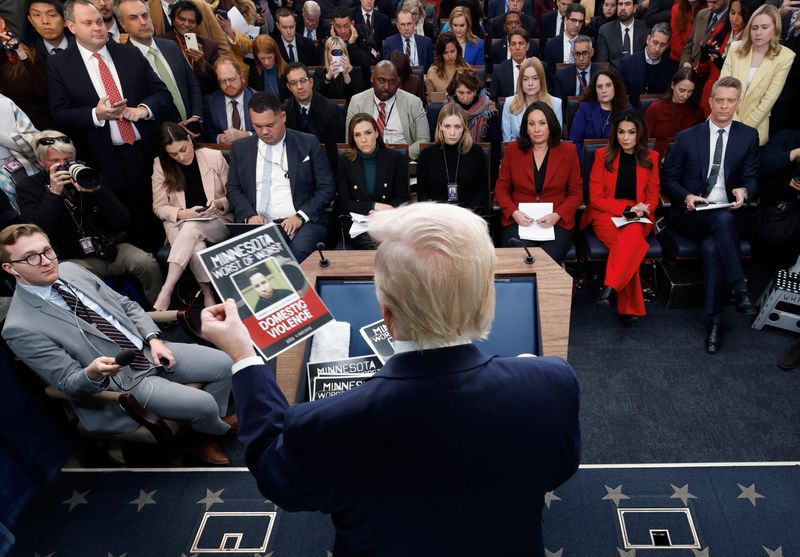
President Donald Trump has not discussed “formal plans” to deploy U.S. Immigration and Customs Enforcement (ICE) agents to polling sites during November’s midterm elections, according to White House press secretary Karoline Leavitt. However, the administration notably declined to rule out the possibility of ICE presence near voting locations.
“I can’t guarantee that an ICE agent won’t be around a polling location in November,” Leavitt told reporters during a Thursday press briefing, “but what I can tell you is I haven’t heard the president discuss any formal plans to put ICE outside of polling locations.”
The comments come after Trump stated on Monday that Republicans should “nationalize” and “take over” voting in at least 15 unspecified locations, continuing his unsubstantiated claims that U.S. elections are compromised by widespread fraud. Election officials and independent studies have consistently found no evidence of significant voter fraud in American elections.
Former Trump adviser Steve Bannon amplified the president’s message on his “War Room” podcast Tuesday, saying, “You’re damn right we’re gonna have ICE surround the polls come November.” Bannon repeated false assertions that undocumented immigrants vote in large numbers, a claim repeatedly debunked by election experts.
The suggestion of deploying immigration enforcement officers near polling sites raises significant legal and civil rights concerns. Federal law explicitly prohibits the president from deploying military troops at election locations. Additionally, several states have laws criminalizing the carrying of firearms at or near polling places.
Civil rights advocates warn that immigration enforcement activities near polling locations could intimidate legitimate voters. Past studies have shown that heightened immigration enforcement has caused both U.S. citizens and legal residents to avoid public spaces, including polling sites, out of fear of detention or racial profiling.
Democratic lawmakers have increasingly expressed concerns that Trump might use federal forces to intimidate voters and interfere with the crucial November elections, which will determine control of Congress. These fears stem from the president’s repeated false claims about election integrity and his administration’s aggressive posture toward Democratic-led states on voting issues.
The Trump administration has intensified pressure on many states to turn over voter data, with the Justice Department filing lawsuits against nearly two dozen states regarding their voter rolls. Last week, the FBI conducted a search of an election office in Georgia’s Fulton County, seeking records related to the 2020 election—an action aligned with Trump’s continued promotion of debunked fraud claims about his electoral defeat.
Not all Republicans support Trump’s call for increased federal involvement in elections. Senate Majority Leader John Thune expressed opposition, stating he is “not in favor of federalizing elections.” Similarly, House Speaker Mike Johnson emphasized that “it’s always been the responsibility of the states to administer elections,” reflecting the traditionally conservative position of maintaining state control over election administration.
The controversy highlights escalating tensions around election security and administration as the November midterms approach. Election experts warn that rhetoric suggesting the presence of enforcement agencies at polling sites could suppress voter turnout, particularly among immigrant communities and communities of color, regardless of whether such deployments actually materialize.
Legal scholars note that while presidents have limited direct authority over election administration, rhetoric from high-ranking officials can significantly impact voter confidence and participation. As campaigns intensify heading toward November, election officials across the country are working to maintain both security and accessibility at polling locations while navigating increasingly polarized political messaging about the electoral process.
Fact Checker
Verify the accuracy of this article using The Disinformation Commission analysis and real-time sources.

9 Comments
The continued rhetoric around ‘taking over’ voting is deeply concerning, regardless of whether there are formal plans for ICE deployment. Maintaining trust in the electoral process should be the top priority for all stakeholders, not partisan power plays.
Agreed. Any actions that could suppress or discourage lawful voting, even unintentionally, are unacceptable. Nonpartisan election administration and security must be the focus, not political grandstanding.
Interesting developments around potential ICE presence at polling sites. While the White House downplays formal plans, the continued rhetoric around ‘taking over’ voting is concerning. Election integrity and security should be the top priority, not political grandstanding.
I agree, any perceived attempts to intimidate or restrict voting access would be highly problematic. Robust election safeguards and nonpartisan oversight are critical for maintaining public trust.
The lack of evidence for widespread voter fraud is well-established. Deploying federal immigration agents near polling places could have a chilling effect on voter participation. Transparency and equal access to the ballot box should be the focus, not unsubstantiated claims.
Absolutely. Any actions that may suppress or discourage lawful voting, regardless of intent, undermine the democratic process. Voters deserve to cast their ballots freely and without fear of interference.
While the White House may not have ‘formal plans’ for ICE presence at polling sites, the very possibility undermines faith in the electoral system. Voters deserve to cast their ballots freely and without fear of interference, regardless of political affiliation.
The White House’s equivocation on potential ICE presence is troubling. While they may not have ‘formal plans’, the very possibility erodes confidence in the electoral system. Nonpartisan election administration and security should be the priority, not political posturing.
I share your concern. Even the perception of voter intimidation, whether intended or not, can have a chilling effect. Protecting the integrity of elections should transcend partisan interests.