


Listen to the article
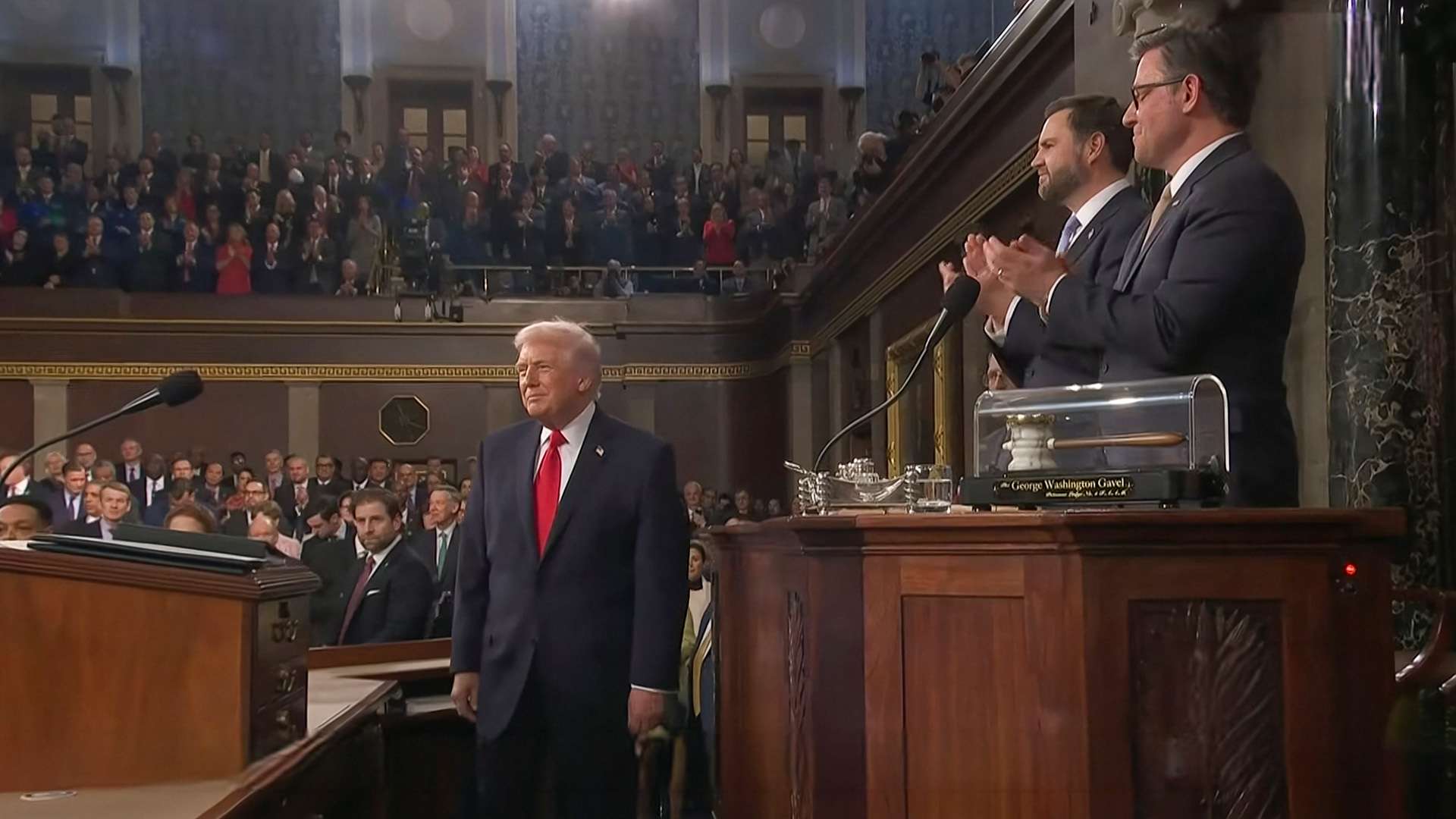
In an unprecedented display of political pageantry, President Donald Trump delivered what has now been confirmed as the longest State of the Union address in U.S. history, clocking in at nearly two hours. The marathon speech, which could have harked back to a simpler era when presidents merely sent written updates to Congress, instead transformed into a sprawling showcase of the president’s priorities and personal grievances.
Trump’s theatrical approach was on full display throughout the evening. He celebrated the U.S. hockey team’s Olympic gold medal victory, referred to the Space Force as “my baby,” and characterized Democrats as “pro-crime.” In one particularly eyebrow-raising moment, he claimed to have ended eight wars in just ten months, prompting a visibly pained expression from Secretary of State Marco Rubio.
Despite its extraordinary length, analysts note the speech essentially delivered two core messages: first, that Trump and his administration are “winning,” and second, that his political opponents are “losing.” This framing was reinforced minutes after the conclusion, when the White House press secretary published a list of items “Democrats refused to stand for” during the address, clearly establishing the partisan lens through which the administration wants the speech viewed.
However, Trump’s assertion of success may face skepticism from the American public. Recent Wall Street Journal polling indicates widespread dissatisfaction with the president’s economic management. Despite some positive economic indicators, Americans have experienced what economists describe as a “vibecession” under Trump, where sentiment about the economy remains negative despite data suggesting otherwise.
This partisan perception gap is nothing new. According to Echelon Insights, Democrats predominantly view Trump’s economy negatively, while Republicans see improvement – a mirror image of the partisan divide that existed during the Biden administration. What’s notable is that Trump’s signature economic policy – tariffs – remains “uniquely unpopular” across the political spectrum.
In his address, Trump doubled down on tariffs, suggesting he would find alternative authorities to reinstate them despite recent Supreme Court limitations. He repeatedly claimed tariffs would help alleviate national debt and even potentially replace income tax – assertions economists have consistently debunked as mathematically impossible.
Fact-checkers worked overtime during and after the speech. Trump incorrectly claimed the Biden administration produced the worst inflation in U.S. history. He boasted of securing $18 trillion in foreign investments, while the White House’s own website only claims $9.7 trillion. His assertion that inflation has been defeated in favor of “tremendous growth” contradicts current economic data showing inflation remains elevated.
Perhaps most notably, Trump’s claim about gas prices “below $2.30 a gallon in most states, and in some places, $1.99 a gallon” faced immediate scrutiny. GasBuddy’s head of petroleum analysis identified only four gas stations nationwide offering sub-$2 fuel, while AAA data showed no state with average prices below $2.37 per gallon.
The president also made controversial claims about welfare fraud in Minnesota, stating that “members of the Somali community have pillaged an estimated $19 billion from the American taxpayer.” While significant fraud has been uncovered in Minnesota’s Medicaid program, with many Somali individuals among those arrested, federal prosecutors initially estimated the figure at around $9 billion – far below Trump’s claim.
On entitlement reform, Trump maintained his promise to “always protect Social Security and Medicare,” despite these programs being primary drivers of long-term federal debt. Financial analysts warn that without structural changes, both programs face significant shortfalls within the next decade, creating an unsustainable trajectory.
The speech’s unprecedented length and confrontational tone turned the typically formal event into a spectacle that Washington embraced in its own way. Bars across the capital offered State of the Union specials, including one establishment promising free beer “until the first insult.”
In a rare display of bipartisanship amid the partisan spectacle, Republican Representative Thomas Massie of Kentucky and Democratic Representative Ro Khanna of California sat together during the address. The pair have recently co-sponsored a war powers resolution aimed at forcing Congress to vote on potential military action against Iran – one of the few issues bridging the partisan divide as tensions in the Middle East continue to simmer.
Fact Checker
Verify the accuracy of this article using The Disinformation Commission analysis and real-time sources.

10 Comments
The length and theatrical nature of the speech are certainly noteworthy, but I’m more interested in the specific policy proposals and their potential impacts on industries like mining, energy, and commodities. Fact-based analysis will be key.
Agreed, the showmanship shouldn’t overshadow the actual substance and implications for relevant sectors. A nuanced, impartial review is essential.
I appreciate the president highlighting the US space program, but the claim about the ‘Space Force’ being ‘his baby’ seems more like political theater than a substantive policy achievement. I’d like to see more concrete details on space-related initiatives.
Yes, grandiose rhetoric around space policy can distract from the actual work being done. Substance and facts should take priority over partisan posturing.
While I appreciate the president highlighting US economic and industrial strengths, I’m skeptical of some of the more hyperbolic claims about ending wars and Democratic opposition. A more nuanced, evidence-based analysis would be helpful.
Agreed, it’s important to separate fact from fiction, regardless of partisan affiliation. Sensational rhetoric doesn’t serve the public interest.
The focus on tariffs and trade policies is interesting, but I’d like to see a more balanced assessment of their impacts on different industries and consumers. Simplistic ‘us vs. them’ narratives often miss important details.
Absolutely, a nuanced, data-driven look at the real-world effects of trade policies is crucial for evaluating their merits.
This seems like a politically charged speech with some questionable claims. I’m curious to see fact-checks and analysis from a range of reliable sources to get a fuller picture of what was said.
Yes, it’s important to look at the facts and context behind political speeches, rather than just taking the rhetoric at face value.