


Listen to the article
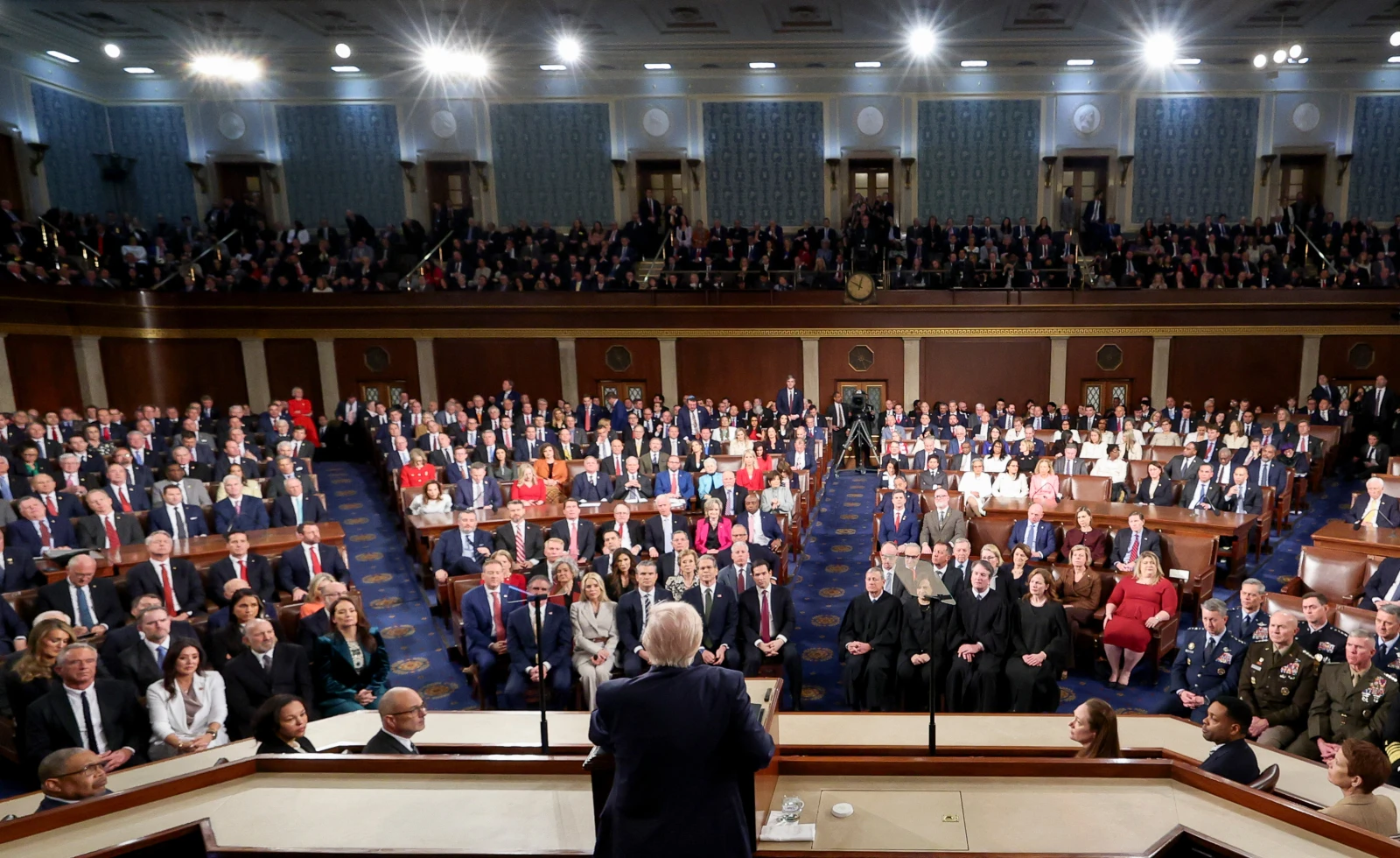
In his State of the Union address Tuesday, President Donald Trump presented Americans with what he called a “turnaround for the ages,” but many of his claims failed to withstand factual scrutiny, according to a detailed analysis of his statements.
Trump’s portrayal of economic conditions featured several mischaracterizations. While claiming he inherited “a stagnant economy” twelve months ago, economic data tells a different story. The U.S. GDP actually grew by 2.8% in 2024 during Biden’s final year, outpacing the 2.2% growth in Trump’s first year back in office.
The president’s assertion that “incomes are rising fast” in a “roaring economy” similarly contradicts economic indicators. After-tax incomes, adjusted for inflation, rose just 0.9% in 2025, a significant decline from the 2.2% growth recorded during Biden’s last year in office. This represents the smallest annual gain since 2022.
Trump’s claim of securing “$18 trillion pouring in from all over the globe” lacks supporting evidence. The White House’s own website lists a much lower figure of $9.6 trillion, which appears to include investment commitments made during the Biden administration. A January study cast doubt on whether more than $5 trillion in investment commitments made by major trading partners last year would actually materialize.
While Trump accurately stated that “more Americans are working today than at any time in the history of our country,” experts point out this is primarily due to population growth. The proportion of Americans with jobs has actually fallen significantly over the past quarter-century. The current employment rate of 59.8% remains well below the April 2000 peak of 64.7%. Additionally, the current unemployment rate of 4.3% is higher than the 4% rate when Biden left office in January 2025.
The president’s claim of having “ended eight wars” in his first ten months appears highly exaggerated. In at least two instances Trump cites—between Serbia and Kosovo, and between Egypt and Ethiopia—there were no active conflicts to resolve. His influence varied significantly in the other disputes he mentioned.
On tariffs, Trump’s assertion that the revenue is “saving our country” overlooks important context. Before the Supreme Court struck down some of his tariff measures, the Congressional Budget Office estimated his new taxes would raise $300 billion annually—far less than needed to offset his $4.7 trillion tax cuts or address the $1.78 trillion annual budget deficit.
Similarly, his claim that “tariffs paid for by foreign countries will substantially replace the modern day system of income tax” appears mathematically implausible. While tariff revenues have increased to $195 billion, they still account for less than 4% of federal revenue, compared to income and payroll taxes which make up 84%.
Trump’s statement about lowering prescription drug prices “from the highest price in the entire world to the lowest” was characterized by health policy experts as “total fiction.” His claims about crime rates also require context: while there has been a significant decrease in violent crime during 2025, this continues a downward trend that began several years earlier, including during Biden’s presidency.
On immigration, the president’s assertion that “we will always allow people to come in legally” contrasts with his administration’s actions. Trump has restricted immigration from nearly 40 countries, many in Africa, and limited the refugee program to primarily white South Africans.
Additional statements regarding tax policy, election security, and even basic historical facts like the start of the American Revolution contained significant inaccuracies or misleading information, according to the analysis.
These factual discrepancies highlight the importance of critical evaluation of presidential statements, particularly on matters of economic policy, international relations, and domestic governance where precision and accuracy are essential for informed public discourse.
Fact Checker
Verify the accuracy of this article using The Disinformation Commission analysis and real-time sources.
