


Listen to the article
Trump’s Economic Claims Under Scrutiny Following State of the Union
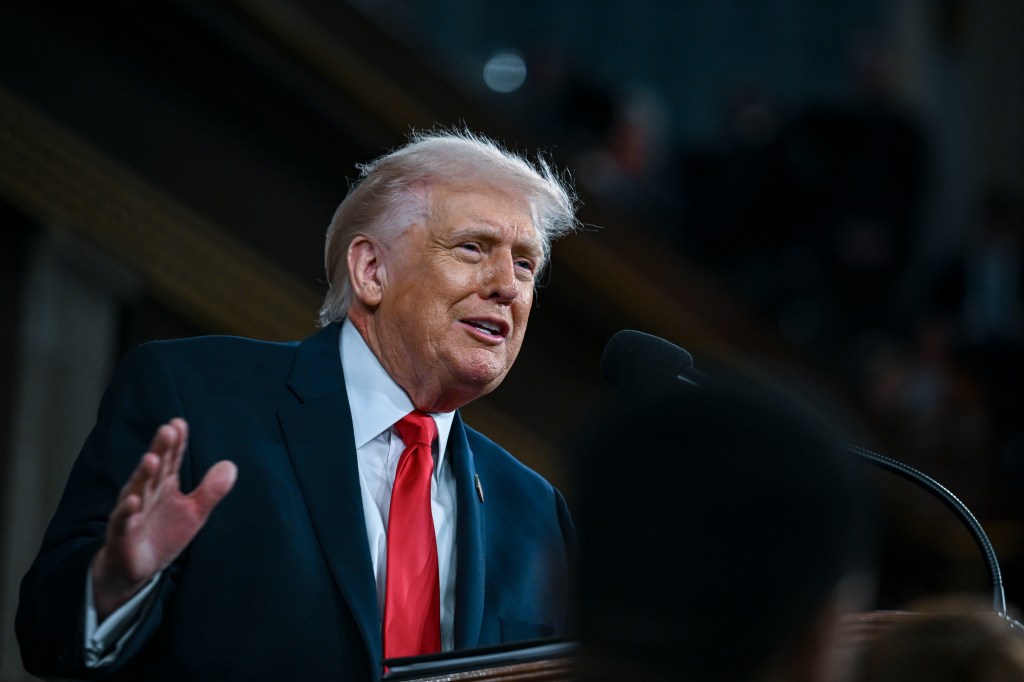
President Donald Trump continued to champion his protectionist trade policies during Tuesday’s State of the Union address, just days after the Supreme Court struck down his tariff agenda. The speech contained several disputed claims about tariffs, trade deals, and the economy that merit closer examination.
In his address, Trump criticized the previous administration, claiming that “the Biden administration and its allies in Congress gave us the worst inflation in the history of our country,” while touting his own record of reducing inflation to “the lowest level in more than five years.”
Economic data contradicts Trump’s characterization of the Biden-era inflation as historically unprecedented. While inflation did reach 9.1 percent in June 2022 under Biden and remained above 6 percent for 17 consecutive months, this falls short of the 14.8 percent peak recorded in March 1980. The all-time record for U.S. inflation actually occurred in June 1920 at 23.7 percent, according to Bureau of Labor Statistics data that dates back to 1913.
Trump’s assertion about current inflation levels being at a five-year low is more accurate. The Bureau of Labor Statistics recently reported that the Consumer Price Index showed prices increasing 2.39 percent for the 12 months ending in January 2026, lower than at any point during most of Biden’s term except for a brief dip to 2.42 percent in September 2024.
However, Trump’s claim about core inflation dropping to 1.7 percent in the final quarter of 2025 requires clarification. This calculation uses a non-standard methodology based on averaging the annualized rates of monthly CPI growth rather than the official year-over-year comparison used by the Bureau of Labor Statistics.
The president also made bold claims about foreign investment, stating he had “secured commitments for more than $18 trillion pouring in from all over the globe” in just 12 months. This figure appears to be substantially inflated, as the White House’s own data cites $9.7 trillion in commitments.
Economic experts have raised questions about the validity of even the lower figure. Scott Lincicome, Vice President at the Cato Institute, noted that many of these “commitments” face practical challenges. Some involve military equipment purchases that were already planned, while others represent agreements that may not materialize due to geopolitical constraints or lack of authority to control private firms’ purchasing decisions.
Additionally, companies often repackage previously planned investments to align with a new administration’s priorities. Bloomberg’s analysis found that approximately 83 percent of corporate investment pledges cited by the White House relate to artificial intelligence and data centers—developments that were likely to occur regardless of trade policy.
Perhaps most controversial was Trump’s assertion that “tariffs, paid for by foreign countries, will, like in the past, substantially replace the modern-day system of income tax.” This claim contradicts economic research, including a February report from the Federal Reserve Bank of New York calculating that Americans bore 94 percent of the cost of Trump’s previous tariffs.
The numbers also don’t support the feasibility of tariffs replacing income taxes. In 2025, tariffs generated an estimated $194.8 billion in inflation-adjusted revenue, while individual federal income taxes totaled $924 billion. With $4.3 trillion in goods and services imported in 2025, tariffs would need to average around 46 percent to generate equivalent revenue—a level that would likely reduce imports and thus undermine the very revenue stream being promoted.
When contacted by reporters, the White House declined to provide additional sources or calculations to support the president’s claims about investment figures or how tariffs could replace income tax revenue.
The president’s economic assertions come at a pivotal time for his trade agenda, following the Supreme Court’s ruling limiting his authority to impose tariffs under the International Emergency Economic Powers Act. Trump vowed to continue his tariff policy using alternative statutes that he claimed would lead to “a solution that will be even stronger than before.”
Fact Checker
Verify the accuracy of this article using The Disinformation Commission analysis and real-time sources.

14 Comments
The article provides a useful fact-check on Trump’s economic claims, particularly around inflation levels. It’s important to scrutinize such statements and ensure they align with empirical data, rather than political narratives.
Agreed. Fact-checking is essential, but it’s also crucial to consider multiple perspectives and avoid oversimplifying complex economic issues. A balanced, evidence-based approach is the best way to evaluate policy claims.
Interesting analysis of Trump’s economic claims. It’s important to fact-check political statements, especially on high-stakes issues like inflation and trade policy. While reasonable people can disagree, objective data should guide the discussion.
Agreed, data and context are crucial when evaluating economic claims. Oversimplifying or cherry-picking stats can distort the reality. A nuanced, evidence-based approach is needed.
The article raises some valid points about Trump’s statements not fully matching the economic data. Reasonable people can interpret the data differently, but it’s good to see a fact-check that cites specific figures.
That’s a fair assessment. Fact-checking is valuable, but can also be politicized. It’s important to consider the full context and multiple perspectives when evaluating economic performance under different administrations.
The article provides a helpful fact-check on Trump’s economic claims. It’s important to scrutinize political statements, especially on high-stakes issues like inflation and trade. While reasonable people may interpret data differently, objective analysis is crucial for informed public discourse.
I agree that fact-checking is essential, but it should be done in a balanced and impartial manner. Oversimplifying complex economic issues or using data selectively to support a particular narrative can be counterproductive. A nuanced, evidence-based approach is needed.
This is a thought-provoking analysis of Trump’s economic statements. While the data may not fully support his characterization, it’s important to acknowledge the nuances and differing interpretations of economic performance. Fact-checking is valuable, but shouldn’t be used to dismiss legitimate policy debates.
Well said. Fact-checking is a valuable tool, but it’s important to use it judiciously and avoid partisan bias. Engaging in constructive dialogue, while grounding discussions in reliable data, is the best way to address complex economic issues.
This is an interesting look at the economic claims made by Trump during the State of the Union address. While the article raises some valid points about the data not fully supporting his characterization, it’s important to acknowledge the complexity of these issues. Fact-checking is valuable, but shouldn’t be used to dismiss legitimate policy debates.
Well said. Fact-checking is a crucial tool, but it’s important to use it judiciously and avoid partisan bias. Engaging in constructive dialogue, while grounding discussions in reliable data, is the best way to address complex economic challenges.
This is an interesting look at Trump’s rhetoric around inflation and trade. While his claims may resonate with some, the data suggests a more complex reality. It’s important to critically examine economic policy statements, regardless of the political affiliation.
Well said. Nuance and objectivity are needed when assessing economic issues that are often politicized. Relying on verifiable data, rather than partisan framing, is the best path forward.