


Listen to the article
President Trump Orders Crackdown on False “Made in America” Claims
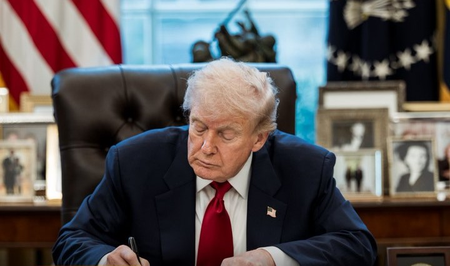
President Donald Trump signed an executive order Wednesday directing federal agencies to intensify enforcement against companies falsely advertising products as “Made in America,” a move aimed at protecting both consumers and legitimate U.S. manufacturers.
The order, signed in Washington, targets a growing problem in e-commerce where foreign manufacturers misrepresent product origins to appeal to patriotic American consumers. It empowers the Federal Trade Commission (FTC) to prioritize enforcement against misleading origin claims such as “Made in America” or “Made in the USA.”
“Americans have a right to clear, accurate, substantiated, and accessible information regarding whether products advertised as ‘Made in America’ are actually made in the United States,” the executive order states. The White House emphasized that many Americans specifically seek out American-made products when making purchasing decisions, making accurate labeling crucial for consumer trust.
The measure particularly focuses on online marketplaces, where verification of origin claims has become increasingly difficult. Under the order, the FTC may propose new regulations specifically targeting these digital platforms. Notably, an online marketplace’s failure to verify country-of-origin claims could be considered an “unfair or deceptive act or practice” under U.S. law, potentially exposing them to legal consequences.
The executive order also addresses federal procurement practices. Agencies managing government-wide contracts must now regularly review origin claims on products sold to the federal government. Products falsely claiming American origin must be removed from government procurement lists, and the companies responsible may face referral to the Department of Justice for potential action under the False Claims Act.
“American businesses building, growing, and manufacturing all, or virtually all, aspects of their products onshore are entitled to the undiluted branding benefits that come with supporting the American economy,” the order states, highlighting the competitive disadvantage legitimate U.S. manufacturers face when competing against falsely labeled imports.
This latest action aligns with the Trump administration’s broader economic agenda focused on revitalizing domestic manufacturing. During his first term, Trump signed multiple executive orders promoting “Buy American and Hire American” policies and implemented tariffs on foreign steel, aluminum, copper, and automobiles to protect domestic industries.
The manufacturing sector has been a key focus for the administration, which has positioned American manufacturing revival as essential for national security and economic resilience. The COVID-19 pandemic exposed vulnerabilities in global supply chains, further reinforcing the administration’s emphasis on domestic production capacity.
Manufacturing industry groups have generally supported stronger enforcement of “Made in America” claims. The National Association of Manufacturers has previously called for stricter standards and better enforcement of origin labeling to protect their members’ investments in domestic production.
The FTC’s existing “Made in USA” standard requires that products carrying this label be “all or virtually all” made in the United States. However, enforcement has been challenging, particularly as supply chains have become increasingly globalized and complex. The commission has brought relatively few enforcement actions in recent years despite widespread concerns about misleading claims.
According to a White House fact sheet accompanying the order, the measure ensures that “‘Made in America’ is more than a label — it’s a promise.”
The executive order takes effect immediately, though the development of new regulations by the FTC would require additional time for proposal, public comment, and implementation phases.
Fact Checker
Verify the accuracy of this article using The Disinformation Commission analysis and real-time sources.

13 Comments
This seems like a commonsense measure to uphold truth in advertising and support American manufacturing. Curious to see the specific mechanisms the FTC will use to verify origin claims.
It will be interesting to see how this plays out in practice, particularly for emerging technologies and materials like lithium, rare earths, and battery components. Accurate labeling is crucial.
This executive order could have significant implications for the mining, metals, and energy sectors if it leads to more scrutiny of supply chain claims. Transparency will be key.
It’s good to see the government taking action against misleading product origin claims, especially in the e-commerce space. Consumers deserve accurate information to make informed purchasing decisions.
Absolutely, accurate labeling is key for consumer trust. Proper verification of origin claims will be crucial to ensure companies are not exploiting patriotic sentiments.
While I appreciate the intent behind this order, I wonder how it will impact global supply chains and international trade. Hopefully it can be implemented in a balanced way.
That’s a fair concern. The administration will need to carefully weigh the consumer protection benefits against any unintended consequences for businesses and trade.
While I support the goal of this order, I wonder about the administrative burden it could place on small businesses and online sellers. Hopefully the implementation is pragmatic.
That’s a good point. The FTC will need to balance enforcement with minimizing compliance costs, especially for smaller companies selling through digital platforms.
Glad to see the government taking steps to crack down on deceptive ‘Made in America’ labeling. Accurate product origin information is crucial for consumers.
Curious to see how effective this executive order will be in practice. Enforcing accurate ‘Made in America’ claims across online marketplaces seems like a major challenge.
You make a good point. Effective monitoring and enforcement will be critical, especially for smaller or international sellers. Proper auditing processes will be needed.
This is an important step to ensure transparency and protect American consumers from deceptive marketing claims. Cracking down on false ‘Made in America’ labels is crucial for the integrity of domestic manufacturing.