


Listen to the article
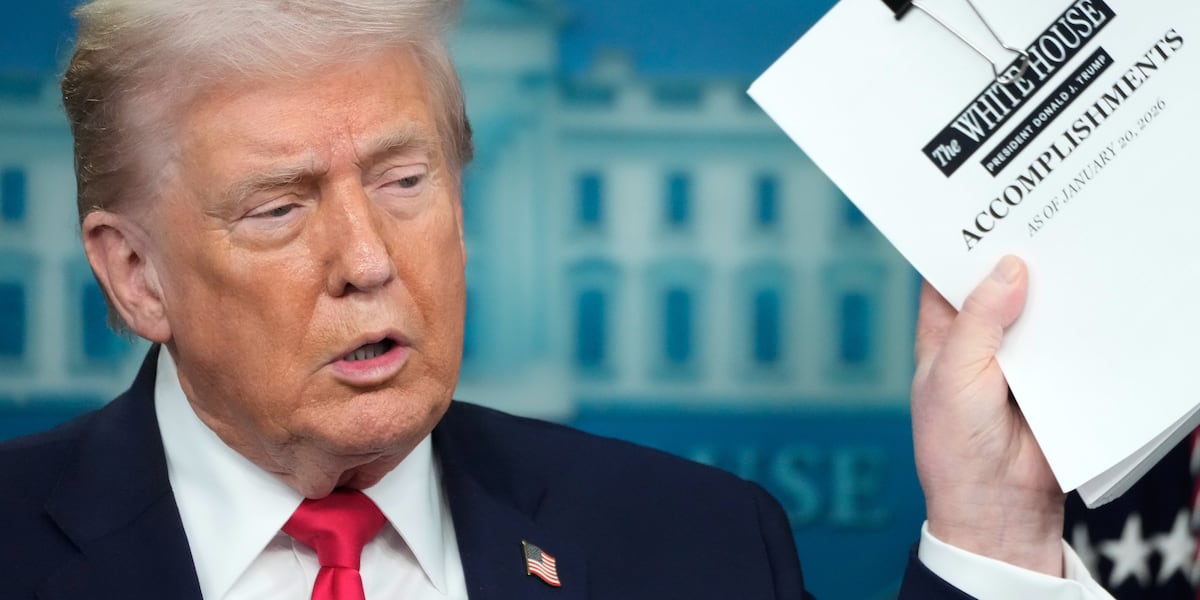
In his first year back in office, President Donald Trump held a nearly two-hour press briefing Tuesday, highlighting his administration’s accomplishments while repeatedly making false claims across multiple policy areas.
The president’s remarks covered a wide range of topics, including the 2020 election, foreign conflicts, economic conditions, energy policy, and California’s wildfire response. Throughout the briefing, Trump continued patterns of misinformation that have characterized much of his public communication in 2025.
Despite losing the 2020 election by a significant margin, Trump again insisted the race was “rigged” against him. “A man that didn’t win the election, by the way, it’s a rigged election. Everybody knows that now,” Trump said, referring to former President Biden.
The facts contradict these assertions. Biden secured 306 electoral votes to Trump’s 232 and won the popular vote by more than 7 million ballots. This victory was verified by state election officials from both parties, courts across the country, and Trump’s own Department of Homeland Security at the time. Even Trump’s then-Attorney General William Barr stated publicly that no evidence of widespread voter fraud had been found.
Trump’s claims about resolving international conflicts were similarly exaggerated. He asserted that he had “settled eight wars,” pointing to situations involving Israel, Hamas, Iran, Egypt, Ethiopia, India, Pakistan, Serbia, Kosovo, Rwanda, Congo, Armenia, Azerbaijan, Cambodia, and Thailand.
Analysis of these conflicts reveals a more complex reality. While Trump helped facilitate agreements between Armenia and Azerbaijan, these nations have yet to sign a formal peace treaty. The Gaza conflict remains unresolved despite temporary ceasefires. Recent fighting has erupted between Cambodia and Thailand, and between Congolese forces and Rwanda-backed rebels, contradicting claims of settled conflicts.
In cases like India and Pakistan, Trump’s role in mediating tensions has been disputed by the nations involved. Many of the situations he cited involved diplomatic tensions rather than actual warfare.
On economic matters, Trump falsely claimed that his administration inherited “historic” inflation levels. “We had the highest inflation, in my opinion, that we’ve ever had,” he stated.
Economic data refutes this characterization. While inflation during the Biden administration peaked at 9.1% in June 2022, driven by pandemic-related supply chain disruptions, government spending, and Russia’s invasion of Ukraine, Americans have experienced far worse inflation historically. Rates exceeded 13% in 1980 and approached 20% during World War I.
By December 2025, inflation had fallen to 2.7%, though it began rising again after Trump announced new tariff policies in April.
The president’s comments on energy policy continued to promote coal as “clean, beautiful” while omitting critical context about environmental impacts. Though emissions from coal production have decreased over three decades, United Nations research indicates that global coal usage must still be significantly reduced to address climate change.
Coal combustion continues to emit carbon dioxide, sulfur dioxide, and nitrogen oxides that contribute to climate change, acid rain, smog, and respiratory illnesses. Once providing over half of U.S. energy, coal now accounts for only about 15% of electricity production.
Trump also made misleading statements about California’s wildfire response, blaming water shortages during the 2025 Los Angeles wildfires on state policies protecting endangered species. He claimed water was routed to the Pacific Ocean instead of being used for firefighting.
Local officials have attributed hydrant failures during the fires to municipal systems being overwhelmed by the disaster’s scale, not water conservation policies. Trump’s subsequent order to release water from Central Valley dams sent resources to a dry lake basin far from Los Angeles, not to firefighting efforts.
Contrary to the president’s assertions, California’s water system does not connect to supplies from the Pacific Northwest.
As the administration moves into its second year, fact-checkers continue to monitor presidential statements against verifiable information, providing context for the American public.
Fact Checker
Verify the accuracy of this article using The Disinformation Commission analysis and real-time sources.

8 Comments
It’s disappointing to see the president continue to push false narratives about the 2020 election. Undermining faith in democratic processes is dangerous and counterproductive. Honesty and integrity should be top priorities for any administration.
I agree, the president’s comments are irresponsible and harmful. He should be held accountable for spreading misinformation that could undermine the integrity of our elections.
It’s concerning to see the president continuing to make false claims about the 2020 election. The results were thoroughly verified by election officials and the courts. Spreading misinformation undermines faith in democratic institutions.
I agree, the president should be more careful about making unsubstantiated claims, especially on such an important issue. Restoring public trust should be a priority.
While the president has the right to share his views, repeatedly making debunked claims about the election is irresponsible. It’s important for leaders to be truthful and build confidence in the electoral process.
You’re right, the president needs to be more accountable and transparent, especially on sensitive topics like elections. Spreading misinformation can have serious consequences.
The president’s comments on the 2020 election are concerning. The results were thoroughly validated, and there’s no credible evidence of widespread fraud. Leaders should focus on uniting the country, not sowing division.
The president’s assertions about the 2020 election being “rigged” are simply not true. The results were extensively verified and validated. Leaders should focus on addressing real issues, not perpetuating false narratives.