


Listen to the article
President Trump’s First-Year Briefing Marred by Continued Factual Inaccuracies
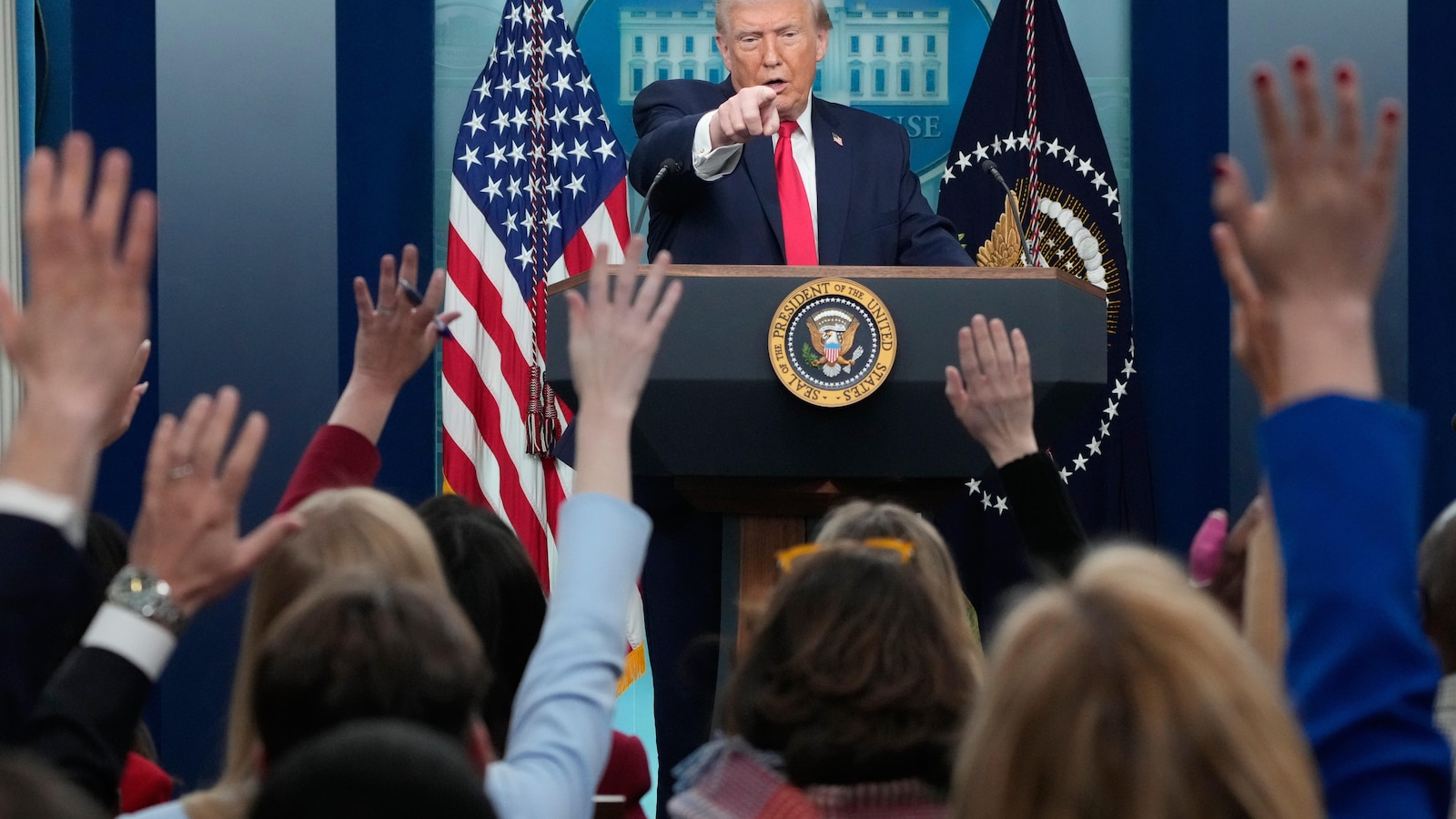
President Donald Trump commemorated his first year back in office with an extensive press briefing that stretched nearly two hours, during which he recounted what he considers his administration’s key achievements. Throughout the lengthy session, the president repeated numerous claims that fact-checkers have consistently identified as false or misleading.
The wide-ranging briefing covered topics from electoral politics to foreign affairs, economic policy, and environmental issues, with several statements contradicting established facts across these domains.
In revisiting the 2020 election, Trump claimed that his predecessor Joe Biden “didn’t win the election” and that “it’s a rigged election. Everybody knows that now.” This assertion has been repeatedly debunked by election officials, courts, and independent analysts. Biden secured 306 electoral votes to Trump’s 232 and won the popular vote by more than 7 million ballots. Multiple investigations, including those conducted by Trump-appointed officials such as former Attorney General William Barr, found no evidence of widespread voter fraud that could have altered the election outcome.
On foreign policy, the president claimed to have “settled eight wars,” a statement that significantly overstates his diplomatic accomplishments. While Trump has engaged in mediation efforts across several international conflicts, many of these situations remain unresolved or have seen renewed violence.
For instance, though Trump took credit for ending the 12-day war between Israel and Iran, experts characterize this as merely a temporary pause in longstanding tensions. Fresh fighting has recently erupted between Cambodia and Thailand, as well as between Congolese forces and Rwanda-backed rebels, contradicting claims of resolved conflicts in these regions.
The president’s claims about economic inheritance also contained inaccuracies. “We inherited inflation at a historic high. We had never had inflation like that,” Trump stated. However, inflation during the Biden administration peaked at 9.1% in June 2022, well below historical highs. The United States experienced far worse inflation in 1980, when rates exceeded 13%, and during World War I, when some estimates placed inflation near 20%. Current inflation stands at 2.7% as of December 2025, though it has risen since Trump implemented new tariff policies in April.
On energy policy, Trump continued to promote “clean, beautiful coal,” insisting he never mentions coal without these modifiers. While coal production has become cleaner compared to historical standards, experts emphasize it remains a significant source of carbon dioxide emissions and other pollutants. According to the U.S. Energy Information Administration, burning coal releases sulfur dioxide and nitrogen oxides that contribute to acid rain, smog, and respiratory illnesses. Coal’s share of U.S. electricity production has declined significantly, now accounting for approximately 15% of the total, down from more than half in previous decades.
The president also made misleading statements about California’s water policies and the 2025 Los Angeles wildfires, claiming that fire hydrants ran dry because water was diverted “into the Pacific Ocean” to protect “the tiny little fish.” Local officials have explained that hydrant outages occurred because municipal systems were overwhelmed by the unprecedented scale of the disaster, not because of environmental policies protecting endangered species like the Delta smelt.
Trump’s assertion that California receives water from the Pacific Northwest is also incorrect. California’s water system primarily relies on mountain snowmelt that flows into northern California rivers and the Sacramento-San Joaquin River Delta, from which it is distributed throughout the state via federal and state-run canal systems.
As the administration enters its second year, the persistence of these falsehoods highlights the ongoing challenge of distinguishing between political rhetoric and factual governance in public discourse. Independent fact-checkers continue to play a crucial role in providing context and corrections to presidential statements across policy areas.
Fact Checker
Verify the accuracy of this article using The Disinformation Commission analysis and real-time sources.

10 Comments
Focusing on false claims about the 2020 election is a missed opportunity to address the real challenges facing the country, from the economy to healthcare to climate change. The public deserves leaders who will ground their policy in facts, not fiction.
Absolutely. Continuing to push these discredited narratives does nothing to improve people’s lives or move the country forward. It’s time to move on and tackle the substantive issues that matter most to citizens.
It’s disappointing to see the former president continuing to spread misinformation about the 2020 election. Fact-checking has thoroughly debunked these claims, and pursuing them further does nothing to improve the lives of Americans. We need leaders who will focus on real issues, not conspiracy theories.
Well said. Repeating debunked claims only undermines public trust and distracts from the serious problems the country is facing. Elected officials should be working to bring people together, not divide them further.
While it’s understandable that the former president would want to defend his legacy, repeating demonstrably false claims about the election does not serve the national interest. A more constructive approach would be to acknowledge the results and work towards bipartisan progress.
Exactly. At this point, the priority should be on addressing the country’s pressing challenges, not relitigating the past. Perpetuating election falsehoods only deepens division when we need unity.
While everyone is entitled to their own opinions, the facts about the 2020 election are clear. Spreading misinformation does a disservice to the public and undermines faith in democratic institutions. I hope the former president will choose to focus on more constructive priorities going forward.
Agreed. Dwelling on falsehoods about the election is a waste of time and resources. The country would be better served by leaders who are willing to engage with reality and work across the aisle to address the real problems people are facing.
Rehashing the same old debunked claims about the 2020 election is not helping the country move forward. Fact-based discourse and evidence-based policymaking should be the priority, not perpetuating falsehoods.
I agree, continuing to push these discredited narratives is deeply concerning. The public deserves leaders who will focus on real issues and solutions rather than pushing conspiracy theories.