


Listen to the article
U.S. President Donald Trump has rekindled his interest in acquiring Greenland, framing it as a national security priority for his second term in office. The president has made several claims about the strategic Arctic island, including suggesting military force as a potential option to gain control of the territory, which remains a self-governing part of Denmark, a NATO ally.
Trump has repeatedly warned that failure to acquire Greenland would leave it vulnerable to Chinese or Russian takeover. “We’re not gonna have Russia or China occupy Greenland, and that’s what they’re going to do if we don’t,” he stated in recent comments.
However, Arctic security experts have consistently refuted Trump’s assertions about foreign military presence around the island. The president claimed there are “Russian destroyers, Chinese destroyers and Russian submarines all over the place” near Greenland—statements that specialists say have no factual basis.
“That statement makes no sense in terms of facts,” said Andreas Østhagen, research director for Arctic and ocean politics at Norway’s Fridtjof Nansen Institute. “There are no Russian and Chinese ships all over the place around Greenland. Russia and/or China has no capacity to occupy Greenland or to take control over Greenland.”
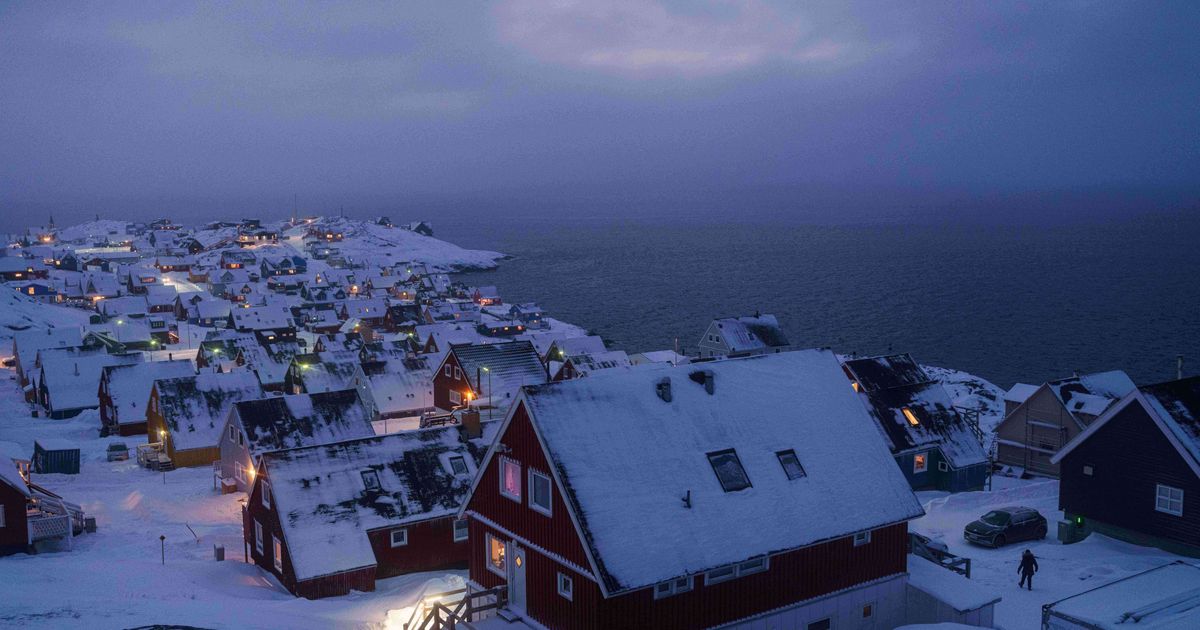
Greenland residents echo this sentiment. Lars Vintner, a heating engineer in Nuuk, told The Associated Press he frequently sails and hunts in the region but has never encountered Russian or Chinese vessels. Another local, Hans Nørgaard, dismissed Trump’s assertions as “fantasy.”
Lin Mortensgaard, an Arctic politics expert at the Danish Institute for International Studies, acknowledged that Russian submarines likely operate in the broader Arctic region but noted there are no surface vessels near Greenland. While China does maintain research vessels in the Central Arctic Ocean, joint Chinese-Russian military exercises have occurred closer to Alaska, not Greenland.
When questioned about Trump’s claims, Greenland’s business minister Naaja Nathanielsen stated simply: “Not that we are aware of.” She added, “While Russia and China have an interest in the Arctic, we don’t detect an actual threat.”
Trump has also belittled Denmark’s defense capabilities in Greenland, claiming their defense consists of “two dog sleds.” This characterization significantly understates Denmark’s military presence on the island.
The Sirius Dog Sled Patrol, an elite Danish naval unit, does operate in Greenland, but it represents only one element of Denmark’s Arctic security apparatus. Experts note that dog sleds are practical in the harsh Arctic environment where conventional vehicles cannot operate.
“Remember, transportation of the area is either by sea or by air. There are no highways,” explained Steven Lamy, an international relations professor and Arctic security expert at the University of Southern California.
Beyond the specialized patrol unit, Denmark maintains several surface patrol ships, surveillance aircraft, and is further strengthening its military presence around Greenland. Last year, the Danish government announced a 14.6 billion-kroner ($2.3 billion) agreement to improve surveillance and sovereignty maintenance in the region, including three new Arctic naval vessels, additional long-range drones, and enhanced satellite capacity.
Denmark’s Joint Arctic Command, headquartered in Nuuk, oversees the “surveillance, assertion of sovereignty and military defense of Greenland.” The island also guards part of the strategically important GIUK (Greenland, Iceland, United Kingdom) Gap, where NATO monitors Russian naval movements in the North Atlantic.
Additionally, the U.S. maintains the Pituffik Space Base in northwestern Greenland, established after the 1951 Defense of Greenland Treaty, which supports missile warning, defense, and space surveillance operations for both the U.S. and NATO.
Trump has also questioned Denmark’s claim to Greenland, stating, “The fact that they had a boat land there 500 years ago doesn’t mean that they own the land.” This comment misrepresents the historical record.
Human habitation of northern Greenland dates back to approximately 2,500 B.C., when the first settlers arrived from what is now Canada. The Norse explorer Erik the Red reached Greenland around 985 A.D. with Viking ships, according to medieval Icelandic sagas. Denmark’s modern colonization began in 1721 with Lutheran missionary Hans Egede, and Greenland formally became a Danish colony in 1814.
In 2009, Greenland achieved self-governing status within the Danish kingdom, with the right to pursue independence should local voters request it. This arrangement reflects modern international norms that prioritize self-determination over territorial conquest.
“It’s the same logic about the U.S. and sovereignty,” noted Østhagen. “You have a couple of boats arriving from Europe and now you own the United States of America? The Indigenous population was there before you guys.”
Fact Checker
Verify the accuracy of this article using The Disinformation Commission analysis and real-time sources.

11 Comments
Trump’s unverified statements about Greenland’s security seem to be more about his own political agenda than the facts on the ground. I hope policymakers focus on realistic assessments of the situation rather than inflammatory rhetoric.
Well said. Sober, fact-based analysis should guide any discussions about Greenland’s future, not unfounded claims about foreign military threats. The stakes are too high for political grandstanding.
This debate over Greenland’s security and potential annexation raises lots of geopolitical questions. I’m curious to see how it plays out and what the implications could be for mining and energy companies operating in the Arctic region.
Absolutely. The strategic importance of the Arctic is only growing, so how countries jockey for influence there will be critical to watch, both from a political and an investment perspective.
Interesting claims by Trump about Greenland’s security. However, the experts seem to refute his statements about Russian and Chinese naval presence there. I wonder what his motivations are for wanting to acquire the territory.
As an energy and mining investor, I’ll be monitoring this situation closely. Greenland’s resources are certainly valuable, but Trump’s heavy-handed approach seems counterproductive. Diplomacy and multilateral cooperation should be the priority.
As someone invested in uranium and lithium producers, I’ll be watching this situation closely. Greenland’s resources could be a game-changer, but Trump’s inflammatory statements about foreign military threats seem unfounded.
Agreed. Unsubstantiated claims about Russian and Chinese naval presence are concerning. I hope cooler diplomatic heads prevail in any discussions about Greenland’s future.
Greenland is an intriguing region for its natural resources like rare earths, uranium, and other critical minerals. But Trump’s unverified claims about military threats seem to be overstated according to security analysts.
As an investor in mining and energy equities, I’m curious to see how this geopolitical posturing around Greenland may impact commodity markets and related companies. The Arctic’s strategic importance is clearly growing.
Hmm, I’m a bit skeptical of Trump’s rhetoric here. While Greenland’s resources and location are certainly strategically important, his suggestion of military action seems reckless and not grounded in facts. Cooler heads should prevail.