


Listen to the article
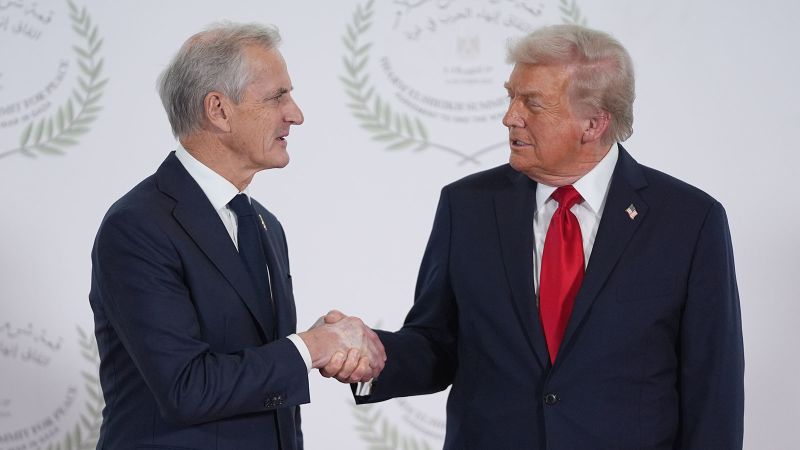
In an escalating diplomatic row over Greenland, former President Donald Trump has made several contentious claims about the Nobel Peace Prize and his contributions to global peace efforts, according to recent communications revealed between Trump and Norwegian Prime Minister Jonas Gahr Støre.
The dispute emerged after Trump sent text messages to Støre on January 18, expressing frustration over not receiving the Nobel Peace Prize. “Considering your Country decided not to give me the Nobel Peace Prize for having stopped 8 Wars PLUS, I no longer feel an obligation to think purely of Peace,” Trump wrote, adding that he would now “think about what is good and proper for the United States of America.”
Trump continued by claiming he had “done more for NATO than any other person since its founding” and suggesting that “NATO should do something for the United States” by helping secure “Complete and Total Control of Greenland.”
The messages coincided with Trump’s move to impose 10% tariffs on eight European countries, including Norway, that have opposed his ambitions to acquire Greenland, a semi-autonomous territory of Denmark.
In response to Trump’s assertions, Prime Minister Støre issued a statement clarifying that “the prize is awarded by an independent Nobel Committee and not the Norwegian Government.” This correction addresses Trump’s fundamental misunderstanding of how the Nobel Prize is awarded.
The Norwegian Nobel Committee consists of five members appointed by the Norwegian Parliament. These appointees must be former politicians or civilians, not active parliamentarians. Erik Aasheim, spokesperson for the Norwegian Nobel Institute, confirmed that the committee operates independently with no government influence over its decisions.
Peter Wallensteen, an international peace researcher at the University of Notre Dame, noted that committee members represent different political perspectives and that the committee’s funding comes from the Stockholm-based Nobel Foundation, not the Norwegian government. He pointed out that “it has happened a number of times that the committee has given the prize to recipients that pursue different policies than the Norwegian government.”
Trump’s claim of having “stopped 8 Wars” also appears exaggerated. While he played a role in ceasefires between Israel and Iran, India and Pakistan, and Armenia and Azerbaijan, experts characterize these as incremental accords. The conflicts Trump referenced also include tensions between Democratic Republic of Congo and Rwanda, Cambodia and Thailand, Egypt and Ethiopia, and Kosovo and Serbia.
Regarding NATO, Trump’s assertion that he has “done more for NATO than any other person since its founding” – and his even bolder claim on Truth Social that “If I didn’t come along, there would be no NATO right now” – draws mixed assessments from experts.
Justin Logan, director of defense and foreign policy studies at the Cato Institute, acknowledged that Trump “frightened the Europeans” into promising additional spending on NATO by 2035. Barry R. Posen, an MIT professor of political science, agreed that “Trump deserves credit for starting a long delayed and necessary rebalancing of responsibilities in the alliance.”
However, experts also point to Russian President Vladimir Putin’s 2014 and 2022 invasions of Ukraine as significant factors that motivated increased European defense spending. Jytte Klausen, a Brandeis University professor of international cooperation, noted that while Trump pushed through a European spending deal, Russia’s aggression was a key motivator for NATO allies.
Klausen also highlighted a concerning aspect of the current situation, saying, “Trump’s threat to annex Greenland has made the breakup of NATO a near-possibility,” suggesting that the former president’s territorial ambitions could undermine the very alliance he claims to have strengthened.
The diplomatic tension continues to unfold as Trump maintains his pursuit of Greenland, despite the territory’s status as part of Denmark and the clear opposition from multiple European allies.
Fact Checker
Verify the accuracy of this article using The Disinformation Commission analysis and real-time sources.

14 Comments
Trump’s assertions about the Nobel Peace Prize and NATO seem to be more about boosting his own ego than reflecting the reality of his foreign policy record. Fact-based analysis is needed to understand the true impact of his actions.
As a former president, Trump should be held to high standards of truthfulness and accountability. Misleading the public undermines democratic norms and institutions.
Trump’s claims about the Nobel Peace Prize and NATO contributions raise concerns about his grasp of international affairs and commitment to the truth. Fact-checking and objective analysis are essential to hold leaders accountable.
Responsible leadership requires nuance, diplomacy, and a commitment to the greater good, not just individual political gain. The public deserves leaders who put principles before personal interests.
While the details of Trump’s diplomatic communications are unclear, his public statements about the Nobel Prize and NATO raise concerns about his grasp of international affairs and commitment to the truth.
Responsible leaders should focus on fostering international cooperation and respecting the sovereignty of other nations, rather than making unsubstantiated claims and using economic pressure for personal gain.
Trump’s comments about the Nobel Peace Prize and NATO highlight his continued tendency to exaggerate his accomplishments and shift blame. Objective analysis of his foreign policy record would provide a more accurate picture.
It’s crucial that the media and public hold leaders accountable for making false claims, rather than allowing misinformation to go unchallenged. Fact-checking and nuanced reporting are essential.
The dispute over Greenland appears to be another power play by Trump, using economic pressure and inflated claims to try to gain concessions. Responsible leadership requires nuance and diplomacy, not bluster.
While securing strategic resources is important, Trump’s approach seems to prioritize his own interests over international cooperation and the wishes of the Greenlandic people. A more balanced perspective is needed.
Trump’s claims about the Nobel Peace Prize and NATO seem to be yet another example of his tendency to exaggerate his accomplishments. The facts don’t support his assertions about stopping wars or strengthening NATO.
It’s concerning when leaders make false or misleading statements, as it undermines public trust and the democratic process. Fact-checking is crucial to hold politicians accountable.
The dispute over Greenland highlights the need for clear-eyed, principled diplomacy that considers the interests of all stakeholders, not just the ambitions of individual leaders. Transparency and adherence to facts should guide foreign policy.
While securing strategic resources is important, Trump’s approach appears to prioritize his own political interests over international cooperation and the rights of indigenous peoples. A more balanced, ethical approach is required.