


Listen to the article
Trump’s Davos Speech Riddled with Inaccuracies on Greenland, NATO
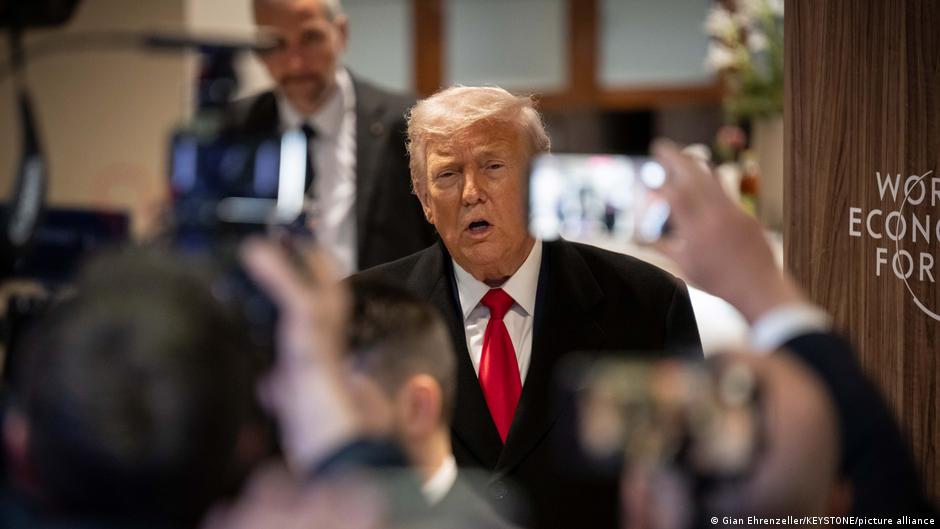
Former US President Donald Trump delivered a lengthy address at the World Economic Forum in Davos, making several false or misleading claims, particularly regarding Greenland, US defense commitments, and NATO.
Throughout his speech, which lasted more than an hour, Trump repeatedly referenced Greenland, characterizing it as territory the United States had once possessed and “respectfully returned” to Denmark after World War II. “We had it, and we gave it back to them,” Trump claimed.
Historians and fact-checkers quickly disputed this assertion. While the US did help defend Greenland during World War II, it never owned the territory and therefore could not have “given it back” to Denmark. When Nazi Germany occupied Denmark in April 1940, Greenland became isolated from the Danish government in Copenhagen.
To prevent Germany from exploiting Greenland’s strategic location and its valuable cryolite mines, which were essential for aircraft aluminum production, the United States established a military presence there with the approval of Denmark’s ambassador in Washington, who was acting independently due to Denmark’s occupation.
Although the US built military bases, weather stations, and airfields in Greenland during this period, the legal sovereignty of the territory never changed. Greenland remained part of the Kingdom of Denmark throughout the war and afterward, with continued US military presence governed by defense agreements rather than ownership claims.
Trump also inaccurately asserted that ownership of Greenland was necessary for its defense, claiming, “You need the ownership to defend it. You can’t defend it on a lease. Legally, it’s not defensible that way.”
This statement contradicts established international defense arrangements. Greenland, as part of Denmark, is already protected under NATO’s collective defense clause in Article 5, which considers an attack on one member an attack on all NATO allies. The United States has bilateral defense agreements with Denmark permitting US military operations in Greenland with Danish consent.
The US currently operates more than 128 foreign military bases in at least 51 countries worldwide through similar arrangements without claiming territorial ownership. Some researchers estimate the number could exceed 750 installations across 80 countries and territories. Major examples include the historic Clark Air Base and Subic Bay Naval Base in the Philippines, which the US maintained for decades under long-term agreements that preserved Philippine sovereignty.
Trump’s claims about NATO financing were similarly misleading. He stated that until his presidency, the US “was paying for virtually 100% of NATO,” adding, “We paid for, in my opinion, 100% of NATO.”
Official NATO figures contradict this assertion. In 2016, before Trump took office, the US accounted for approximately 70 percent of total defense spending among NATO members—a significant portion, but far from the claimed 100 percent. The US contributes about 22 percent to NATO’s common budget, which covers alliance headquarters and administrative costs, with other member states funding the remainder.
Trump further claimed that “the United States had never received anything from NATO, despite having paid for it.” This statement ignores a crucial historical fact: NATO’s collective defense clause was invoked for the first and only time in the alliance’s history following the September 11, 2001 terrorist attacks on the United States.
In response, numerous NATO allies, including Germany, joined the US in international military operations such as the International Security Assistance Force (ISAF) and Operation Enduring Freedom in Afghanistan. Germany’s military deployment in Afghanistan lasted approximately 20 years and cost about €12.3 billion, with 60 German soldiers losing their lives during the mission.
Trump also made false claims about renewable energy in China, stating that China produces wind turbines but doesn’t use them itself, instead selling them to “stupid people.”
Data from the US Energy Information Administration shows that China actually produces more wind energy than any other nation, generating 521 gigawatts in 2024—approximately 40 percent of global wind energy production. The EIA notes that China continues to expand its solar and wind energy capacity “at record speed.”
While China still relies heavily on coal (56 percent of its electricity mix), wind power accounts for about 12 percent of the country’s electricity generation, with renewable sources totaling around 23 percent. By comparison, renewable energy represents approximately 64 percent of electricity generation in Germany, with wind power alone contributing nearly 27 percent.
The various inaccuracies in Trump’s Davos address highlight the importance of fact-checking high-profile political statements, particularly on matters of international relations, defense agreements, and global energy trends.
Fact Checker
Verify the accuracy of this article using The Disinformation Commission analysis and real-time sources.

12 Comments
Interesting to see how Trump’s claims about Greenland and NATO continue to be disputed by historians and fact-checkers. It’s important to rely on authoritative sources when it comes to such geopolitical matters.
Agreed. Providing accurate information on the historical record is crucial, especially when it comes to sensitive foreign policy issues.
The Trump administration’s tendency to make false or misleading claims is troubling, and this speech at Davos is just the latest example. Fact-based reporting and objective analysis are crucial in these high-stakes settings.
You’re right. Unchecked misinformation can have far-reaching consequences, especially when it comes from influential figures. Rigorous fact-checking is essential to uphold the truth.
While Trump’s speech touched on some important global economic issues, the factual errors and misleading claims undermine the credibility of his message. Fact-checking is crucial in these high-profile settings.
Agreed. Even if the intent is to highlight certain policy positions, inaccurate statements can distract from the core substance and erode public trust.
It’s concerning to see such blatant disregard for historical facts in a speech at the World Economic Forum. Robust fact-checking and accountability should be the norm, regardless of the speaker’s background.
Absolutely. Maintaining the integrity of global discourse is essential, especially on issues that have significant geopolitical and economic implications.
This speech highlights the ongoing challenge of addressing misinformation, even from high-profile political figures. Fact-checking and objective reporting are essential to uphold the truth.
Absolutely. Transparency and accountability should be the cornerstones of any democratic discourse, regardless of the speaker’s status or position.
The inaccuracies and false claims in Trump’s Davos address are concerning. It’s worrying to see such a prominent leader make statements that are so easily refuted by historical facts.
You’re right. Spreading misinformation, even inadvertently, can have serious consequences. Leaders have a responsibility to be truthful and well-informed.