


Listen to the article
In a fiery exchange that has intensified the political climate ahead of upcoming elections, Tamil Nadu Chief Minister M.K. Stalin launched a scathing critique of opposition leader Edappadi K. Palaniswami on Wednesday, accusing him of fabricating allegations against the ruling DMK coalition due to a lack of substantial achievements during his own tenure.
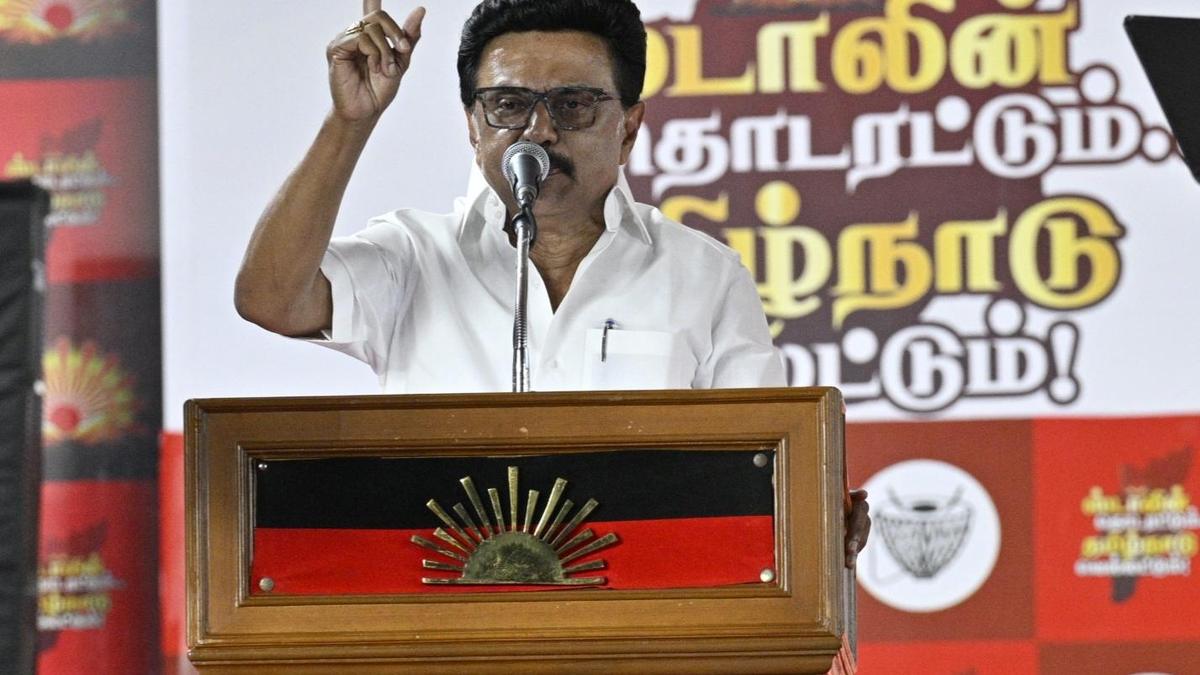
Speaking to party supporters and residents in Tiruvannamalai town, Stalin, who also serves as president of the Dravida Munnetra Kazhagam (DMK), characterized Palaniswami’s campaign rhetoric as a desperate attempt to discredit the current administration’s accomplishments. The Chief Minister was campaigning on behalf of candidates from the Secular Progressive Alliance (SPA) in Tiruvannamalai district and neighboring Kallakurichi.
“Mr. Palaniswami has nothing to show for his 10 years in power,” Stalin told the gathered crowd. “Instead of discussing his own record, he resorts to false accusations against our party and our allies.”
The DMK leader specifically highlighted Palaniswami’s apparent frustration with the current government’s welfare initiatives, including the widely popular Kalaignar Magalir Urimai Thittam, which provides monthly financial assistance to eligible women across Tamil Nadu, and Pudhumai Penn, a scheme designed to support higher education for female students.
These flagship social welfare programs have been central to the DMK government’s policy agenda since coming to power in 2021, representing a continuation of the party’s traditional focus on social justice and economic support for marginalized communities.
Stalin also took aim at what he described as Palaniswami’s opportunistic relationship with the Bharatiya Janata Party (BJP), accusing the AIADMK leader of aligning with the national party when politically convenient, particularly during election periods.
The exchange underscores the intensifying political rivalry between Tamil Nadu’s two dominant Dravidian parties ahead of the electoral contest. The DMK-led Secular Progressive Alliance, which includes Congress and several regional parties, has been emphasizing its welfare-oriented governance model, while the AIADMK has been attempting to regroup after losing power in 2021.
Political analysts note that this confrontation reflects broader tensions in Tamil Nadu’s political landscape, where parties are increasingly focused on welfare schemes as key electoral strategies. The state has a long tradition of pioneering social welfare programs, dating back to the administrations of former Chief Ministers C.N. Annadurai and M. Karunanidhi, Stalin’s father.
“What we’re seeing is classic Tamil Nadu political discourse,” said Dr. Rajan Kurai, political scientist at Madras University. “Both parties are fighting to claim the mantle of being the true champions of the common people through welfare measures, while simultaneously attempting to portray their opponents as ineffective administrators.”
The reference to BJP alignments also highlights the complex position of national parties in Tamil Nadu’s political ecosystem, where regional identity and autonomy remain powerful forces. The AIADMK’s relationship with the BJP has been a point of contention, with DMK frequently portraying such alliances as compromising Tamil interests.
For voters in Tiruvannamalai and Kallakurichi, these campaigns represent an opportunity to evaluate competing visions for regional development. Both districts face challenges related to agricultural sustainability, water resources, and industrial growth that have featured prominently in recent policy discussions.
As the campaign season progresses, political observers expect the rhetorical exchanges between Stalin and Palaniswami to intensify further, particularly as both leaders attempt to consolidate their respective bases and appeal to undecided voters ahead of the crucial vote.
Fact Checker
Verify the accuracy of this article using The Disinformation Commission analysis and real-time sources.

8 Comments
I’m curious to learn more about the DMK’s welfare initiatives like the Kalaignar Magalir Urimai Thittam program. Providing direct support to women seems like an important priority. How effective has this been so far?
Interesting that the opposition leader seems frustrated by the current government’s popular welfare programs. That suggests they may be resonating with the public and posing a real challenge for the opposition.
The opposition leader’s strategy of hurling accusations instead of touting his own record is a risky one. Voters typically want to hear about concrete plans and achievements, not just attacks on the other side.
I’m curious to learn more about the Secular Progressive Alliance and its policy platform. The contrast between their initiatives and the previous administration’s apparent lack of achievements could be a key factor for voters.
This is a good example of how political campaigns can sometimes devolve into personal attacks rather than substantive debates. I hope the candidates can find a way to elevate the discourse and focus on the real issues facing the state.
It’s concerning to see the political climate heating up with these kinds of personal attacks. I hope the candidates can find a way to focus the debate on substantive issues and policy proposals rather than descending into mudslinging.
Very interesting to see the ruling party highlighting the lack of tangible accomplishments by the previous administration. Voters will likely be more interested in what candidates can actually deliver, not just empty rhetoric.
Looks like the opposition leader is struggling to find real achievements to campaign on, so he’s resorted to making false accusations instead. Not a good look for someone aspiring to lead the state.